





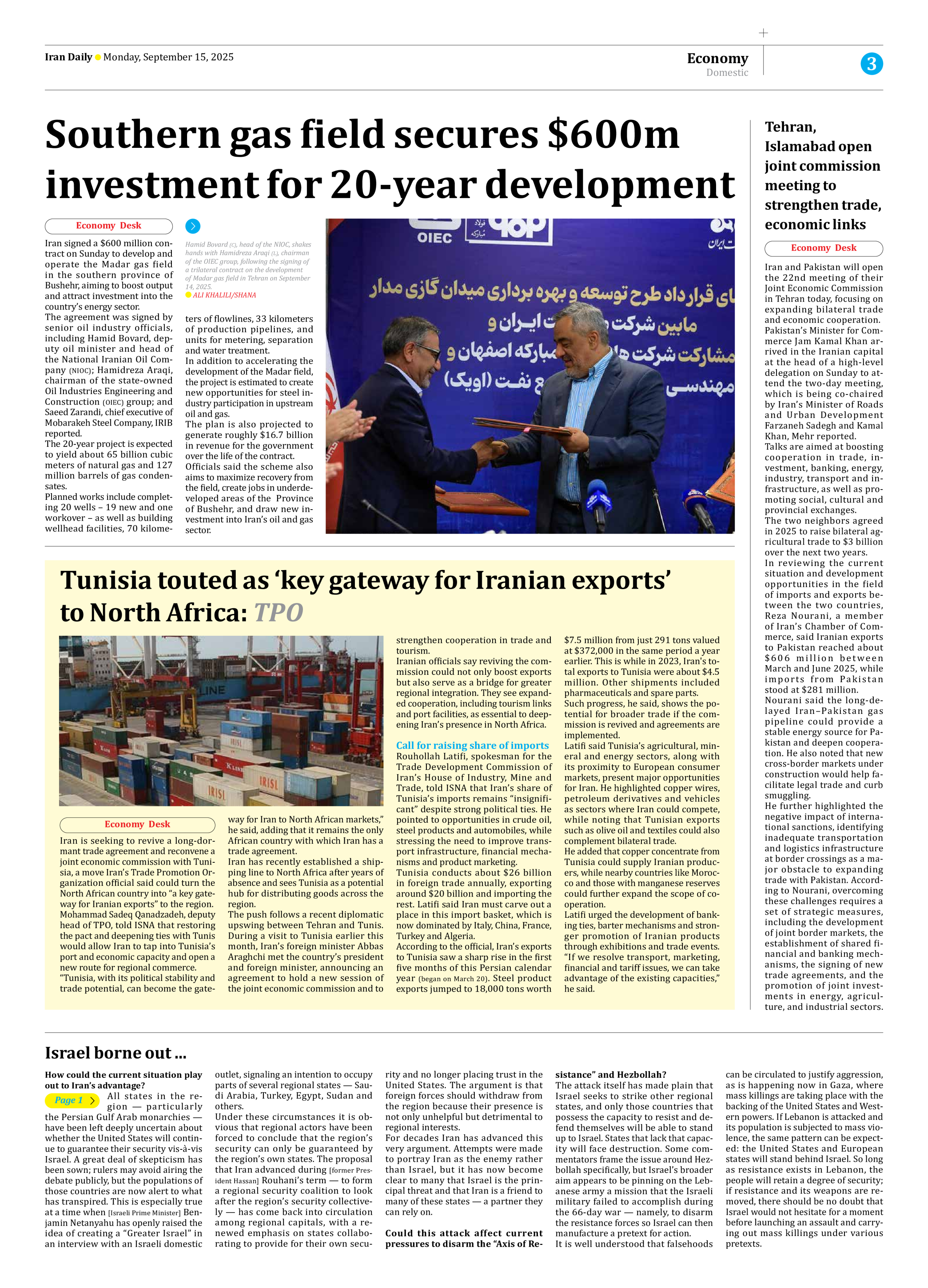


Tunisia touted as ‘key gateway for Iranian exports’ to North Africa: TPO
Iran is seeking to revive a long-dormant trade agreement and reconvene a joint economic commission with Tunisia, a move Iran’s Trade Promotion Organization official said could turn the North African country into “a key gateway for Iranian exports” to the region.
Mohammad Sadeq Qanadzadeh, deputy head of TPO, told ISNA that restoring the pact and deepening ties with Tunis would allow Iran to tap into Tunisia’s port and economic capacity and open a new route for regional commerce.
“Tunisia, with its political stability and trade potential, can become the gateway for Iran to North African markets,” he said, adding that it remains the only African country with which Iran has a trade agreement.
Iran has recently established a shipping line to North Africa after years of absence and sees Tunisia as a potential hub for distributing goods across the region.
The push follows a recent diplomatic upswing between Tehran and Tunis. During a visit to Tunisia earlier this month, Iran’s foreign minister Abbas Araghchi met the country’s president and foreign minister, announcing an agreement to hold a new session of the joint economic commission and to strengthen cooperation in trade and tourism.
Iranian officials say reviving the commission could not only boost exports but also serve as a bridge for greater regional integration. They see expanded cooperation, including tourism links and port facilities, as essential to deepening Iran’s presence in North Africa.
Call for raising share of imports
Rouhollah Latifi, spokesman for the Trade Development Commission of Iran’s House of Industry, Mine and Trade, told ISNA that Iran’s share of Tunisia’s imports remains “insignificant” despite strong political ties. He pointed to opportunities in crude oil, steel products and automobiles, while stressing the need to improve transport infrastructure, financial mechanisms and product marketing.
Tunisia conducts about $26 billion in foreign trade annually, exporting around $20 billion and importing the rest. Latifi said Iran must carve out a place in this import basket, which is now dominated by Italy, China, France, Turkey and Algeria.
According to the official, Iran’s exports to Tunisia saw a sharp rise in the first five months of this Persian calendar year (began on March 20). Steel product exports jumped to 18,000 tons worth $7.5 million from just 291 tons valued at $372,000 in the same period a year earlier. This is while in 2023, Iran's total exports to Tunisia were about $4.5 million. Other shipments included pharmaceuticals and spare parts.
Such progress, he said, shows the potential for broader trade if the commission is revived and agreements are implemented.
Latifi said Tunisia’s agricultural, mineral and energy sectors, along with its proximity to European consumer markets, present major opportunities for Iran. He highlighted copper wires, petroleum derivatives and vehicles as sectors where Iran could compete, while noting that Tunisian exports such as olive oil and textiles could also complement bilateral trade.
He added that copper concentrate from Tunisia could supply Iranian producers, while nearby countries like Morocco and those with manganese reserves could further expand the scope of cooperation.
Latifi urged the development of banking ties, barter mechanisms and stronger promotion of Iranian products through exhibitions and trade events. “If we resolve transport, marketing, financial and tariff issues, we can take advantage of the existing capacities,” he said.