







Impact of eco-lodges on culture, economy of Kurdistan Province
When stepping into an eco-lodge nestled in the heart of the villages of Kurdistan Province, you are not merely entering a building; you are embarking on a profound journey into the vibrant core of the culture and natural beauty of this land. The moment you open your eyes, you are greeted not by the incessant honking and chaos of urban traffic, but by the absolute tranquility that envelops the air. You refresh yourself by washing your hands and face with cool, crisp water, then open the window to breathe in the fresh, pure air—untainted by the smoke and fumes of the city. Before you stretches a breathtaking panorama of towering mountains, lush deep green valleys, and flowing rivers that extend as far as the eye can see.
Instead of the acrid scent of smoke, the warm, inviting aroma of freshly baked bread wafts from the clay oven, enveloping you in a comforting embrace. Silence pervades the surroundings, broken only by the crowing of the local rooster, melodious bird songs, and the gentle sound of a woman pressing dough against the stone walls of the traditional oven, ISNA wrote.
Here, you experience the true essence of staying at an eco-lodge in the heart of Kurdistan, where life flows with genuine simplicity and beauty, offering you the chance to distance yourself for a few precious days from all that alienates you from nature.
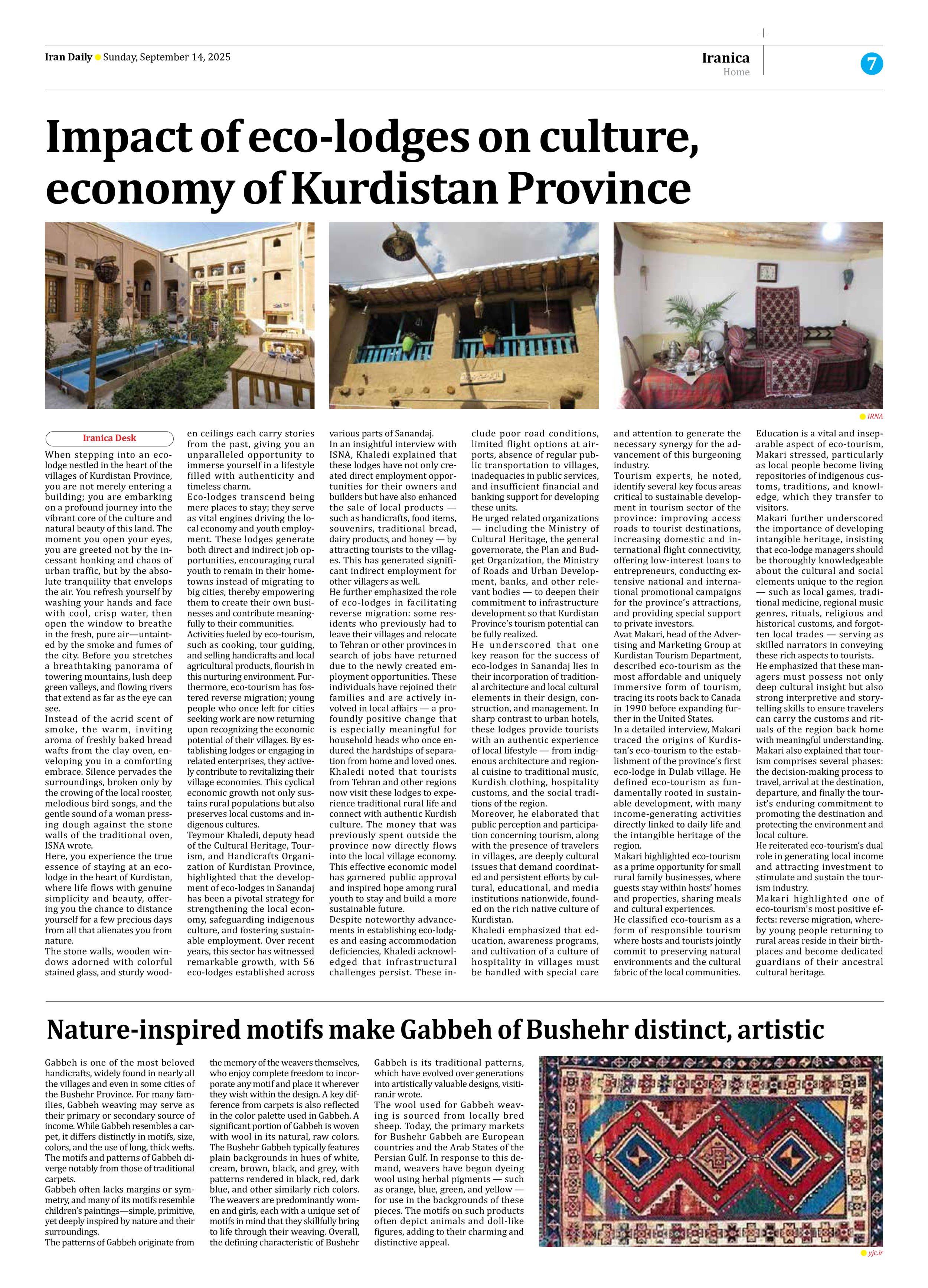
The stone walls, wooden windows adorned with colorful stained glass, and sturdy wooden ceilings each carry stories from the past, giving you an unparalleled opportunity to immerse yourself in a lifestyle filled with authenticity and timeless charm.
Eco-lodges transcend being mere places to stay; they serve as vital engines driving the local economy and youth employment. These lodges generate both direct and indirect job opportunities, encouraging rural youth to remain in their hometowns instead of migrating to big cities, thereby empowering them to create their own businesses and contribute meaningfully to their communities.
Activities fueled by eco-tourism, such as cooking, tour guiding, and selling handicrafts and local agricultural products, flourish in this nurturing environment. Furthermore, eco-tourism has fostered reverse migration; young people who once left for cities seeking work are now returning upon recognizing the economic potential of their villages. By establishing lodges or engaging in related enterprises, they actively contribute to revitalizing their village economies. This cyclical economic growth not only sustains rural populations but also preserves local customs and indigenous cultures.
Teymour Khaledi, deputy head of the Cultural Heritage, Tourism, and Handicrafts Organization of Kurdistan Province, highlighted that the development of eco-lodges in Sanandaj has been a pivotal strategy for strengthening the local economy, safeguarding indigenous culture, and fostering sustainable employment. Over recent years, this sector has witnessed remarkable growth, with 56 eco-lodges established across various parts of Sanandaj.
In an insightful interview with ISNA, Khaledi explained that these lodges have not only created direct employment opportunities for their owners and builders but have also enhanced the sale of local products — such as handicrafts, food items, souvenirs, traditional bread, dairy products, and honey — by attracting tourists to the villages. This has generated significant indirect employment for other villagers as well.
He further emphasized the role of eco-lodges in facilitating reverse migration: some residents who previously had to leave their villages and relocate to Tehran or other provinces in search of jobs have returned due to the newly created employment opportunities. These individuals have rejoined their families and are actively involved in local affairs — a profoundly positive change that is especially meaningful for household heads who once endured the hardships of separation from home and loved ones.
Khaledi noted that tourists from Tehran and other regions now visit these lodges to experience traditional rural life and connect with authentic Kurdish culture. The money that was previously spent outside the province now directly flows into the local village economy. This effective economic model has garnered public approval and inspired hope among rural youth to stay and build a more sustainable future.
Despite noteworthy advancements in establishing eco-lodges and easing accommodation deficiencies, Khaledi acknowledged that infrastructural challenges persist. These include poor road conditions, limited flight options at airports, absence of regular public transportation to villages, inadequacies in public services, and insufficient financial and banking support for developing these units.
He urged related organizations — including the Ministry of Cultural Heritage, the general governorate, the Plan and Budget Organization, the Ministry of Roads and Urban Development, banks, and other relevant bodies — to deepen their commitment to infrastructure development so that Kurdistan Province’s tourism potential can be fully realized.
He underscored that one key reason for the success of eco-lodges in Sanandaj lies in their incorporation of traditional architecture and local cultural elements in their design, construction, and management. In sharp contrast to urban hotels, these lodges provide tourists with an authentic experience of local lifestyle — from indigenous architecture and regional cuisine to traditional music, Kurdish clothing, hospitality customs, and the social traditions of the region.
Moreover, he elaborated that public perception and participation concerning tourism, along with the presence of travelers in villages, are deeply cultural issues that demand coordinated and persistent efforts by cultural, educational, and media institutions nationwide, founded on the rich native culture of Kurdistan.
Khaledi emphasized that education, awareness programs, and cultivation of a culture of hospitality in villages must be handled with special care and attention to generate the necessary synergy for the advancement of this burgeoning industry.
Tourism experts, he noted, identify several key focus areas critical to sustainable development in tourism sector of the province: improving access roads to tourist destinations, increasing domestic and international flight connectivity, offering low-interest loans to entrepreneurs, conducting extensive national and international promotional campaigns for the province’s attractions, and providing special support to private investors.
Avat Makari, head of the Advertising and Marketing Group at Kurdistan Tourism Department, described eco-tourism as the most affordable and uniquely immersive form of tourism, tracing its roots back to Canada in 1990 before expanding further in the United States.
In a detailed interview, Makari traced the origins of Kurdistan’s eco-tourism to the establishment of the province’s first eco-lodge in Dulab village. He defined eco-tourism as fundamentally rooted in sustainable development, with many income-generating activities directly linked to daily life and the intangible heritage of the region.
Makari highlighted eco-tourism as a prime opportunity for small rural family businesses, where guests stay within hosts’ homes and properties, sharing meals and cultural experiences.
He classified eco-tourism as a form of responsible tourism where hosts and tourists jointly commit to preserving natural environments and the cultural fabric of the local communities.
Education is a vital and inseparable aspect of eco-tourism, Makari stressed, particularly as local people become living repositories of indigenous customs, traditions, and knowledge, which they transfer to visitors.
Makari further underscored the importance of developing intangible heritage, insisting that eco-lodge managers should be thoroughly knowledgeable about the cultural and social elements unique to the region — such as local games, traditional medicine, regional music genres, rituals, religious and historical customs, and forgotten local trades — serving as skilled narrators in conveying these rich aspects to tourists.
He emphasized that these managers must possess not only deep cultural insight but also strong interpretive and storytelling skills to ensure travelers can carry the customs and rituals of the region back home with meaningful understanding.
Makari also explained that tourism comprises several phases: the decision-making process to travel, arrival at the destination, departure, and finally the tourist’s enduring commitment to promoting the destination and protecting the environment and local culture.
He reiterated eco-tourism’s dual role in generating local income and attracting investment to stimulate and sustain the tourism industry.
Makari highlighted one of eco-tourism’s most positive effects: reverse migration, whereby young people returning to rural areas reside in their birthplaces and become dedicated guardians of their ancestral cultural heritage.