





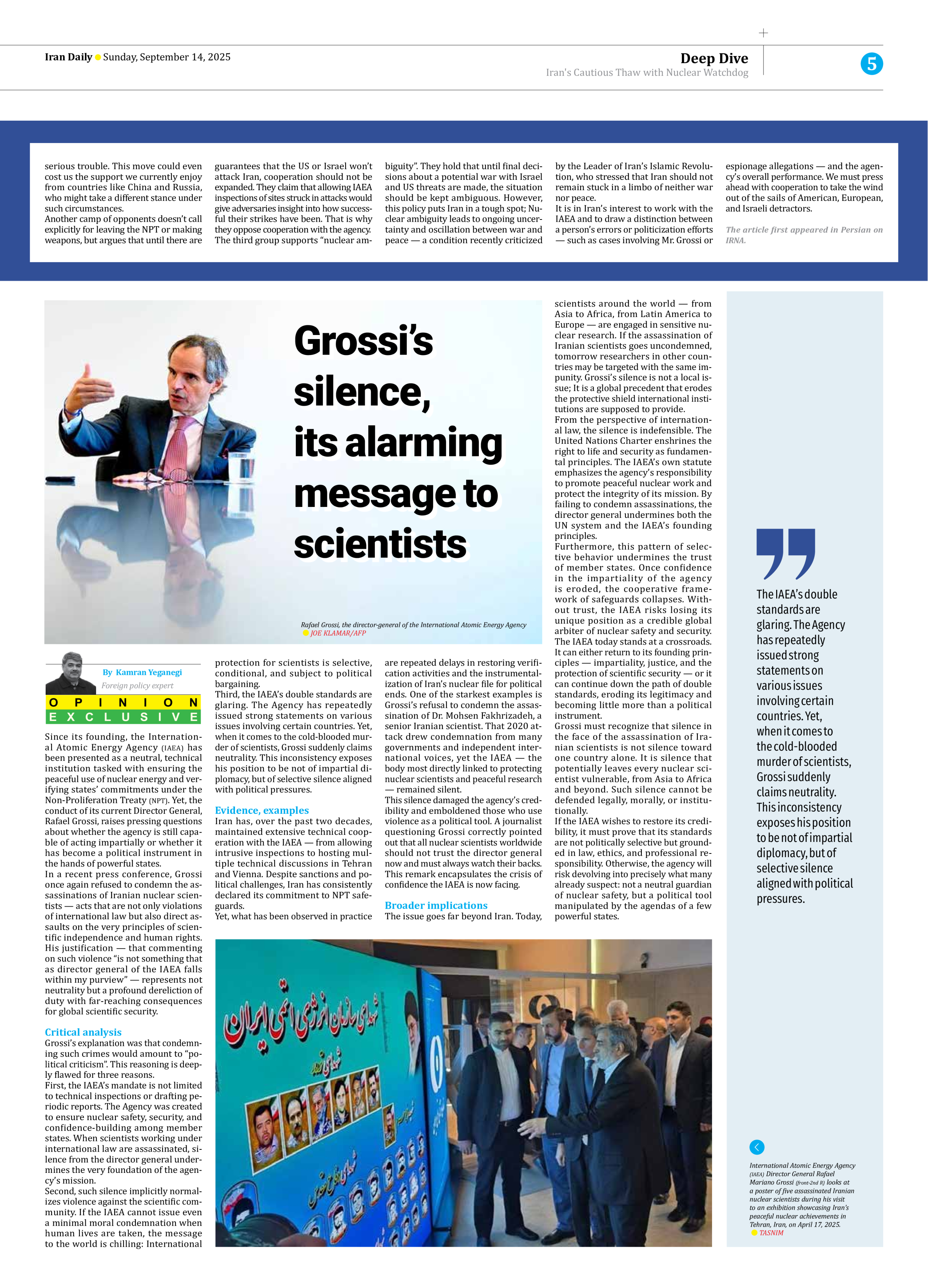


Grossi’s silence, its alarming message to scientists
By Kamran Yeganegi
Foreign policy expert
Since its founding, the International Atomic Energy Agency (IAEA) has been presented as a neutral, technical institution tasked with ensuring the peaceful use of nuclear energy and verifying states’ commitments under the Non-Proliferation Treaty (NPT). Yet, the conduct of its current Director General, Rafael Grossi, raises pressing questions about whether the agency is still capable of acting impartially or whether it has become a political instrument in the hands of powerful states.
In a recent press conference, Grossi once again refused to condemn the assassinations of Iranian nuclear scientists — acts that are not only violations of international law but also direct assaults on the very principles of scientific independence and human rights. His justification — that commenting on such violence “is not something that as director general of the IAEA falls within my purview” — represents not neutrality but a profound dereliction of duty with far-reaching consequences for global scientific security.
Critical analysis
Grossi’s explanation was that condemning such crimes would amount to “political criticism”. This reasoning is deeply flawed for three reasons.
First, the IAEA’s mandate is not limited to technical inspections or drafting periodic reports. The Agency was created to ensure nuclear safety, security, and confidence-building among member states. When scientists working under international law are assassinated, silence from the director general undermines the very foundation of the agency’s mission.
Second, such silence implicitly normalizes violence against the scientific community. If the IAEA cannot issue even a minimal moral condemnation when human lives are taken, the message to the world is chilling: International protection for scientists is selective, conditional, and subject to political bargaining.
Third, the IAEA’s double standards are glaring. The Agency has repeatedly issued strong statements on various issues involving certain countries. Yet, when it comes to the cold-blooded murder of scientists, Grossi suddenly claims neutrality. This inconsistency exposes his position to be not of impartial diplomacy, but of selective silence aligned with political pressures.
Evidence, examples
Iran has, over the past two decades, maintained extensive technical cooperation with the IAEA — from allowing intrusive inspections to hosting multiple technical discussions in Tehran and Vienna. Despite sanctions and political challenges, Iran has consistently declared its commitment to NPT safeguards.
Yet, what has been observed in practice are repeated delays in restoring verification activities and the instrumentalization of Iran’s nuclear file for political ends. One of the starkest examples is Grossi’s refusal to condemn the assassination of Dr. Mohsen Fakhrizadeh, a senior Iranian scientist. That 2020 attack drew condemnation from many governments and independent international voices, yet the IAEA — the body most directly linked to protecting nuclear scientists and peaceful research — remained silent.
This silence damaged the agency’s credibility and emboldened those who use violence as a political tool. A journalist questioning Grossi correctly pointed out that all nuclear scientists worldwide should not trust the director general now and must always watch their backs. This remark encapsulates the crisis of confidence the IAEA is now facing.
Broader implications
The issue goes far beyond Iran. Today, scientists around the world — from Asia to Africa, from Latin America to Europe — are engaged in sensitive nuclear research. If the assassination of Iranian scientists goes uncondemned, tomorrow researchers in other countries may be targeted with the same impunity. Grossi’s silence is not a local issue; It is a global precedent that erodes the protective shield international institutions are supposed to provide.
From the perspective of international law, the silence is indefensible. The United Nations Charter enshrines the right to life and security as fundamental principles. The IAEA’s own statute emphasizes the agency’s responsibility to promote peaceful nuclear work and protect the integrity of its mission. By failing to condemn assassinations, the director general undermines both the UN system and the IAEA’s founding principles.
Furthermore, this pattern of selective behavior undermines the trust of member states. Once confidence in the impartiality of the agency is eroded, the cooperative framework of safeguards collapses. Without trust, the IAEA risks losing its unique position as a credible global arbiter of nuclear safety and security.
The IAEA today stands at a crossroads. It can either return to its founding principles — impartiality, justice, and the protection of scientific security — or it can continue down the path of double standards, eroding its legitimacy and becoming little more than a political instrument.
Grossi must recognize that silence in the face of the assassination of Iranian scientists is not silence toward one country alone. It is silence that potentially leaves every nuclear scientist vulnerable, from Asia to Africa and beyond. Such silence cannot be defended legally, morally, or institutionally.
If the IAEA wishes to restore its credibility, it must prove that its standards are not politically selective but grounded in law, ethics, and professional responsibility. Otherwise, the agency will risk devolving into precisely what many already suspect: not a neutral guardian of nuclear safety, but a political tool manipulated by the agendas of a few powerful states.