





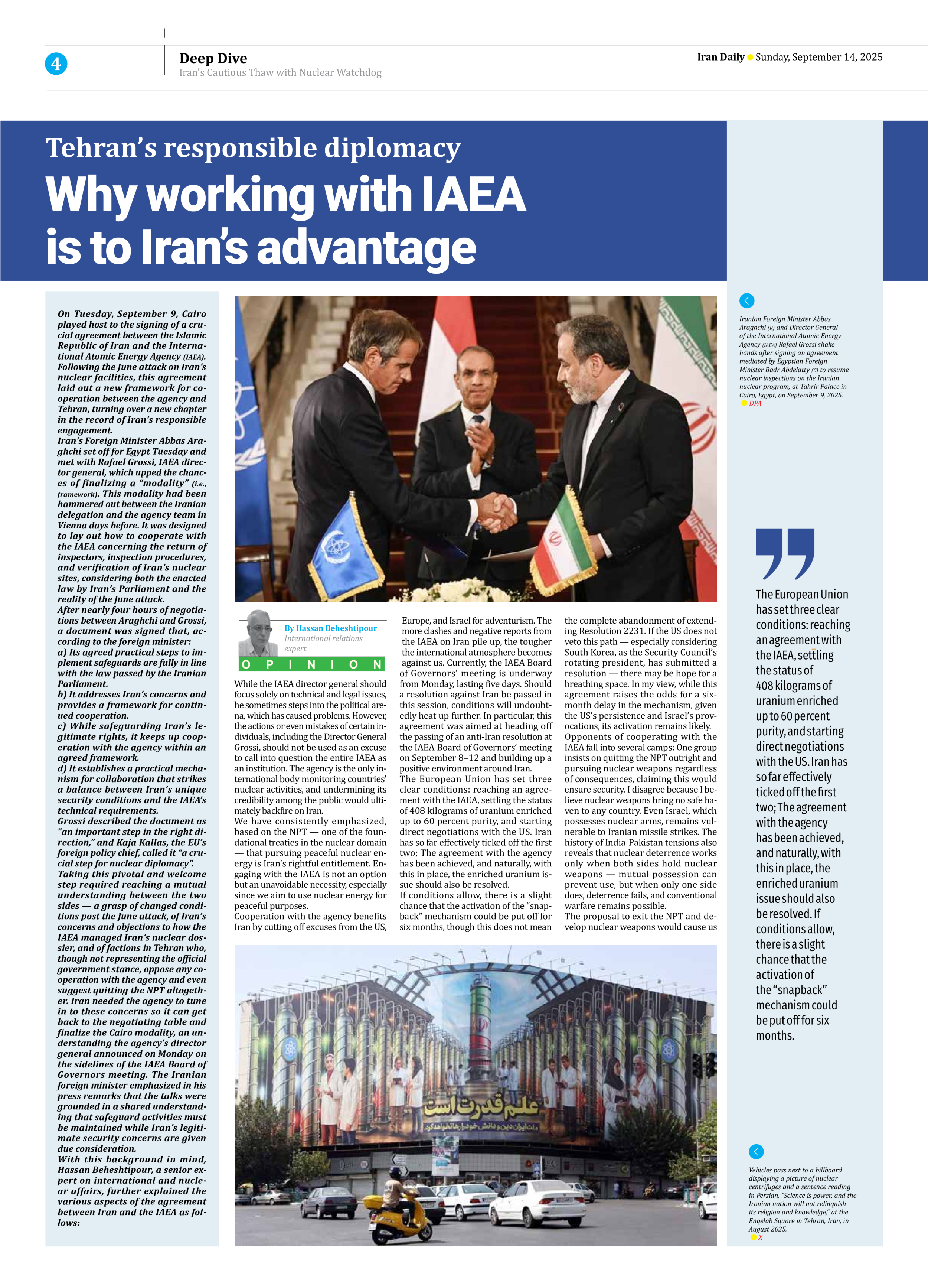


Tehran’s responsible diplomacy
Why working with IAEA is to Iran’s advantage
On Tuesday, September 9, Cairo played host to the signing of a crucial agreement between the Islamic Republic of Iran and the International Atomic Energy Agency (IAEA). Following the June attack on Iran’s nuclear facilities, this agreement laid out a new framework for cooperation between the agency and Tehran, turning over a new chapter in the record of Iran’s responsible engagement. Iran’s Foreign Minister Abbas Araghchi set off for Egypt Tuesday and met with Rafael Grossi, IAEA director general, which upped the chances of finalizing a “modality” (i.e., framework). This modality had been hammered out between the Iranian delegation and the agency team in Vienna days before. It was designed to lay out how to cooperate with the IAEA concerning the return of inspectors, inspection procedures, and verification of Iran’s nuclear sites, considering both the enacted law by Iran’s Parliament and the reality of the June attack. After nearly four hours of negotiations between Araghchi and Grossi, a document was signed that, according to the foreign minister: a) Its agreed practical steps to implement safeguards are fully in line with the law passed by the Iranian Parliament. b) It addresses Iran’s concerns and provides a framework for continued cooperation. c) While safeguarding Iran’s legitimate rights, it keeps up cooperation with the agency within an agreed framework. d) It establishes a practical mechanism for collaboration that strikes a balance between Iran’s unique security conditions and the IAEA’s technical requirements. Grossi described the document as “an important step in the right direction,” and Kaja Kallas, the EU’s foreign policy chief, called it “a crucial step for nuclear diplomacy”. Taking this pivotal and welcome step required reaching a mutual understanding between the two sides — a grasp of changed conditions post the June attack, of Iran’s concerns and objections to how the IAEA managed Iran’s nuclear dossier, and of factions in Tehran who, though not representing the official government stance, oppose any cooperation with the agency and even suggest quitting the NPT altogether. Iran needed the agency to tune in to these concerns so it can get back to the negotiating table and finalize the Cairo modality, an understanding the agency’s director general announced on Monday on the sidelines of the IAEA Board of Governors meeting. The Iranian foreign minister emphasized in his press remarks that the talks were grounded in a shared understanding that safeguard activities must be maintained while Iran’s legitimate security concerns are given due consideration. With this background in mind, Hassan Beheshtipour, a senior expert on international and nuclear affairs, further explained the various aspects of the agreement between Iran and the IAEA as follows:
By Hassan Beheshtipour
International relations expert
While the IAEA director general should focus solely on technical and legal issues, he sometimes steps into the political arena, which has caused problems. However, the actions or even mistakes of certain individuals, including the Director General Grossi, should not be used as an excuse to call into question the entire IAEA as an institution. The agency is the only international body monitoring countries’ nuclear activities, and undermining its credibility among the public would ultimately backfire on Iran.
We have consistently emphasized, based on the NPT — one of the foundational treaties in the nuclear domain — that pursuing peaceful nuclear energy is Iran’s rightful entitlement. Engaging with the IAEA is not an option but an unavoidable necessity, especially since we aim to use nuclear energy for peaceful purposes.
Cooperation with the agency benefits Iran by cutting off excuses from the US, Europe, and Israel for adventurism. The more clashes and negative reports from the IAEA on Iran pile up, the tougher the international atmosphere becomes against us. Currently, the IAEA Board of Governors’ meeting is underway from Monday, lasting five days. Should a resolution against Iran be passed in this session, conditions will undoubtedly heat up further. In particular, this agreement was aimed at heading off the passing of an anti-Iran resolution at the IAEA Board of Governors’ meeting on September 8–12 and building up a positive environment around Iran.
The European Union has set three clear conditions: reaching an agreement with the IAEA, settling the status of 408 kilograms of uranium enriched up to 60 percent purity, and starting direct negotiations with the US. Iran has so far effectively ticked off the first two; The agreement with the agency has been achieved, and naturally, with this in place, the enriched uranium issue should also be resolved.
If conditions allow, there is a slight chance that the activation of the “snapback” mechanism could be put off for six months, though this does not mean the complete abandonment of extending Resolution 2231. If the US does not veto this path — especially considering South Korea, as the Security Council’s rotating president, has submitted a resolution — there may be hope for a breathing space. In my view, while this agreement raises the odds for a six-month delay in the mechanism, given the US’s persistence and Israel’s provocations, its activation remains likely.
Opponents of cooperating with the IAEA fall into several camps: One group insists on quitting the NPT outright and pursuing nuclear weapons regardless of consequences, claiming this would ensure security. I disagree because I believe nuclear weapons bring no safe haven to any country. Even Israel, which possesses nuclear arms, remains vulnerable to Iranian missile strikes. The history of India-Pakistan tensions also reveals that nuclear deterrence works only when both sides hold nuclear weapons — mutual possession can prevent use, but when only one side does, deterrence fails, and conventional warfare remains possible.
The proposal to exit the NPT and develop nuclear weapons would cause us serious trouble. This move could even cost us the support we currently enjoy from countries like China and Russia, who might take a different stance under such circumstances.
Another camp of opponents doesn’t call explicitly for leaving the NPT or making weapons, but argues that until there are guarantees that the US or Israel won’t attack Iran, cooperation should not be expanded. They claim that allowing IAEA inspections of sites struck in attacks would give adversaries insight into how successful their strikes have been. That is why they oppose cooperation with the agency.
The third group supports “nuclear ambiguity”. They hold that until final decisions about a potential war with Israel and US threats are made, the situation should be kept ambiguous. However, this policy puts Iran in a tough spot; Nuclear ambiguity leads to ongoing uncertainty and oscillation between war and peace — a condition recently criticized by the Leader of Iran’s Islamic Revolution, who stressed that Iran should not remain stuck in a limbo of neither war nor peace.
It is in Iran’s interest to work with the IAEA and to draw a distinction between a person’s errors or politicization efforts — such as cases involving Mr. Grossi or espionage allegations — and the agency’s overall performance. We must press ahead with cooperation to take the wind out of the sails of American, European, and Israeli detractors.
The article first appeared in Persian on IRNA.