







Ideals cannot be assassinated
By Javad Shamloo
Journalist
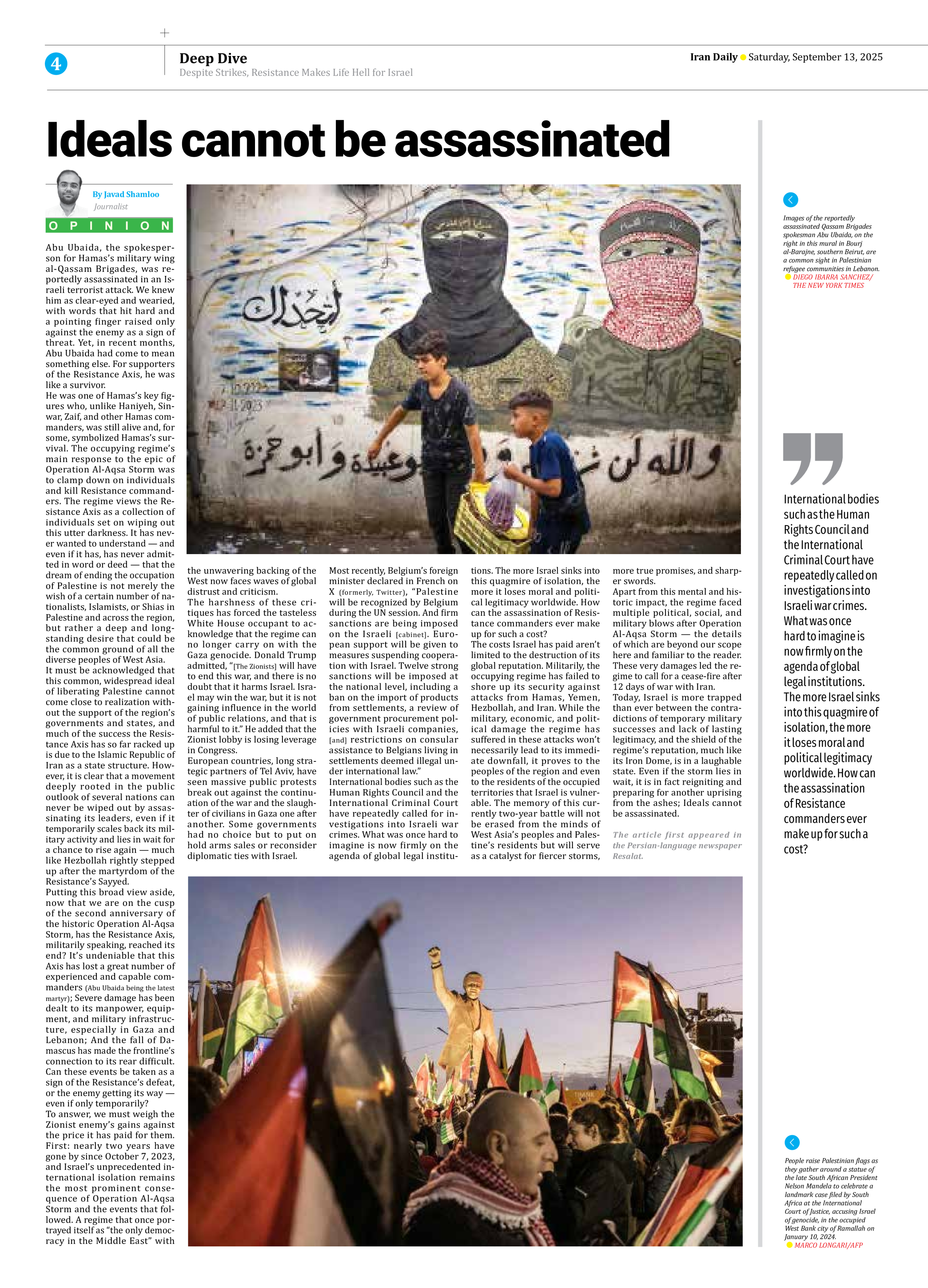
Abu Ubaida, the spokesperson for Hamas’s military wing al-Qassam Brigades, was reportedly assassinated in an Israeli terrorist attack. We knew him as clear-eyed and wearied, with words that hit hard and a pointing finger raised only against the enemy as a sign of threat. Yet, in recent months, Abu Ubaida had come to mean something else. For supporters of the Resistance Axis, he was like a survivor.
He was one of Hamas’s key figures who, unlike Haniyeh, Sinwar, Zaif, and other Hamas commanders, was still alive and, for some, symbolized Hamas’s survival. The occupying regime’s main response to the epic of Operation Al-Aqsa Storm was to clamp down on individuals and kill Resistance commanders. The regime views the Resistance Axis as a collection of individuals set on wiping out this utter darkness. It has never wanted to understand — and even if it has, has never admitted in word or deed — that the dream of ending the occupation of Palestine is not merely the wish of a certain number of nationalists, Islamists, or Shias in Palestine and across the region, but rather a deep and longstanding desire that could be the common ground of all the diverse peoples of West Asia.
It must be acknowledged that this common, widespread ideal of liberating Palestine cannot come close to realization without the support of the region’s governments and states, and much of the success the Resistance Axis has so far racked up is due to the Islamic Republic of Iran as a state structure. However, it is clear that a movement deeply rooted in the public outlook of several nations can never be wiped out by assassinating its leaders, even if it temporarily scales back its military activity and lies in wait for a chance to rise again — much like Hezbollah rightly stepped up after the martyrdom of the Resistance’s Sayyed.
Putting this broad view aside, now that we are on the cusp of the second anniversary of the historic Operation Al-Aqsa Storm, has the Resistance Axis, militarily speaking, reached its end? It’s undeniable that this Axis has lost a great number of experienced and capable commanders (Abu Ubaida being the latest martyr); Severe damage has been dealt to its manpower, equipment, and military infrastructure, especially in Gaza and Lebanon; And the fall of Damascus has made the frontline’s connection to its rear difficult. Can these events be taken as a sign of the Resistance’s defeat, or the enemy getting its way — even if only temporarily?
To answer, we must weigh the Zionist enemy’s gains against the price it has paid for them. First: nearly two years have gone by since October 7, 2023, and Israel’s unprecedented international isolation remains the most prominent consequence of Operation Al-Aqsa Storm and the events that followed. A regime that once portrayed itself as “the only democracy in the Middle East” with the unwavering backing of the West now faces waves of global distrust and criticism.
The harshness of these critiques has forced the tasteless White House occupant to acknowledge that the regime can no longer carry on with the Gaza genocide. Donald Trump admitted, “[The Zionists] will have to end this war, and there is no doubt that it harms Israel. Israel may win the war, but it is not gaining influence in the world of public relations, and that is harmful to it.” He added that the Zionist lobby is losing leverage in Congress.
European countries, long strategic partners of Tel Aviv, have seen massive public protests break out against the continuation of the war and the slaughter of civilians in Gaza one after another. Some governments had no choice but to put on hold arms sales or reconsider diplomatic ties with Israel.
Most recently, Belgium’s foreign minister declared in French on X (formerly, Twitter), “Palestine will be recognized by Belgium during the UN session. And firm sanctions are being imposed on the Israeli [cabinet]. European support will be given to measures suspending cooperation with Israel. Twelve strong sanctions will be imposed at the national level, including a ban on the import of products from settlements, a review of government procurement policies with Israeli companies, [and] restrictions on consular assistance to Belgians living in settlements deemed illegal under international law.”
International bodies such as the Human Rights Council and the International Criminal Court have repeatedly called for investigations into Israeli war crimes. What was once hard to imagine is now firmly on the agenda of global legal institutions. The more Israel sinks into this quagmire of isolation, the more it loses moral and political legitimacy worldwide. How can the assassination of Resistance commanders ever make up for such a cost?
The costs Israel has paid aren’t limited to the destruction of its global reputation. Militarily, the occupying regime has failed to shore up its security against attacks from Hamas, Yemen, Hezbollah, and Iran. While the military, economic, and political damage the regime has suffered in these attacks won’t necessarily lead to its immediate downfall, it proves to the peoples of the region and even to the residents of the occupied territories that Israel is vulnerable. The memory of this currently two-year battle will not be erased from the minds of West Asia’s peoples and Palestine’s residents but will serve as a catalyst for fiercer storms, more true promises, and sharper swords.
Apart from this mental and historic impact, the regime faced multiple political, social, and military blows after Operation Al-Aqsa Storm — the details of which are beyond our scope here and familiar to the reader. These very damages led the regime to call for a cease-fire after 12 days of war with Iran.
Today, Israel is more trapped than ever between the contradictions of temporary military successes and lack of lasting legitimacy, and the shield of the regime’s reputation, much like its Iron Dome, is in a laughable state. Even if the storm lies in wait, it is in fact reigniting and preparing for another uprising from the ashes; Ideals cannot be assassinated.
The article first appeared in
the Persian-language newspaper
Resalat.