







Copy in clipboard...
Cooperation with IAEA cannot be same as before: Araghchi
‘Iran-IAEA deal would be void if Europe activated snapback mechanism’
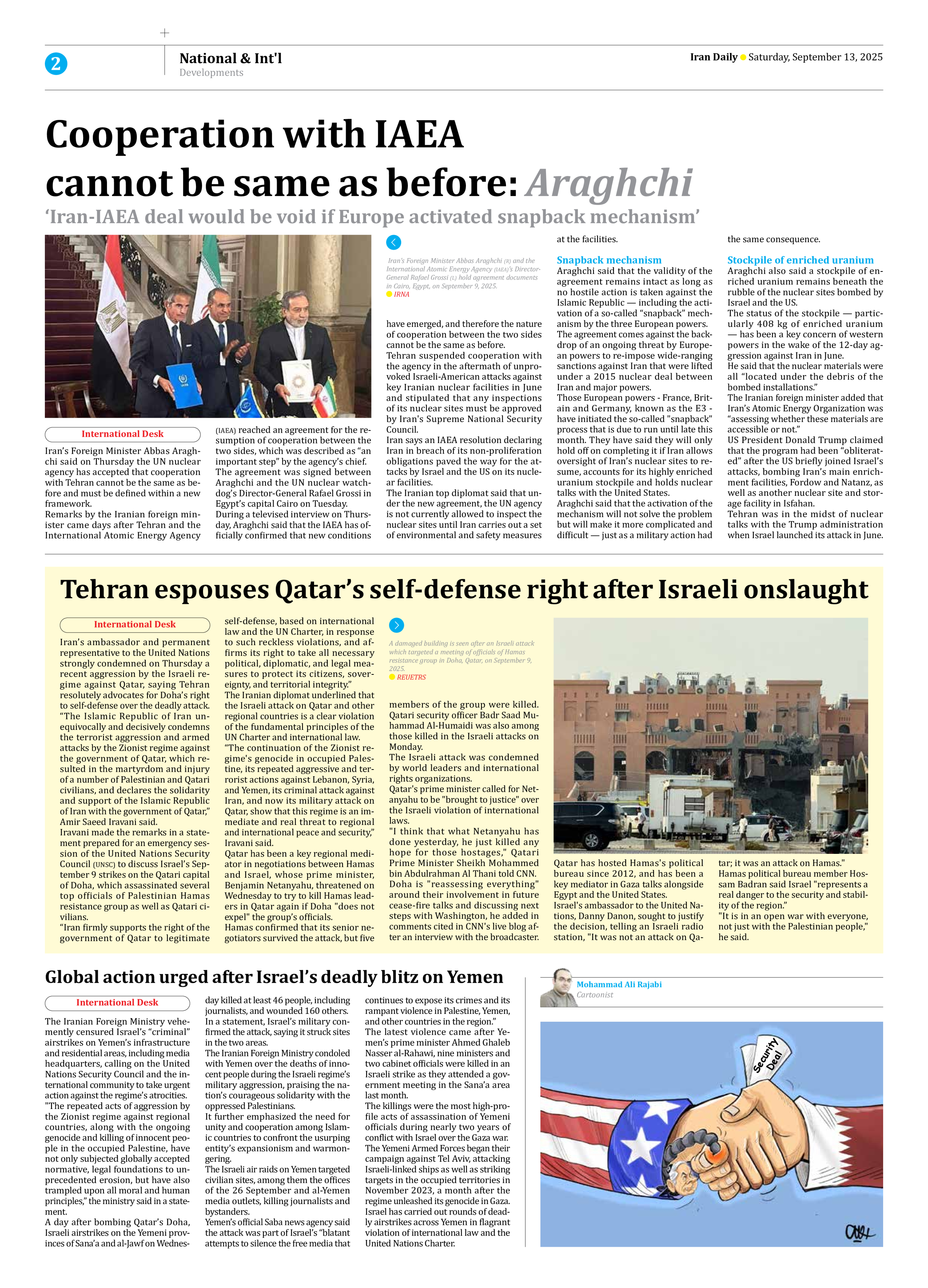
Iran’s Foreign Minister Abbas Araghchi said on Thursday the UN nuclear agency has accepted that cooperation with Tehran cannot be the same as before and must be defined within a new framework.
Remarks by the Iranian foreign minister came days after Tehran and the International Atomic Energy Agency (IAEA) reached an agreement for the resumption of cooperation between the two sides, which was described as “an important step” by the agency’s chief.
The agreement was signed between Araghchi and the UN nuclear watchdog’s Director-General Rafael Grossi in Egypt’s capital Cairo on Tuesday.
During a televised interview on Thursday, Araghchi said that the IAEA has officially confirmed that new conditions have emerged, and therefore the nature of cooperation between the two sides cannot be the same as before.
Tehran suspended cooperation with the agency in the aftermath of unprovoked Israeli-American attacks against key Iranian nuclear facilities in June and stipulated that any inspections of its nuclear sites must be approved by Iran's Supreme National Security Council.
Iran says an IAEA resolution declaring Iran in breach of its non-proliferation obligations paved the way for the attacks by Israel and the US on its nuclear facilities.
The Iranian top diplomat said that under the new agreement, the UN agency is not currently allowed to inspect the nuclear sites until Iran carries out a set of environmental and safety measures at the facilities.
Snapback mechanism
Araghchi said that the validity of the agreement remains intact as long as no hostile action is taken against the Islamic Republic — including the activation of a so-called “snapback” mechanism by the three European powers.
The agreement comes against the backdrop of an ongoing threat by European powers to re-impose wide-ranging sanctions against Iran that were lifted under a 2015 nuclear deal between Iran and major powers.
Those European powers - France, Britain and Germany, known as the E3 - have initiated the so-called "snapback" process that is due to run until late this month. They have said they will only hold off on completing it if Iran allows oversight of Iran’s nuclear sites to resume, accounts for its highly enriched uranium stockpile and holds nuclear talks with the United States.
Araghchi said that the activation of the mechanism will not solve the problem but will make it more complicated and difficult — just as a military action had the same consequence.
Stockpile of enriched uranium
Araghchi also said a stockpile of enriched uranium remains beneath the rubble of the nuclear sites bombed by Israel and the US.
The status of the stockpile — particularly 408 kg of enriched uranium — has been a key concern of western powers in the wake of the 12-day aggression against Iran in June.
He said that the nuclear materials were all “located under the debris of the bombed installations.”
The Iranian foreign minister added that Iran’s Atomic Energy Organization was “assessing whether these materials are accessible or not.”
US President Donald Trump claimed that the program had been “obliterated” after the US briefly joined Israel’s attacks, bombing Iran’s main enrichment facilities, Fordow and Natanz, as well as another nuclear site and storage facility in Isfahan.
Tehran was in the midst of nuclear talks with the Trump administration when Israel launched its attack in June.