







Russia, China can be included in a 3+3 mechanism: Expert
The diplomatic process initiated to reach a win-win agreement between the Islamic Republic of Iran and the West has hit a wall following attacks by the Zionist regime and the US on Iran. The initiation of the process of reactivating the snapback mechanism by the European trio of France, the UK, and Germany against Iran has complicated the deadlock like never before. However, Tehran, throughout the years of its challenges with the West, has consistently regarded diplomacy as the better and less costly option. But the West’s insistence on continuing unreasonable demands casts a shadow over future relations. To examine the latest developments in Iran’s relations with Europe and the US, and to analyze the causes and background of Washington and the European trio’s behavior, an interview was conducted with Seyed Jalal Dehghani Firouzabadi, a university professor and international relations analyst. Parts of the interview follow below.
Regarding the speculation we hear from various sources that Iran is not necessarily reluctant to start negotiations, but the US is currently in a passive position — what do you see as the reason for this US inertia?
DEHGHANI FIROUZABADI: At present, time is not on Iran’s side; Iran is facing a time crunch that the Americans do not currently experience. There was a sense of urgency for the Americans in the Muscat negotiations that either led to agreement or changed the circumstances, but now, after Israel’s attack, the situation has taken a turn.
However, it should not be forgotten that Iran is unwilling to negotiate under any conditions. The Iranian Foreign Ministry and the foreign minister have explicitly said Tehran will not give up in the negotiations what it has protected through war. Therefore, it will only agree to conditional negotiations — indirect and limited strictly to the nuclear issue, accompanied by American security guarantees that force will not be used during talks.
Currently, the US pursues a three-dimensional, triangular maximum pressure policy: The first dimension is economic, through initial and secondary sanctions it increasingly intensifies; The second is diplomatic and political, where the three European countries act on behalf of the US; And the third is military, which Israel carries out. It can be stated that the US has handed over diplomatic responsibilities to Europe, which will conduct proxy negotiations with Iran. So, it can be concluded that the Americans have no desire for direct talks because Europeans will take the baton. Presently, Europeans play the role of diplomatic brokers, while Israel acts as the military bully. With the residual days of the 30-day deadline ticking away, Iran needs active diplomacy, but the US has little incentive for it.
Is continuing this status quo beneficial for both sides? In your view, what initiatives should be rolled out to move past these conditions?
I believe maintaining the current state is not equal for Iran and the US. Actually, the present situation favors the US. One reason for America’s reluctance to negotiate is that it doesn’t see the ongoing situation as harmful to itself. I see this situation as a win-win game for the US; If it results in negotiations, regardless of their content, America achieves its goals. If negotiations don’t happen, the current conditions may still lead to the Security Council implementing previous commitments and triggering the snapback mechanism, which also benefits the US.
Prolonging the current circumstances could hurt Iran, putting it at a crossroads where it must either concede to America’s maximalist demands or face the snapback and return of Security Council resolutions. This explains why some think Iran shows greater willingness to negotiate, while the US is less eager. Both outcomes serve US interests.
I think Iran should step up a combined, active, and innovative diplomacy in the remaining time since time is of the essence. All efforts must focus on preventing the snapback mechanism from being triggered. Iran needs dual-track diplomacy — simultaneously legal and political, both bilateral and multilateral.
On the legal front, as Iran has started, it should continue correspondence with the Security Council, arguing that Europe fundamentally lacks the legitimacy to activate the snapback since it repeatedly violated the agreement and cannot benefit from a contract it has consistently broken. This is a legal argument Iran can present to the Security Council. There is also a multilateral legal path through permanent Security Council members and JCPOA parties such as Russia and China. For instance, Russia’s resolution, backed by China, is a legal route in motion.
Politically, Iran should pursue active diplomacy both bilaterally and multilaterally. Iran should forge closer ties with countries that can play a role in this situation. On a bilateral level, it can strengthen relations with Russia and China, and on a multilateral scale, it should leverage regional and international organizations.
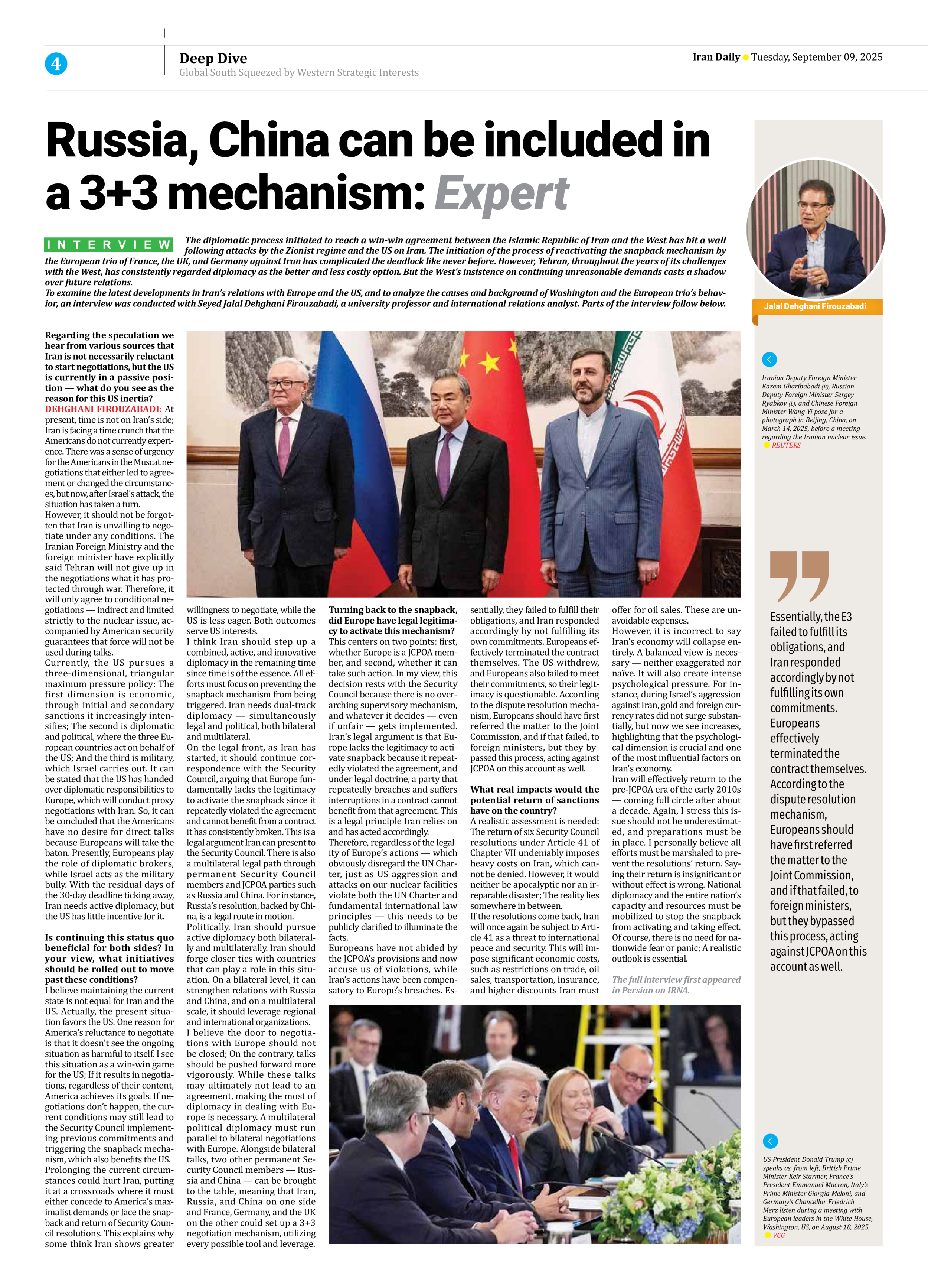
I believe the door to negotiations with Europe should not be closed; On the contrary, talks should be pushed forward more vigorously. While these talks may ultimately not lead to an agreement, making the most of diplomacy in dealing with Europe is necessary. A multilateral political diplomacy must run parallel to bilateral negotiations with Europe. Alongside bilateral talks, two other permanent Security Council members — Russia and China — can be brought to the table, meaning that Iran, Russia, and China on one side and France, Germany, and the UK on the other could set up a 3+3 negotiation mechanism, utilizing every possible tool and leverage.
Turning back to the snapback, did Europe have legal legitimacy to activate this mechanism?
This centers on two points: first, whether Europe is a JCPOA member, and second, whether it can take such action. In my view, this decision rests with the Security Council because there is no overarching supervisory mechanism, and whatever it decides — even if unfair — gets implemented. Iran’s legal argument is that Europe lacks the legitimacy to activate snapback because it repeatedly violated the agreement, and under legal doctrine, a party that repeatedly breaches and suffers interruptions in a contract cannot benefit from that agreement. This is a legal principle Iran relies on and has acted accordingly.
Therefore, regardless of the legality of Europe’s actions — which obviously disregard the UN Charter, just as US aggression and attacks on our nuclear facilities violate both the UN Charter and fundamental international law principles — this needs to be publicly clarified to illuminate the facts.
Europeans have not abided by the JCPOA’s provisions and now accuse us of violations, while Iran’s actions have been compensatory to Europe’s breaches. Essentially, they failed to fulfill their obligations, and Iran responded accordingly by not fulfilling its own commitments. Europeans effectively terminated the contract themselves. The US withdrew, and Europeans also failed to meet their commitments, so their legitimacy is questionable. According to the dispute resolution mechanism, Europeans should have first referred the matter to the Joint Commission, and if that failed, to foreign ministers, but they bypassed this process, acting against JCPOA on this account as well.
What real impacts would the potential return of sanctions have on the country?
A realistic assessment is needed: The return of six Security Council resolutions under Article 41 of Chapter VII undeniably imposes heavy costs on Iran, which cannot be denied. However, it would neither be apocalyptic nor an irreparable disaster; The reality lies somewhere in between.
If the resolutions come back, Iran will once again be subject to Article 41 as a threat to international peace and security. This will impose significant economic costs, such as restrictions on trade, oil sales, transportation, insurance, and higher discounts Iran must offer for oil sales. These are unavoidable expenses.
However, it is incorrect to say Iran’s economy will collapse entirely. A balanced view is necessary — neither exaggerated nor naïve. It will also create intense psychological pressure. For instance, during Israel’s aggression against Iran, gold and foreign currency rates did not surge substantially, but now we see increases, highlighting that the psychological dimension is crucial and one of the most influential factors on Iran’s economy.
Iran will effectively return to the pre-JCPOA era of the early 2010s — coming full circle after about a decade. Again, I stress this issue should not be underestimated, and preparations must be in place. I personally believe all efforts must be marshaled to prevent the resolutions’ return. Saying their return is insignificant or without effect is wrong. National diplomacy and the entire nation’s capacity and resources must be mobilized to stop the snapback from activating and taking effect. Of course, there is no need for nationwide fear or panic; A realistic outlook is essential.
The full interview first appeared in Persian on IRNA.