





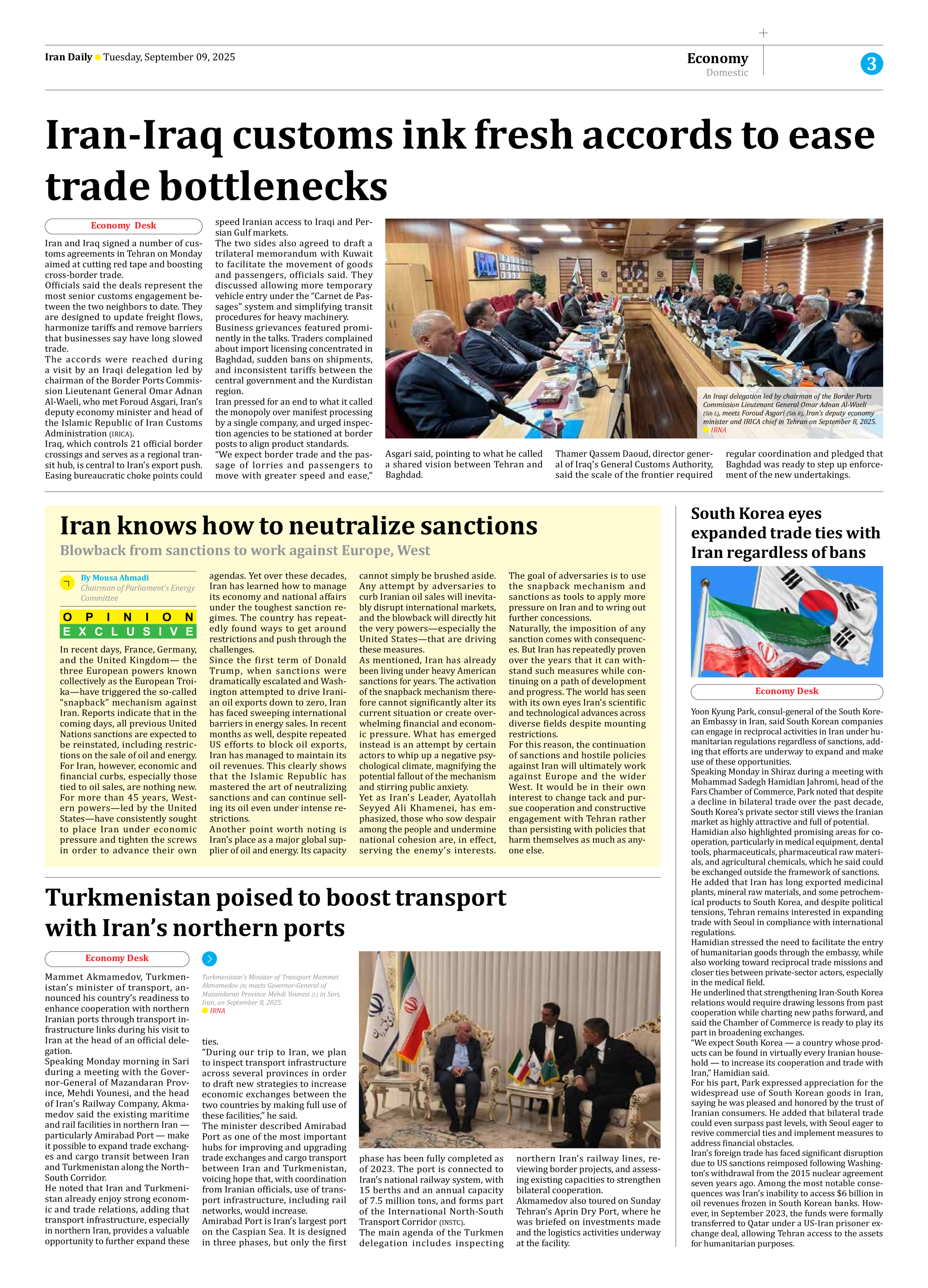


South Korea eyes expanded trade ties with Iran regardless of bans
Yoon Kyung Park, consul-general of the South Korean Embassy in Iran, said South Korean companies can engage in reciprocal activities in Iran under humanitarian regulations regardless of sanctions, adding that efforts are underway to expand and make use of these opportunities.
Speaking Monday in Shiraz during a meeting with Mohammad Sadegh Hamidian Jahromi, head of the Fars Chamber of Commerce, Park noted that despite a decline in bilateral trade over the past decade, South Korea’s private sector still views the Iranian market as highly attractive and full of potential.
Hamidian also highlighted promising areas for cooperation, particularly in medical equipment, dental tools, pharmaceuticals, pharmaceutical raw materials, and agricultural chemicals, which he said could be exchanged outside the framework of sanctions.
He added that Iran has long exported medicinal plants, mineral raw materials, and some petrochemical products to South Korea, and despite political tensions, Tehran remains interested in expanding trade with Seoul in compliance with international regulations.
Hamidian stressed the need to facilitate the entry of humanitarian goods through the embassy, while also working toward reciprocal trade missions and closer ties between private-sector actors, especially in the medical field.
He underlined that strengthening Iran-South Korea relations would require drawing lessons from past cooperation while charting new paths forward, and said the Chamber of Commerce is ready to play its part in broadening exchanges.
“We expect South Korea — a country whose products can be found in virtually every Iranian household — to increase its cooperation and trade with Iran,” Hamidian said.
For his part, Park expressed appreciation for the widespread use of South Korean goods in Iran, saying he was pleased and honored by the trust of Iranian consumers. He added that bilateral trade could even surpass past levels, with Seoul eager to revive commercial ties and implement measures to address financial obstacles.
Iran’s foreign trade has faced significant disruption due to US sanctions reimposed following Washington’s withdrawal from the 2015 nuclear agreement seven years ago. Among the most notable consequences was Iran’s inability to access $6 billion in oil revenues frozen in South Korean banks. However, in September 2023, the funds were formally transferred to Qatar under a US-Iran prisoner exchange deal, allowing Tehran access to the assets for humanitarian purposes.