







Iran’s good neighborliness policy not short-term tactic: Envoy
‘Joint security pact’ Tehran’s preferred prescription for region
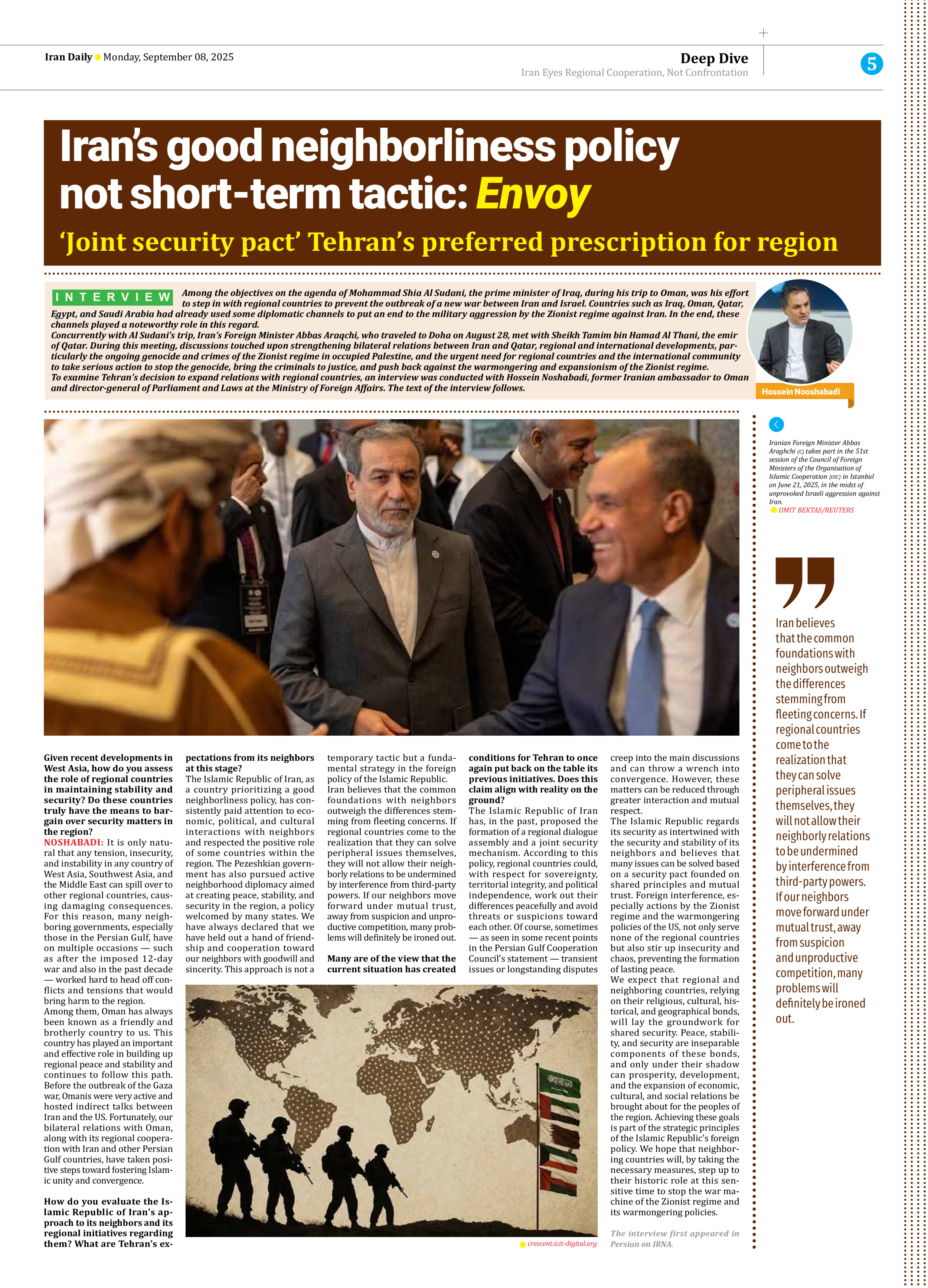
Among the objectives on the agenda of Mohammad Shia Al Sudani, the prime minister of Iraq, during his trip to Oman, was his effort to step in with regional countries to prevent the outbreak of a new war between Iran and Israel. Countries such as Iraq, Oman, Qatar, Egypt, and Saudi Arabia had already used some diplomatic channels to put an end to the military aggression by the Zionist regime against Iran. In the end, these channels played a noteworthy role in this regard. Concurrently with Al Sudani’s trip, Iran’s Foreign Minister Abbas Araqchi, who traveled to Doha on August 28, met with Sheikh Tamim bin Hamad Al Thani, the emir of Qatar. During this meeting, discussions touched upon strengthening bilateral relations between Iran and Qatar, regional and international developments, particularly the ongoing genocide and crimes of the Zionist regime in occupied Palestine, and the urgent need for regional countries and the international community to take serious action to stop the genocide, bring the criminals to justice, and push back against the warmongering and expansionism of the Zionist regime. To examine Tehran’s decision to expand relations with regional countries, an interview was conducted with Hossein Noshabadi, former Iranian ambassador to Oman and director-general of Parliament and Laws at the Ministry of Foreign Affairs. The text of the interview follows.
Given recent developments in West Asia, how do you assess the role of regional countries in maintaining stability and security? Do these countries truly have the means to bargain over security matters in the region?
NOSHABADI: It is only natural that any tension, insecurity, and instability in any country of West Asia, Southwest Asia, and the Middle East can spill over to other regional countries, causing damaging consequences. For this reason, many neighboring governments, especially those in the Persian Gulf, have on multiple occasions — such as after the imposed 12-day war and also in the past decade — worked hard to head off conflicts and tensions that would bring harm to the region.
Among them, Oman has always been known as a friendly and brotherly country to us. This country has played an important and effective role in building up regional peace and stability and continues to follow this path. Before the outbreak of the Gaza war, Omanis were very active and hosted indirect talks between Iran and the US. Fortunately, our bilateral relations with Oman, along with its regional cooperation with Iran and other Persian Gulf countries, have taken positive steps toward fostering Islamic unity and convergence.
How do you evaluate the Islamic Republic of Iran’s approach to its neighbors and its regional initiatives regarding them? What are Tehran’s expectations from its neighbors at this stage?
The Islamic Republic of Iran, as a country prioritizing a good neighborliness policy, has consistently paid attention to economic, political, and cultural interactions with neighbors and respected the positive role of some countries within the region. The Pezeshkian government has also pursued active neighborhood diplomacy aimed at creating peace, stability, and security in the region, a policy welcomed by many states. We have always declared that we have held out a hand of friendship and cooperation toward our neighbors with goodwill and sincerity. This approach is not a temporary tactic but a fundamental strategy in the foreign policy of the Islamic Republic.
Iran believes that the common foundations with neighbors outweigh the differences stemming from fleeting concerns. If regional countries come to the realization that they can solve peripheral issues themselves, they will not allow their neighborly relations to be undermined by interference from third-party powers. If our neighbors move forward under mutual trust, away from suspicion and unproductive competition, many problems will definitely be ironed out.
Many are of the view that the current situation has created conditions for Tehran to once again put back on the table its previous initiatives. Does this claim align with reality on the ground?
The Islamic Republic of Iran has, in the past, proposed the formation of a regional dialogue assembly and a joint security mechanism. According to this policy, regional countries could, with respect for sovereignty, territorial integrity, and political independence, work out their differences peacefully and avoid threats or suspicions toward each other. Of course, sometimes — as seen in some recent points in the Persian Gulf Cooperation Council’s statement — transient issues or longstanding disputes creep into the main discussions and can throw a wrench into convergence. However, these matters can be reduced through greater interaction and mutual respect.
The Islamic Republic regards its security as intertwined with the security and stability of its neighbors and believes that many issues can be solved based on a security pact founded on shared principles and mutual trust. Foreign interference, especially actions by the Zionist regime and the warmongering policies of the US, not only serve none of the regional countries but also stir up insecurity and chaos, preventing the formation of lasting peace.
We expect that regional and neighboring countries, relying on their religious, cultural, historical, and geographical bonds, will lay the groundwork for shared security. Peace, stability, and security are inseparable components of these bonds, and only under their shadow can prosperity, development, and the expansion of economic, cultural, and social relations be brought about for the peoples of the region. Achieving these goals is part of the strategic principles of the Islamic Republic’s foreign policy. We hope that neighboring countries will, by taking the necessary measures, step up to their historic role at this sensitive time to stop the war machine of the Zionist regime and its warmongering policies.
The interview first appeared in Persian on IRNA.