







GCC’s worn-out claims, ignoring region’s real needs
What are requirements of being responsible neighbors?
The statement by the Persian Gulf Cooperation Council (GCC), while reflecting the views of Iran’s neighbors on key regional developments, once again came up with claims against the Islamic Republic of Iran — and against certain regional trends — that have nothing to do with realities on the ground, regional dynamics, or the true needs of West Asia.
Contradictions in GCC statement
The 165th session of GCC foreign ministers was this time held in Kuwait, chaired by that country’s Foreign Minister Abdullah Ali Al Yahya. As per tradition, the session wrapped up with a final statement. The foreign ministers of Saudi Arabia, Bahrain, the UAE, Qatar, Oman, and Kuwait signed off on their gathering on September 1.
As the region was grappling with a humanitarian disaster in Gaza, in their final statement, the GCC condemned — with the harshest tone — the “genocide in Gaza,” denouncing Israel’s deliberate blockade that has brought about famine, ethnic cleansing, collective punishment, mass killings of civilians and journalists, torture, executions on the spot, disappearances, forced displacement, looting, and the relentless demolition of residential neighborhoods, hospitals, schools, universities, mosques, churches, and infrastructures — all aimed at driving out the people of Gaza and resettling them elsewhere.
Looking through the statement released by the Arab states of the Persian Gulf, one can reasonably conclude that the only fair and realistic part of it was on Gaza. What else it said about Yemen, Lebanon, Syria, Iraq, and ultimately Iran is worlds apart from what is actually unfolding.
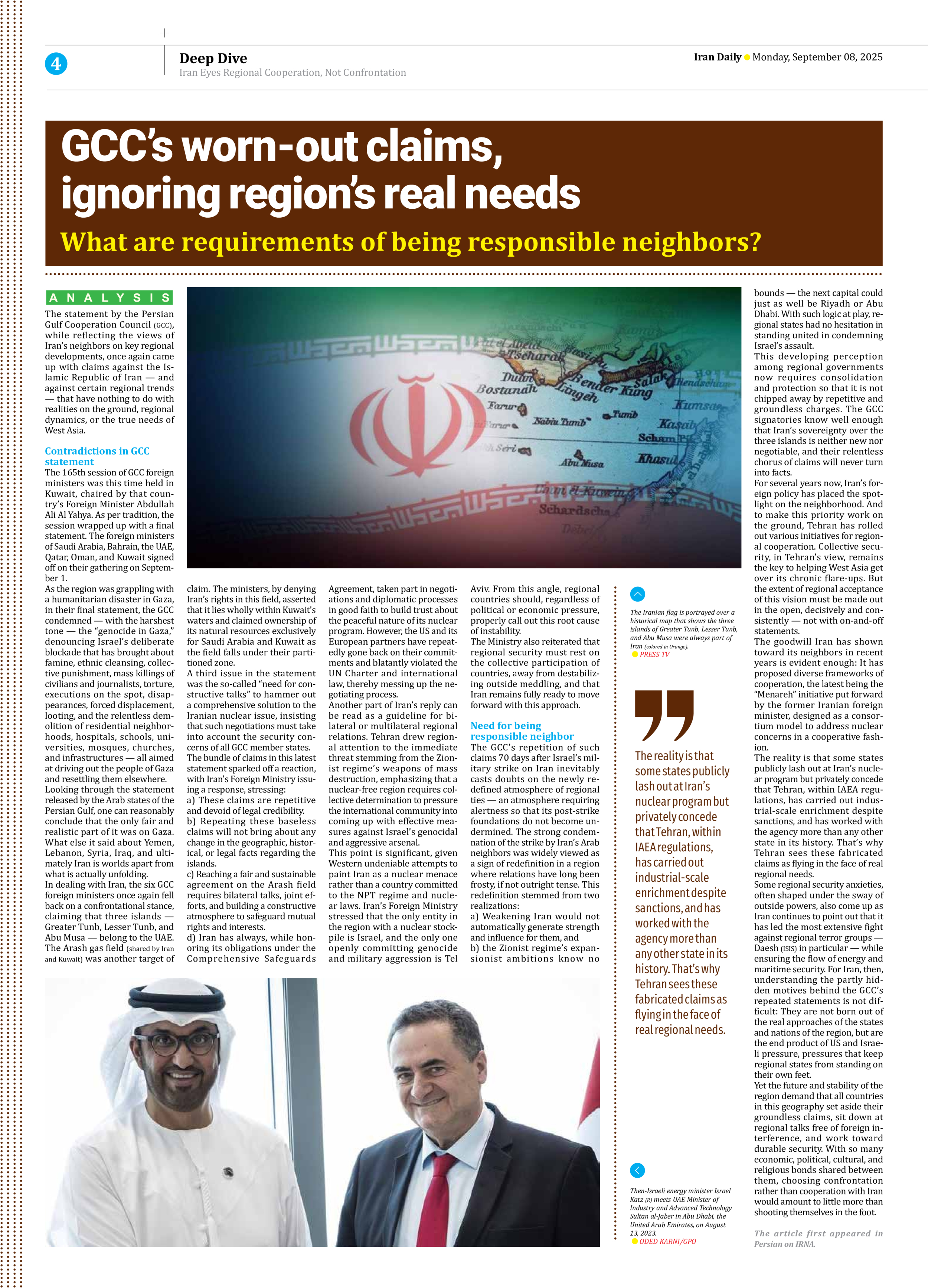
In dealing with Iran, the six GCC foreign ministers once again fell back on a confrontational stance, claiming that three islands — Greater Tunb, Lesser Tunb, and Abu Musa — belong to the UAE. The Arash gas field (shared by Iran and Kuwait) was another target of claim. The ministers, by denying Iran’s rights in this field, asserted that it lies wholly within Kuwait’s waters and claimed ownership of its natural resources exclusively for Saudi Arabia and Kuwait as the field falls under their partitioned zone.
A third issue in the statement was the so-called “need for constructive talks” to hammer out a comprehensive solution to the Iranian nuclear issue, insisting that such negotiations must take into account the security concerns of all GCC member states.
The bundle of claims in this latest statement sparked off a reaction, with Iran’s Foreign Ministry issuing a response, stressing:
a) These claims are repetitive and devoid of legal credibility.
b) Repeating these baseless claims will not bring about any change in the geographic, historical, or legal facts regarding the islands.
c) Reaching a fair and sustainable agreement on the Arash field requires bilateral talks, joint efforts, and building a constructive atmosphere to safeguard mutual rights and interests.
d) Iran has always, while honoring its obligations under the Comprehensive Safeguards Agreement, taken part in negotiations and diplomatic processes in good faith to build trust about the peaceful nature of its nuclear program. However, the US and its European partners have repeatedly gone back on their commitments and blatantly violated the UN Charter and international law, thereby messing up the negotiating process.
Another part of Iran’s reply can be read as a guideline for bilateral or multilateral regional relations. Tehran drew regional attention to the immediate threat stemming from the Zionist regime’s weapons of mass destruction, emphasizing that a nuclear-free region requires collective determination to pressure the international community into coming up with effective measures against Israel’s genocidal and aggressive arsenal.
This point is significant, given Western undeniable attempts to paint Iran as a nuclear menace rather than a country committed to the NPT regime and nuclear laws. Iran’s Foreign Ministry stressed that the only entity in the region with a nuclear stockpile is Israel, and the only one openly committing genocide and military aggression is Tel Aviv. From this angle, regional countries should, regardless of political or economic pressure, properly call out this root cause of instability.
The Ministry also reiterated that regional security must rest on the collective participation of countries, away from destabilizing outside meddling, and that Iran remains fully ready to move forward with this approach.
Need for being responsible neighbor
The GCC’s repetition of such claims 70 days after Israel’s military strike on Iran inevitably casts doubts on the newly redefined atmosphere of regional ties — an atmosphere requiring alertness so that its post-strike foundations do not become undermined. The strong condemnation of the strike by Iran’s Arab neighbors was widely viewed as a sign of redefinition in a region where relations have long been frosty, if not outright tense. This redefinition stemmed from two realizations:
a) Weakening Iran would not automatically generate strength and influence for them, and
b) the Zionist regime’s expansionist ambitions know no bounds — the next capital could just as well be Riyadh or Abu Dhabi. With such logic at play, regional states had no hesitation in standing united in condemning Israel’s assault.
This developing perception among regional governments now requires consolidation and protection so that it is not chipped away by repetitive and groundless charges. The GCC signatories know well enough that Iran’s sovereignty over the three islands is neither new nor negotiable, and their relentless chorus of claims will never turn into facts.
For several years now, Iran’s foreign policy has placed the spotlight on the neighborhood. And to make this priority work on the ground, Tehran has rolled out various initiatives for regional cooperation. Collective security, in Tehran’s view, remains the key to helping West Asia get over its chronic flare-ups. But the extent of regional acceptance of this vision must be made out in the open, decisively and consistently — not with on-and-off statements.
The goodwill Iran has shown toward its neighbors in recent years is evident enough: It has proposed diverse frameworks of cooperation, the latest being the “Menareh” initiative put forward by the former Iranian foreign minister, designed as a consortium model to address nuclear concerns in a cooperative fashion.
The reality is that some states publicly lash out at Iran’s nuclear program but privately concede that Tehran, within IAEA regulations, has carried out industrial-scale enrichment despite sanctions, and has worked with the agency more than any other state in its history. That’s why Tehran sees these fabricated claims as flying in the face of real regional needs.
Some regional security anxieties, often shaped under the sway of outside powers, also come up as Iran continues to point out that it has led the most extensive fight against regional terror groups — Daesh (ISIS) in particular — while ensuring the flow of energy and maritime security. For Iran, then, understanding the partly hidden motives behind the GCC’s repeated statements is not difficult: They are not born out of the real approaches of the states and nations of the region, but are the end product of US and Israeli pressure, pressures that keep regional states from standing on their own feet.
Yet the future and stability of the region demand that all countries in this geography set aside their groundless claims, sit down at regional talks free of foreign interference, and work toward durable security. With so many economic, political, cultural, and religious bonds shared between them, choosing confrontation rather than cooperation with Iran would amount to little more than shooting themselves in the foot.
The article first appeared in
Persian on IRNA.