







Copy in clipboard...
Araghchi excoriates European snapback as ‘drastic’ mistake doomed to backfire
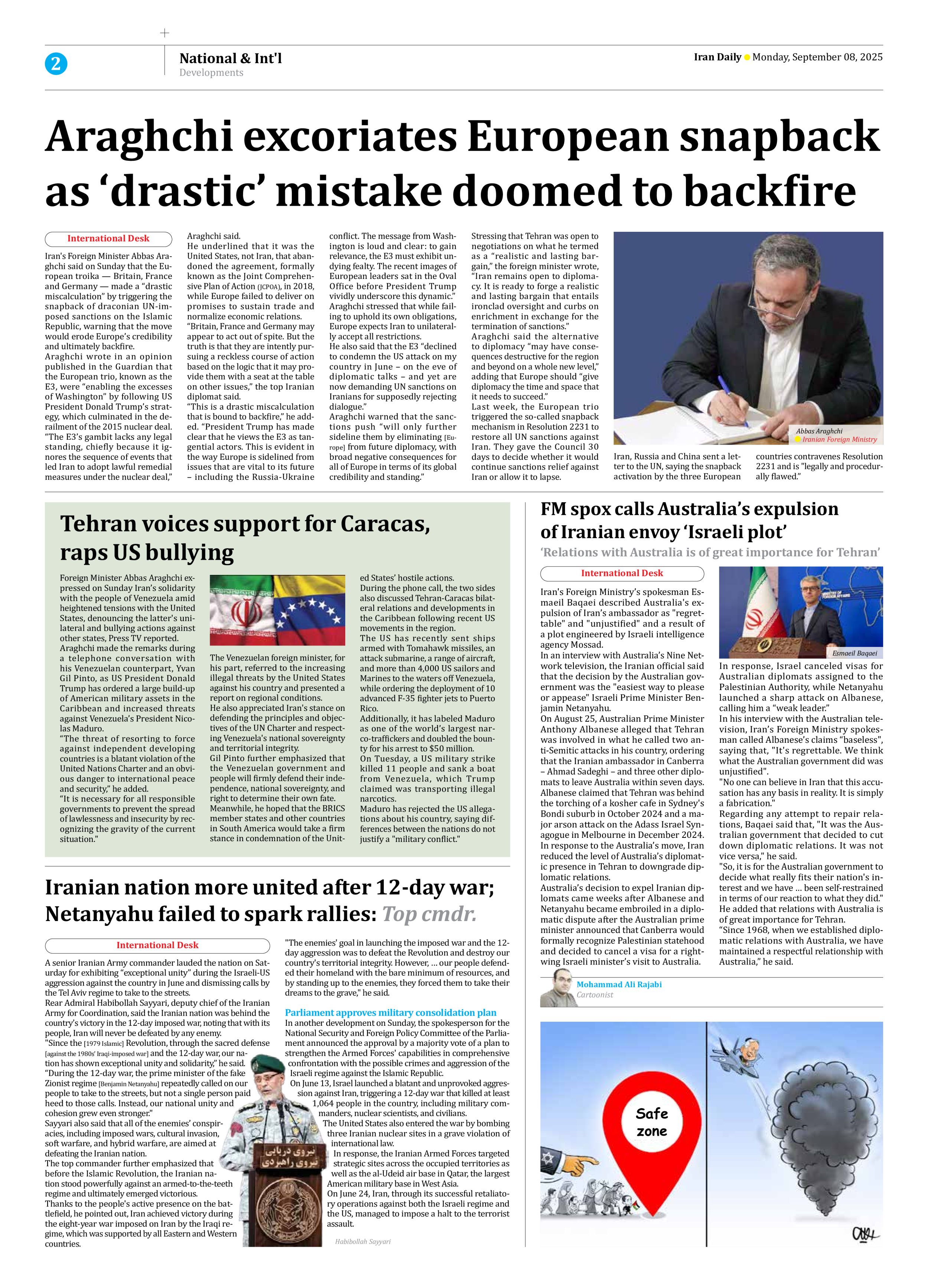
Iran's Foreign Minister Abbas Araghchi said on Sunday that the European troika — Britain, France and Germany — made a “drastic miscalculation” by triggering the snapback of draconian UN-imposed sanctions on the Islamic Republic, warning that the move would erode Europe’s credibility and ultimately backfire.
Araghchi wrote in an opinion published in the Guardian that the European trio, known as the E3, were “enabling the excesses of Washington” by following US President Donald Trump’s strategy, which culminated in the derailment of the 2015 nuclear deal.
“The E3’s gambit lacks any legal standing, chiefly because it ignores the sequence of events that led Iran to adopt lawful remedial measures under the nuclear deal,” Araghchi said.
He underlined that it was the United States, not Iran, that abandoned the agreement, formally known as the Joint Comprehensive Plan of Action (JCPOA), in 2018, while Europe failed to deliver on promises to sustain trade and normalize economic relations.
“Britain, France and Germany may appear to act out of spite. But the truth is that they are intently pursuing a reckless course of action based on the logic that it may provide them with a seat at the table on other issues,” the top Iranian diplomat said.
“This is a drastic miscalculation that is bound to backfire,” he added. “President Trump has made clear that he views the E3 as tangential actors. This is evident in the way Europe is sidelined from issues that are vital to its future – including the Russia-Ukraine conflict. The message from Washington is loud and clear: to gain relevance, the E3 must exhibit undying fealty. The recent images of European leaders sat in the Oval Office before President Trump vividly underscore this dynamic.”
Araghchi stressed that while failing to uphold its own obligations, Europe expects Iran to unilaterally accept all restrictions.
He also said that the E3 “declined to condemn the US attack on my country in June – on the eve of diplomatic talks – and yet are now demanding UN sanctions on Iranians for supposedly rejecting dialogue.”
Araghchi warned that the sanctions push “will only further sideline them by eliminating [Europe] from future diplomacy, with broad negative consequences for all of Europe in terms of its global credibility and standing.”
Stressing that Tehran was open to negotiations on what he termed as a “realistic and lasting bargain,” the foreign minister wrote, “Iran remains open to diplomacy. It is ready to forge a realistic and lasting bargain that entails ironclad oversight and curbs on enrichment in exchange for the termination of sanctions.”
Araghchi said the alternative to diplomacy “may have consequences destructive for the region and beyond on a whole new level,” adding that Europe should “give diplomacy the time and space that it needs to succeed.”
Last week, the European trio triggered the so-called snapback mechanism in Resolution 2231 to restore all UN sanctions against Iran. They gave the Council 30 days to decide whether it would continue sanctions relief against Iran or allow it to lapse.
Iran, Russia and China sent a letter to the UN, saying the snapback activation by the three European countries contravenes Resolution 2231 and is "legally and procedurally flawed.”