







Why it took Palestinians starving for many to finally admit genocide in Gaza
By Maryam Jamshidi
Professor at the University of Colorado Law School
As anyone who studies the crime of crimes knows, genocide is a process, not an event. For some NGOs, politicians, and other public figures, concluding that Israel is committing genocide against the Palestinians has also been a “process”. It has taken months, at times nearly two years, for some to admit that Israel has violated the UN Convention on the Prevention and Punishment of the Crime of Genocide.
One factor has been decisive in prompting these admissions. That factor is “starvation,” namely, Israel’s deliberate starvation of 2.1 million Palestinians who inhabit this tiny, densely packed strip of land.
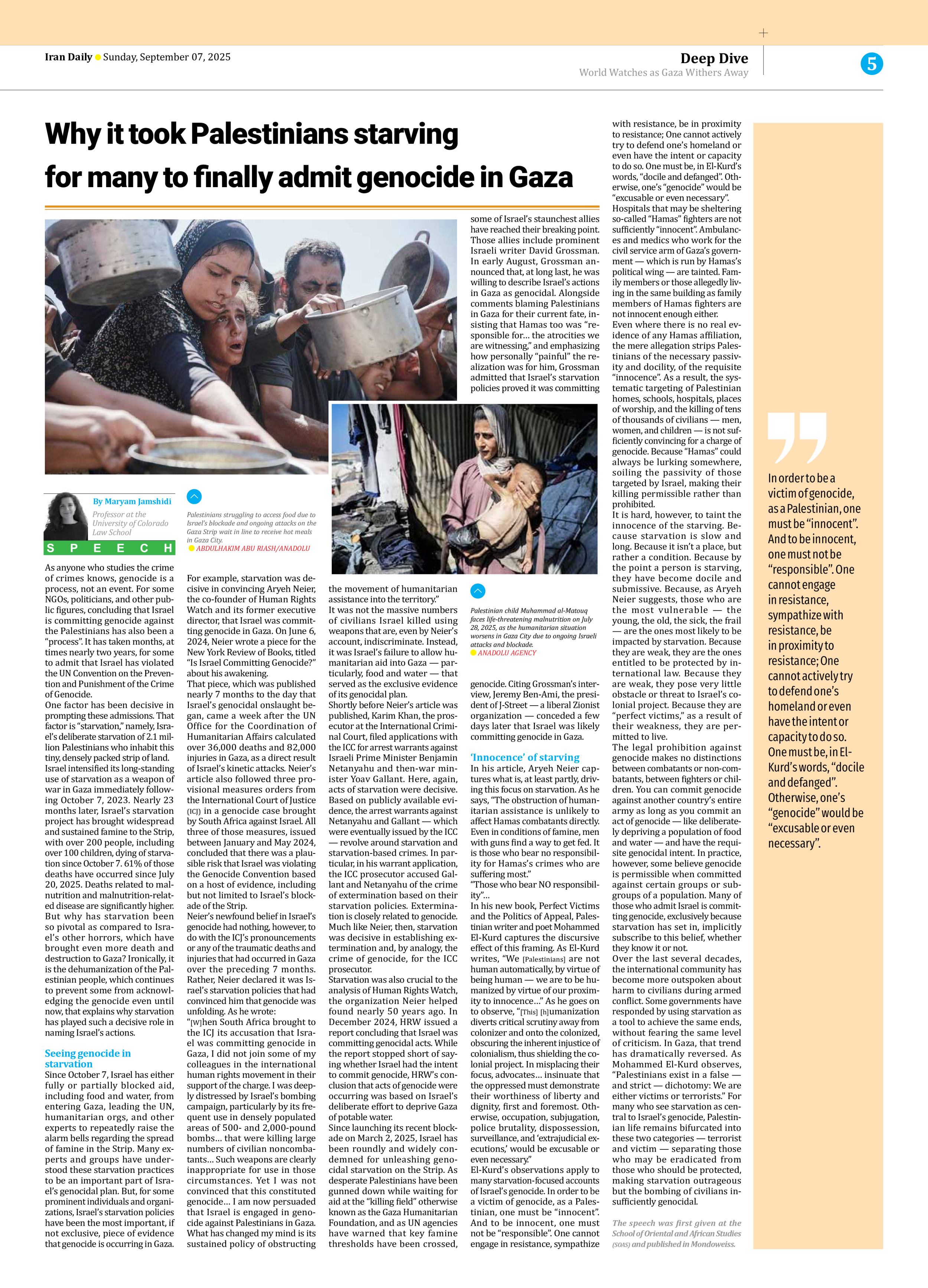
Israel intensified its long-standing use of starvation as a weapon of war in Gaza immediately following October 7, 2023. Nearly 23 months later, Israel’s starvation project has brought widespread and sustained famine to the Strip, with over 200 people, including over 100 children, dying of starvation since October 7. 61% of those deaths have occurred since July 20, 2025. Deaths related to malnutrition and malnutrition-related disease are significantly higher.
But why has starvation been so pivotal as compared to Israel’s other horrors, which have brought even more death and destruction to Gaza? Ironically, it is the dehumanization of the Palestinian people, which continues to prevent some from acknowledging the genocide even until now, that explains why starvation has played such a decisive role in naming Israel’s actions.
Seeing genocide in starvation
Since October 7, Israel has either fully or partially blocked aid, including food and water, from entering Gaza, leading the UN, humanitarian orgs, and other experts to repeatedly raise the alarm bells regarding the spread of famine in the Strip. Many experts and groups have understood these starvation practices to be an important part of Israel’s genocidal plan. But, for some prominent individuals and organizations, Israel’s starvation policies have been the most important, if not exclusive, piece of evidence that genocide is occurring in Gaza.
For example, starvation was decisive in convincing Aryeh Neier, the co-founder of Human Rights Watch and its former executive director, that Israel was committing genocide in Gaza. On June 6, 2024, Neier wrote a piece for the New York Review of Books, titled “Is Israel Committing Genocide?” about his awakening.
That piece, which was published nearly 7 months to the day that Israel’s genocidal onslaught began, came a week after the UN Office for the Coordination of Humanitarian Affairs calculated over 36,000 deaths and 82,000 injuries in Gaza, as a direct result of Israel’s kinetic attacks. Neier’s article also followed three provisional measures orders from the International Court of Justice (ICJ) in a genocide case brought by South Africa against Israel. All three of those measures, issued between January and May 2024, concluded that there was a plausible risk that Israel was violating the Genocide Convention based on a host of evidence, including but not limited to Israel’s blockade of the Strip.
Neier’s newfound belief in Israel’s genocide had nothing, however, to do with the ICJ’s pronouncements or any of the traumatic deaths and injuries that had occurred in Gaza over the preceding 7 months. Rather, Neier declared it was Israel’s starvation policies that had convinced him that genocide was unfolding. As he wrote:
“[W]hen South Africa brought to the ICJ its accusation that Israel was committing genocide in Gaza, I did not join some of my colleagues in the international human rights movement in their support of the charge. I was deeply distressed by Israel’s bombing campaign, particularly by its frequent use in densely populated areas of 500- and 2,000-pound bombs… that were killing large numbers of civilian noncombatants… Such weapons are clearly inappropriate for use in those circumstances. Yet I was not convinced that this constituted genocide… I am now persuaded that Israel is engaged in genocide against Palestinians in Gaza. What has changed my mind is its sustained policy of obstructing the movement of humanitarian assistance into the territory.”
It was not the massive numbers of civilians Israel killed using weapons that are, even by Neier’s account, indiscriminate. Instead, it was Israel’s failure to allow humanitarian aid into Gaza — particularly, food and water — that served as the exclusive evidence of its genocidal plan.
Shortly before Neier’s article was published, Karim Khan, the prosecutor at the International Criminal Court, filed applications with the ICC for arrest warrants against Israeli Prime Minister Benjamin Netanyahu and then-war minister Yoav Gallant. Here, again, acts of starvation were decisive. Based on publicly available evidence, the arrest warrants against Netanyahu and Gallant — which were eventually issued by the ICC — revolve around starvation and starvation-based crimes. In particular, in his warrant application, the ICC prosecutor accused Gallant and Netanyahu of the crime of extermination based on their starvation policies. Extermination is closely related to genocide. Much like Neier, then, starvation was decisive in establishing extermination and, by analogy, the crime of genocide, for the ICC prosecutor.
Starvation was also crucial to the analysis of Human Rights Watch, the organization Neier helped found nearly 50 years ago. In December 2024, HRW issued a report concluding that Israel was committing genocidal acts. While the report stopped short of saying whether Israel had the intent to commit genocide, HRW’s conclusion that acts of genocide were occurring was based on Israel’s deliberate effort to deprive Gaza of potable water.
Since launching its recent blockade on March 2, 2025, Israel has been roundly and widely condemned for unleashing genocidal starvation on the Strip. As desperate Palestinians have been gunned down while waiting for aid at the “killing field” otherwise known as the Gaza Humanitarian Foundation, and as UN agencies have warned that key famine thresholds have been crossed, some of Israel’s staunchest allies have reached their breaking point.
Those allies include prominent Israeli writer David Grossman. In early August, Grossman announced that, at long last, he was willing to describe Israel’s actions in Gaza as genocidal. Alongside comments blaming Palestinians in Gaza for their current fate, insisting that Hamas too was “responsible for… the atrocities we are witnessing,” and emphasizing how personally “painful” the realization was for him, Grossman admitted that Israel’s starvation policies proved it was committing genocide. Citing Grossman’s interview, Jeremy Ben-Ami, the president of J-Street — a liberal Zionist organization — conceded a few days later that Israel was likely committing genocide in Gaza.
‘Innocence’ of starving
In his article, Aryeh Neier captures what is, at least partly, driving this focus on starvation. As he says, “The obstruction of humanitarian assistance is unlikely to affect Hamas combatants directly. Even in conditions of famine, men with guns find a way to get fed. It is those who bear no responsibility for Hamas’s crimes who are suffering most.”
“Those who bear NO responsibility”…
In his new book, Perfect Victims and the Politics of Appeal, Palestinian writer and poet Mohammed El-Kurd captures the discursive effect of this framing. As El-Kurd writes, “We [Palestinians] are not human automatically, by virtue of being human — we are to be humanized by virtue of our proximity to innocence…” As he goes on to observe, “[This] [h]umanization diverts critical scrutiny away from colonizer and onto the colonized, obscuring the inherent injustice of colonialism, thus shielding the colonial project. In misplacing their focus, advocates… insinuate that the oppressed must demonstrate their worthiness of liberty and dignity, first and foremost. Otherwise, occupation, subjugation, police brutality, dispossession, surveillance, and ‘extrajudicial executions,’ would be excusable or even necessary.”
El-Kurd’s observations apply to many starvation-focused accounts of Israel’s genocide. In order to be a victim of genocide, as a Palestinian, one must be “innocent”. And to be innocent, one must not be “responsible”. One cannot engage in resistance, sympathize with resistance, be in proximity to resistance; One cannot actively try to defend one’s homeland or even have the intent or capacity to do so. One must be, in El-Kurd’s words, “docile and defanged”. Otherwise, one’s “genocide” would be “excusable or even necessary”.
Hospitals that may be sheltering so-called “Hamas” fighters are not sufficiently “innocent”. Ambulances and medics who work for the civil service arm of Gaza’s government — which is run by Hamas’s political wing — are tainted. Family members or those allegedly living in the same building as family members of Hamas fighters are not innocent enough either.
Even where there is no real evidence of any Hamas affiliation, the mere allegation strips Palestinians of the necessary passivity and docility, of the requisite “innocence”. As a result, the systematic targeting of Palestinian homes, schools, hospitals, places of worship, and the killing of tens of thousands of civilians — men, women, and children — is not sufficiently convincing for a charge of genocide. Because “Hamas” could always be lurking somewhere, soiling the passivity of those targeted by Israel, making their killing permissible rather than prohibited.
It is hard, however, to taint the innocence of the starving. Because starvation is slow and long. Because it isn’t a place, but rather a condition. Because by the point a person is starving, they have become docile and submissive. Because, as Aryeh Neier suggests, those who are the most vulnerable — the young, the old, the sick, the frail — are the ones most likely to be impacted by starvation. Because they are weak, they are the ones entitled to be protected by international law. Because they are weak, they pose very little obstacle or threat to Israel’s colonial project. Because they are “perfect victims,” as a result of their weakness, they are permitted to live.
The legal prohibition against genocide makes no distinctions between combatants or non-combatants, between fighters or children. You can commit genocide against another country’s entire army as long as you commit an act of genocide — like deliberately depriving a population of food and water — and have the requisite genocidal intent. In practice, however, some believe genocide is permissible when committed against certain groups or sub-groups of a population. Many of those who admit Israel is committing genocide, exclusively because starvation has set in, implicitly subscribe to this belief, whether they know it or not.
Over the last several decades, the international community has become more outspoken about harm to civilians during armed conflict. Some governments have responded by using starvation as a tool to achieve the same ends, without fearing the same level of criticism. In Gaza, that trend has dramatically reversed. As Mohammed El-Kurd observes, “Palestinians exist in a false — and strict — dichotomy: We are either victims or terrorists.” For many who see starvation as central to Israel’s genocide, Palestinian life remains bifurcated into these two categories — terrorist and victim — separating those who may be eradicated from those who should be protected, making starvation outrageous but the bombing of civilians insufficiently genocidal.
The speech was first given at the School of Oriental and African Studies (SOAS) and published in Mondoweiss.