







Tehran’s comprehensive diplomacy in first year
From crisis management to broadening new horizons
The first year of the Iranian Ministry of Foreign Affairs under the “national unity” government kicked off amid one of the most sensitive and critical phases in contemporary Iranian history; a time when the Zionist regime and the United States tried to carry out 12 days of attacks aiming to shake up the country’s security and stability. Under such circumstances, Iran’s diplomatic apparatus was handed a tough mission, including keeping a lid on the crisis, neutralizing the political and legal consequences of this aggression, and at the same time holding onto and building up the Islamic Republic of Iran’s standing on the international stage. This complex mission was shaped by a strategy based on “comprehensiveness, agility, and influence,” which ended up delivering significant achievements.
From confronting aggression to political, legal initiatives
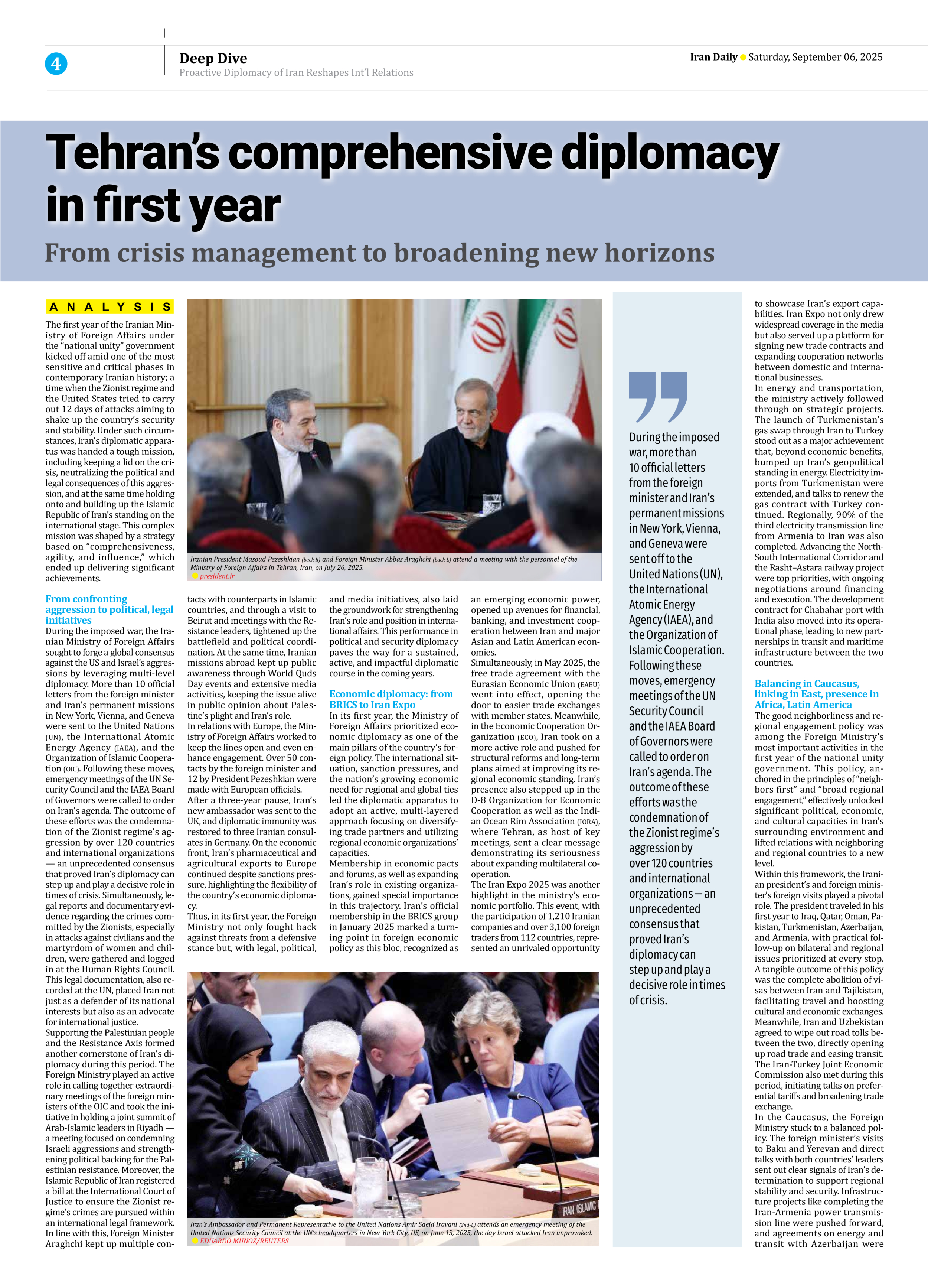
During the imposed war, the Iranian Ministry of Foreign Affairs sought to forge a global consensus against the US and Israel’s aggressions by leveraging multi-level diplomacy. More than 10 official letters from the foreign minister and Iran’s permanent missions in New York, Vienna, and Geneva were sent to the United Nations (UN), the International Atomic Energy Agency (IAEA), and the Organization of Islamic Cooperation (OIC). Following these moves, emergency meetings of the UN Security Council and the IAEA Board of Governors were called to order on Iran’s agenda. The outcome of these efforts was the condemnation of the Zionist regime’s aggression by over 120 countries and international organizations — an unprecedented consensus that proved Iran’s diplomacy can step up and play a decisive role in times of crisis. Simultaneously, legal reports and documentary evidence regarding the crimes committed by the Zionists, especially in attacks against civilians and the martyrdom of women and children, were gathered and logged in at the Human Rights Council. This legal documentation, also recorded at the UN, placed Iran not just as a defender of its national interests but also as an advocate for international justice.
Supporting the Palestinian people and the Resistance Axis formed another cornerstone of Iran’s diplomacy during this period. The Foreign Ministry played an active role in calling together extraordinary meetings of the foreign ministers of the OIC and took the initiative in holding a joint summit of Arab-Islamic leaders in Riyadh — a meeting focused on condemning Israeli aggressions and strengthening political backing for the Palestinian resistance. Moreover, the Islamic Republic of Iran registered a bill at the International Court of Justice to ensure the Zionist regime’s crimes are pursued within an international legal framework. In line with this, Foreign Minister Araghchi kept up multiple contacts with counterparts in Islamic countries, and through a visit to Beirut and meetings with the Resistance leaders, tightened up the battlefield and political coordination. At the same time, Iranian missions abroad kept up public awareness through World Quds Day events and extensive media activities, keeping the issue alive in public opinion about Palestine’s plight and Iran’s role.
In relations with Europe, the Ministry of Foreign Affairs worked to keep the lines open and even enhance engagement. Over 50 contacts by the foreign minister and 12 by President Pezeshkian were made with European officials.
After a three-year pause, Iran’s new ambassador was sent to the UK, and diplomatic immunity was restored to three Iranian consulates in Germany. On the economic front, Iran’s pharmaceutical and agricultural exports to Europe continued despite sanctions pressure, highlighting the flexibility of the country’s economic diplomacy.
Thus, in its first year, the Foreign Ministry not only fought back against threats from a defensive stance but, with legal, political, and media initiatives, also laid the groundwork for strengthening Iran’s role and position in international affairs. This performance in political and security diplomacy paves the way for a sustained, active, and impactful diplomatic course in the coming years.
Economic diplomacy: from BRICS to Iran Expo
In its first year, the Ministry of Foreign Affairs prioritized economic diplomacy as one of the main pillars of the country’s foreign policy. The international situation, sanction pressures, and the nation’s growing economic need for regional and global ties led the diplomatic apparatus to adopt an active, multi-layered approach focusing on diversifying trade partners and utilizing regional economic organizations’ capacities.
Membership in economic pacts and forums, as well as expanding Iran’s role in existing organizations, gained special importance in this trajectory. Iran’s official membership in the BRICS group in January 2025 marked a turning point in foreign economic policy as this bloc, recognized as an emerging economic power, opened up avenues for financial, banking, and investment cooperation between Iran and major Asian and Latin American economies.
Simultaneously, in May 2025, the free trade agreement with the Eurasian Economic Union (EAEU) went into effect, opening the door to easier trade exchanges with member states. Meanwhile, in the Economic Cooperation Organization (ECO), Iran took on a more active role and pushed for structural reforms and long-term plans aimed at improving its regional economic standing. Iran’s presence also stepped up in the D-8 Organization for Economic Cooperation as well as the Indian Ocean Rim Association (IORA), where Tehran, as host of key meetings, sent a clear message demonstrating its seriousness about expanding multilateral cooperation.
The Iran Expo 2025 was another highlight in the ministry’s economic portfolio. This event, with the participation of 1,210 Iranian companies and over 3,100 foreign traders from 112 countries, represented an unrivaled opportunity to showcase Iran’s export capabilities. Iran Expo not only drew widespread coverage in the media but also served up a platform for signing new trade contracts and expanding cooperation networks between domestic and international businesses.
In energy and transportation, the ministry actively followed through on strategic projects. The launch of Turkmenistan’s gas swap through Iran to Turkey stood out as a major achievement that, beyond economic benefits, bumped up Iran’s geopolitical standing in energy. Electricity imports from Turkmenistan were extended, and talks to renew the gas contract with Turkey continued. Regionally, 90% of the third electricity transmission line from Armenia to Iran was also completed. Advancing the North-South International Corridor and the Rasht–Astara railway project were top priorities, with ongoing negotiations around financing and execution. The development contract for Chabahar port with India also moved into its operational phase, leading to new partnerships in transit and maritime infrastructure between the two countries.
Balancing in Caucasus, linking in East, presence in Africa, Latin America
The good neighborliness and regional engagement policy was among the Foreign Ministry’s most important activities in the first year of the national unity government. This policy, anchored in the principles of “neighbors first” and “broad regional engagement,” effectively unlocked significant political, economic, and cultural capacities in Iran’s surrounding environment and lifted relations with neighboring and regional countries to a new level.
Within this framework, the Iranian president’s and foreign minister’s foreign visits played a pivotal role. The president traveled in his first year to Iraq, Qatar, Oman, Pakistan, Turkmenistan, Azerbaijan, and Armenia, with practical follow-up on bilateral and regional issues prioritized at every stop. A tangible outcome of this policy was the complete abolition of visas between Iran and Tajikistan, facilitating travel and boosting cultural and economic exchanges. Meanwhile, Iran and Uzbekistan agreed to wipe out road tolls between the two, directly opening up road trade and easing transit. The Iran-Turkey Joint Economic Commission also met during this period, initiating talks on preferential tariffs and broadening trade exchange.
In the Caucasus, the Foreign Ministry stuck to a balanced policy. The foreign minister’s visits to Baku and Yerevan and direct talks with both countries’ leaders sent out clear signals of Iran’s determination to support regional stability and security. Infrastructure projects like completing the Iran-Armenia power transmission line were pushed forward, and agreements on energy and transit with Azerbaijan were signed off on. In Central Asia, beyond economic engagements with Turkmenistan and Uzbekistan, ties with Kazakhstan, Kyrgyzstan, and Tajikistan spread out through bilateral and regional meetings.
Engagement with regional powers was also a key pillar of regional policy. In January 2025, the Comprehensive Strategic Partnership Treaty between Iran and Russia was signed; a treaty covering diverse economic, military, and political dimensions, marking a significant upgrade in Tehran-Moscow relations. Moreover, a monetary agreement and banking network connection between the two countries were implemented, laying the groundwork for reducing reliance on the dollar and euro. Iran’s cooperation with China also picked up steam, with Iran, Russia, and China jointly issuing a statement in support of Iran’s nuclear rights — an action that strengthened Iran’s standing within the Eastern bloc. The development contract for Chabahar port with India was also formally put into play, opening up a new route for Iran to connect with South Asian markets.
In East Asia and Oceania, the Ministry of Foreign Affairs kept up an active policy. Political consultation meetings were held with Japan, South Korea, Australia, Malaysia, Thailand, and other countries, creating fertile ground for new cooperation in agriculture and technology with China and the Philippines. Iran’s defense industries’ presence at military exhibitions in Indonesia, Malaysia, and Vietnam not only showcased Iran’s capabilities but also deepened defense and security ties with regional countries.
Africa secured a special place in Iran’s foreign policy. The third Iran-Africa Economic Cooperation Conference was convened in Tehran in the past year, attended by representatives from 31 African countries. Agreements were hammered out in medicine, pharmaceuticals, agriculture, and telecommunications between Iran and African nations. The foreign minister’s and president’s visits to Egypt and the beginning of the normalization process with Cairo marked a historic milestone, signaling a new chapter in Tehran-Cairo relations after decades of severed ties.
In Latin America, Iranian diplomacy was also in full swing. Cooperation with Venezuela expanded in the fields of medicine, energy, and information technology, while new joint projects kicked off. Iran’s defense industries also made their mark at Brazil’s military exhibition, showcasing domestic defense products and technologies. This presence, especially on a continent where Iran has long sought to build up relations, was a sign of Tehran’s fresh approach to expanding interregional cooperation.
Taken together, these initiatives demonstrated that the good neighborliness and regional policy of the national unity government went beyond mere slogans and translated into tangible achievements across diplomacy, economy, energy, culture, and security. Iran managed to patch up relations with neighboring countries, boost strategic partnerships with emerging powers, and cement its foothold on other continents such as Africa and Latin America. These achievements illustrate that the diplomatic apparatus has been able to push foreign policy beyond geographic borders limited to Iran’s immediate neighborhood and paint a new picture of the country as an active, balanced, and forward-thinking player in regional and international arenas.
Public, cultural, and think-tank diplomacies
Another major thread of foreign policy in the first year of the national unity government was strengthening public, cultural, and think-tank diplomacies. The Ministry of Foreign Affairs was well aware that in today’s world, international relations are not just played out at the official government-to-government level, but public opinion, academic elites, media, and cultural institutions also hold sway in international equations. Accordingly, the diplomatic apparatus sought to boost Iran’s narrative regarding regional and global developments by using cultural and “soft” tools, alongside official policymaking, to deploy face-to-face and public diplomacy.
In the media domain, the ministry kept up weekly spokesperson briefings, issued numerous statements and press releases, and produced multimedia content aiming to get across Iran’s stance clearly and transparently worldwide. Exclusive interviews with the Iranian foreign minister and ambassadors in international media, especially during the imposed 12-day war, formed part of this strategy that largely helped to set the record straight against distorted enemy narratives.
On the cultural front, the ministry focused sharply on expanding Iranian studies and the Persian language worldwide. Supporting Persian language chairs in universities, strengthening Iranology centers, and sending professors and researchers abroad were part of these efforts. Moreover, over 30 Iranian Film Weeks and 60 cultural exhibitions were held across various countries, showcasing Iranian art, cinema, handicrafts, and literature. Cooperation with friendship associations and signing sister-city agreements between Iranian cities and foreign counterparts also added another dimension to cultural bonds. Alongside these activities, international Qur’an competitions, Islamic Unity Conferences, and interfaith meetings with Muslim and non-Muslim scholars were lined up, receiving wide attention in host countries. Together, these efforts both bolstered Iran’s cultural identity and improved the country’s image in global public opinion.
Sports diplomacy was also put on the agenda, with Iranian sports teams sent off to various countries and friendly matches organized to capitalize on sports as a tool for cohesion and cultural exchange. Likewise, Iranian Cultural Weeks in Asian, African, and European countries — featuring music and performing arts — laid out the country’s rich cultural diversity more prominently on the international stage.
In the think-tank sphere, the ministry sought to build up systematic and constructive engagement with international elites and researchers. Organizing the Tehran Dialogue Forum was among the most important initiatives in this area. This event, bringing together 250 foreign delegations and 20 foreign ministers and senior officials from various countries, turned into a venue for discussion and exchange on major regional and global issues, demonstrating that Iran can be not only a diplomatic host but also a hub for think-tank and expert dialogues. In this vein, Track II meetings between diplomats, academics, and specialists were also held, helping to bridge gaps in mutual understanding and open up informal cooperation channels.
Moreover, reviving the ministry’s School of International Relations under the new conditions was a key step in training skilled human resources. After several years of hiatus, permission to enroll students for the 2025–2026 academic year was given, and new programs to train a new generation of diplomats were mapped out. Hence, the Foreign Ministry was not only active in operational foreign policy but also invested in academic and research fields to strengthen the intellectual and human foundations of Iranian diplomacy’s future.
All in all, these measures revealed that Iran’s diplomatic apparatus in the first year of the national unity government clearly grasped the fact that foreign policy is not confined to hard politics and official dealings; Soft and cultural tools also play a vital role in shaping Iran’s standing. Consequently, strengthening public, cultural, and think-tank diplomacy became an inseparable part of Iran’s foreign policy — one that could, in the long run, beef up the Islamic Republic’s soft power and solidify its place in the global community.
People’s diplomacy: from Parliament to Iranians abroad
One major dimension of the ministry’s activities in the first year was expanding interaction with the Parliament and providing effective services to Iranians living abroad. The Foreign Ministry picked up on the fact that to succeed in foreign policy, close coordination with the legislative body and effective support for the large diaspora community are vital. Accordingly, various initiatives in parliamentary diplomacy, consular affairs, and support services were put in motion.
In parliamentary diplomacy, cooperation between the Foreign Ministry and Parliament stepped up, with the ministry playing an active role in planning and coordinating MPs’ foreign trips. Over 120 parliamentary delegations were dispatched abroad with the ministry’s coordination during the year, and representatives participated in international parliamentary assemblies such as the Inter-Parliamentary Union and regional forums.
At the same time, the ministry rolled out a fresh policy for supporting Iranians abroad. New supportive regulations were approved and implemented, return facilitation for nationals during the imposed 12-day war was carried out, and opportunities for direct meetings between expatriates and senior officials were created. The launch of the “Porsesh” (in Persian: Question) website also offered up a new channel for Iranians abroad to directly raise issues and concerns and receive prompt, official responses.
Practically, freeing Iranian prisoners in countries like Thailand and Malaysia was among the standout achievements of this year, made possible by the persistent efforts of Iranian missions and the diplomatic apparatus. Also, health insurance for foreign nationals was put into operation, representing a significant step toward organizing migrant affairs and easing consular challenges.
In consular services, the Foreign Ministry worked to speed up and simplify services for Iranians abroad. Increasing the number of centers issuing smart national ID cards to 49 Iranian missions overseas was part of this policy, making it easier for expatriates to access identity services. Furthermore, passport issuance, certificates, and official document processes were sped up, and electronic infrastructure in missions was expanded — measures warmly welcomed by Iranians living abroad.
These efforts showed that the diplomatic apparatus fully understood the vital role of Iranians abroad. The large diaspora community worldwide is not only a part of the country’s human and economic capital but also plays an undeniable role in public diplomacy and Iran’s international image. For this reason, the Ministry of Foreign Affairs sought in its first year not only to iron out everyday issues for this community but also to tighten their ties with the homeland.
In short, alongside official government diplomacy, parliamentary and consular diplomacy became a key part of Iran’s foreign policy. Extensive coordination with Parliament and special attention to Iranians abroad demonstrated that the national unity government’s foreign policy adopts a comprehensive view of national power, seeing diplomacy not just as a tool for government-to-government engagement but as a means to lock in the Iranian community both inside and outside the country.
Looking back on past 12 months
A review of the Ministry of Foreign Affairs’ performance in the first year of the Pezeshkian government shows that it has been able to make headway on multiple critical fronts simultaneously. Politically and security-wise, Iranian diplomacy successfully rounded up global consensus against the June aggression by the Zionist regime and the US, and seriously backed the Resistance Axis and the Palestinian people. Economically, joining international pacts, holding joint commissions, and hosting major economic exhibitions turned diplomacy into a tool for economic growth and expanded regional ties. In neighborhood and regional policies, Iran, by adopting a balanced and active approach, enhanced relations with neighbors and emerging powers and cemented its position across Asia, Africa, and Latin America. In public and cultural diplomacy, leveraging soft, cultural, media, and think-tank instruments, Iran rolled out a fresh image in global public opinion. Meanwhile, attention to Iranians abroad, development of consular services, and expansion of parliamentary diplomacy reflected a holistic view of national power, tying foreign policy closely with the Iranian community both at home and abroad.
Ultimately, in its first year, the Ministry of Foreign Affairs was able to turn around Iran’s foreign policy amid security crises and sanction pressures, setting it on a path of dynamism and impact. Although many of these achievements require continuation and completion in the coming years, they have undoubtedly laid down new foundations for raising the Islamic Republic’s standing in the international arena. Accordingly, it can be said that the diplomatic apparatus not only got through serious challenges but also carved out new opportunities for Iran’s foreign policy future.
The full article first appeared in
Persian on IRNA.