







Saudis view relations with Iran as ‘strategic, essential’: Ambassador
The Islamic Republic of Iran and the Kingdom of Saudi Arabia have been on different paths in their relationship over the last two years or so. Before October 7, 2023 — when the Zionist regime started attacking the Gaza Strip and subsequently escalated acts of aggression against Lebanon and Syria, culminating in the 12-day war between Israel, the US, and Iran — Tehran and Riyadh were working hard to patch up their ties with a focus on bilateral issues. Over the last year, broader issues such as the fate of Palestine, the dangerous plans of the Zionist regime for West Asia, fears of the tensions spilling over, and the region getting stuck in a quagmire of military and security crises have become new driving forces for cooperation between the two sides. How far can the scope of cooperation between Tehran and Riyadh be stretched under current conditions? Does the rapprochement we witness today have enough staying power to continue? These questions were put forward to Alireza Enayati, ambassador of the Islamic Republic of Iran to Saudi Arabia, in an interview:
Tehran-Riyadh
security talks ongoing
Two or three months ago, you confirmed that Tehran and Riyadh have set out on a new track of relationship; an experience that seeks to pull this relationship out of prior stagnation. Exactly which areas does this new phase and this fresh chapter cover?
ENAYATI: It has been about two years since the start of the new phase of relations between Iran and Saudi Arabia. This relationship took shape in March 2023, and by late September of that year, the ambassadors of both countries headed off to their new posts simultaneously. I arrived in Riyadh in the morning, and Mr. Al-Anzi, my esteemed counterpart, checked in in Tehran in the afternoon.
Since then, we have kicked off cooperation in multiple fields and have expanded and deepened the relationship; notably in continuous political and international dialogues across various arenas, especially on the issue of Palestine, which took on special conditions after the October 7 event. These consultations between Iran and Saudi Arabia have persisted consistently in support of and defending the rights of the Palestinian people. Consequently, several meetings of the Organization of Islamic Cooperation, called for by Iran, were held, receiving full backing from the Saudis, enabling a series of meetings at the level of leaders, foreign ministers, and executive committees.
These meetings stem from the new type of Iran-Saudi relationship, and the consultations have gone beyond just formal meetings. They included numerous phone calls and meetings between high-ranking officials of the two countries. The late president Raisi, the late foreign minister Amir-Abdollahian, the First Vice President Aref, and the current Foreign Minister Araghchi all visited Saudi Arabia; In every one of these five meetings, joint sessions were held with Mohammed bin Salman, the crown prince of Saudi Arabia. These sessions covered a broad range of bilateral, regional, Islamic world, and international issues.
Therefore, over two years, frequent contacts have been carried out between the last two presidents of Iran and Mohammed bin Salman. All these areas have been unlocked under the revival of Iran-Saudi relations.
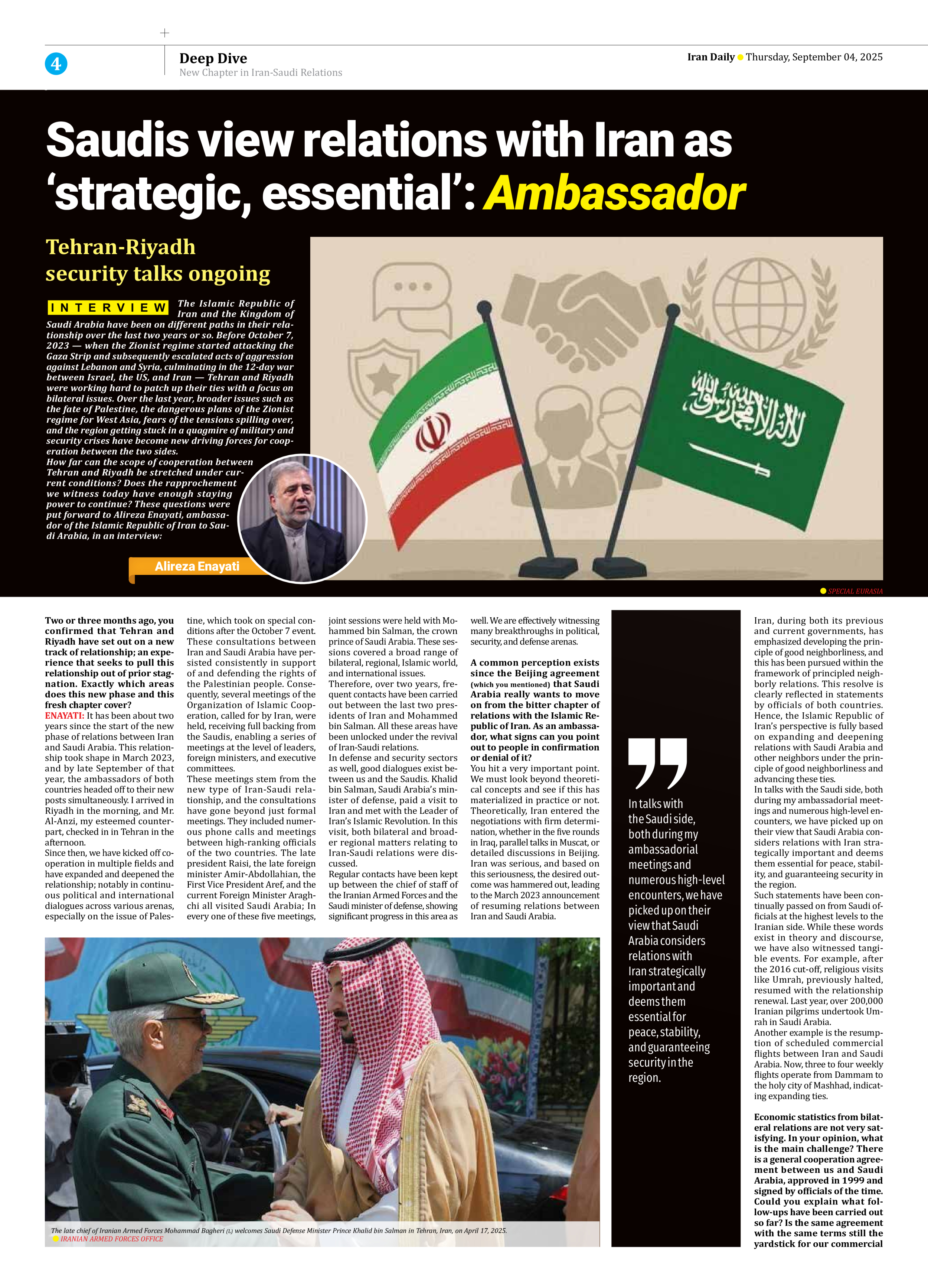
In defense and security sectors as well, good dialogues exist between us and the Saudis. Khalid bin Salman, Saudi Arabia’s minister of defense, paid a visit to Iran and met with the Leader of Iran’s Islamic Revolution. In this visit, both bilateral and broader regional matters relating to Iran-Saudi relations were discussed.
Regular contacts have been kept up between the chief of staff of the Iranian Armed Forces and the Saudi minister of defense, showing significant progress in this area as well. We are effectively witnessing many breakthroughs in political, security, and defense arenas.
A common perception exists since the Beijing agreement (which you mentioned) that Saudi Arabia really wants to move on from the bitter chapter of relations with the Islamic Republic of Iran. As an ambassador, what signs can you point out to people in confirmation or denial of it?
You hit a very important point. We must look beyond theoretical concepts and see if this has materialized in practice or not. Theoretically, Iran entered the negotiations with firm determination, whether in the five rounds in Iraq, parallel talks in Muscat, or detailed discussions in Beijing. Iran was serious, and based on this seriousness, the desired outcome was hammered out, leading to the March 2023 announcement of resuming relations between Iran and Saudi Arabia.
Iran, during both its previous and current governments, has emphasized developing the principle of good neighborliness, and this has been pursued within the framework of principled neighborly relations. This resolve is clearly reflected in statements by officials of both countries. Hence, the Islamic Republic of Iran’s perspective is fully based on expanding and deepening relations with Saudi Arabia and other neighbors under the principle of good neighborliness and advancing these ties.
In talks with the Saudi side, both during my ambassadorial meetings and numerous high-level encounters, we have picked up on their view that Saudi Arabia considers relations with Iran strategically important and deems them essential for peace, stability, and guaranteeing security in the region.
Such statements have been continually passed on from Saudi officials at the highest levels to the Iranian side. While these words exist in theory and discourse, we have also witnessed tangible events. For example, after the 2016 cut-off, religious visits like Umrah, previously halted, resumed with the relationship renewal. Last year, over 200,000 Iranian pilgrims undertook Umrah in Saudi Arabia.
Another example is the resumption of scheduled commercial flights between Iran and Saudi Arabia. Now, three to four weekly flights operate from Dammam to the holy city of Mashhad, indicating expanding ties.
Economic statistics from bilateral relations are not very satisfying. In your opinion, what is the main challenge? There is a general cooperation agreement between us and Saudi Arabia, approved in 1999 and signed by officials of the time. Could you explain what follow-ups have been carried out so far? Is the same agreement with the same terms still the yardstick for our commercial and economic work? And fundamentally, what programs does the Islamic Republic of Iran have to boost economic and commercial relations with Riyadh?
I mentioned some areas in terms of developing relations, but in the economic and commercial sectors, cooperation indicators have not taken off noticeably. Despite all the talks and efforts that have been made, we cannot yet talk about a significant trade volume between Iran and Saudi Arabia. This does not mean efforts have ground to a halt; Rather, boosting the economic ties is time-consuming, and its fruits take time to show up.
Nonetheless, over the past two years, several economic and commercial measures have been rolled out. Many visits by Iranian officials to Saudi Arabia have taken place within international summits, and meetings with Saudi ministers of economy, finance, investment, and commerce have taken place, all emphasizing developing economic relations. This shows that the Saudi side also has this matter on its agenda, but execution requires time, and we hope it pays off soon.
Are sanctions one of the main obstacles, or are there other obstacles at play as well?
Let me pick up from the previous question by saying that the agreement to avoid double taxation between Iran and Saudi Arabia has been initialed, and we hope it will be signed soon. Also, drafts of documents concerning mutual investment protection, customs cooperation, and road transport have been put forward by Iran to Saudi Arabia. This shows that serious steps have been taken on the economic front, but tangible results have yet to come through as we expect.
Could you shed some light on the issue of sanctions?
Yes, sanctions are indeed one of the challenges, but in our talks with our Saudi brothers, we have stressed that not all economic activities of Iran with other countries fall under sanctions. Some parts may be subject to sanctions, but the entire economic apparatus is not held back. Iran has commercial cooperation exceeding €20 billion with many countries in the region and beyond.
Is this figure applicable to current conditions?
Yes, this volume of cooperation with neighboring countries exists under current circumstances, indicating there are areas where sanctions can be sidestepped and cooperation expanded. Efforts in this regard are underway. In Dr. Araghchi’s recent trip to Saudi Arabia and meeting with the crown prince, regional as well as economic and commercial issues were brought up, with emphasis on gearing up these areas. We hope these discussions will soon yield tangible outcomes so that the economic and commercial sectors can keep pace with political, security, defense, cultural, and scientific fields.
Saudi Arabia has now opened scholarships for Iranian students, and at least three Iranian students have been officially taken in at the King Fahd University of Petroleum and Minerals, where they are currently studying. This matter was also raised and emphasized during the visit of the Iranian minister of education to Saudi Arabia.
Therefore, multiple branches of Iran-Saudi relations exist that we hope will bear fruit, benefiting Iran, Saudi Arabia, and other countries in the region.
Back in 2015, during the JCPOA era, certain behaviors from Saudi officials were perceived as opposition to the deal. Now that efforts to revive the JCPOA or a similar agreement are in progress, Saudi Arabia seems to have come around to accepting it. As the ambassador, do media speculations that Saudi Arabia is willing to host indirect talks between Iran and the US hold water? Have you been offered any proposal? And what is Saudi Arabia’s stance on de-escalation between Iran and the US at this juncture?
Saudi Arabia, according to its officials, advances its policies with a priority on preserving peace, stability, and calm in the region and strives to cool down regional tensions and keep things peaceful. My impression is that Saudi priorities right now are maintaining calm, peace, and regional stability. On this basis, we have seen Saudi backing of Iran’s recent nuclear talks.
Has any proposal for hosting indirect talks been put on the table by Saudi Arabia? Because several countries have been floated as options.
If I say I’m not aware, please chalk it up to a lack of information on my part.
Discussions in the last few months during indirect Iran-US talks have focused on forming a regional nuclear consortium. While this idea was still very raw — and of course, the Israeli and US aggression that took place has pushed this issue to the sidelines — do you think there is a basis for cooperation on peaceful nuclear energy between Iran and Saudi Arabia?
Well, I believe this is a fully technical matter and my answer cannot cover all its dimensions, but in brief, it is as you described — a kind of cooperation within a consortium framework. Under what conditions it will be is for experts in the field to say. Yet, another very positive point comes into play, which makes collaboration possible: the idea of a Middle East free of weapons of mass destruction.
This idea was put forward by Iran before the Islamic Revolution, then Egypt joined in, and it has since appeared as a guideline in regional cooperation. Recently, Iran has reiterated this idea. It could foster regional cooperation in the area of opposition to weapons of mass destruction in West Asia in general, not just the Persian Gulf — meaning the circle is broader. It could also discipline unfounded fears about Iran’s nuclear program by emphasizing this proposal or initiative in the region and through regional collaborations. I think there is room for cooperation here as well.
Is the idea you mentioned currently being actively discussed between Iran and Saudi Arabia? Are there ongoing consultations?
Specifically, no; thoroughly, no. But as a concept, it is indeed on the table. However, Iran and Saudi Arabia have not yet sat down to hammer out details on this topic.
Following the Israeli and US aggression, different reactions emerged from the region and beyond. Some reactions were disappointing, others hopeful signs of better days ahead. You were in Riyadh at the time — how would you describe Saudi Arabia’s response to the aggression? And as a closing note, could you share a memory from those 12 days and Saudi Arabia’s approach at that time?
The first contact was made by the Saudi foreign minister with his counterpart, Dr. Araghchi, extending condolences and sympathy and expressing support for Iran.
On the morning of the aggression, Jassim Al Budaiwi called me and said they sympathize and condemn the attack, and they were waiting to touch base with Dr. Araghchi to personally offer condolences and issue a statement.
Saudi Arabia immediately put out a very strong statement that explicitly used the word “aggression,” not just “targeting”. Staunch words like “strong condemnation” and “denunciation” were used.
Later, the crown prince held a phone call with Dr. Pezeshkian, followed by a detailed statement by the Ministry of Foreign Affairs. When the Americans attacked Iran, the Saudis again issued a statement condemning it. Officially and through their declarations, Saudi Arabia went all in condemning the aggression. Afterwards, the Cooperation Council and the Organization of Islamic Cooperation, headquartered in Saudi Arabia, also rolled out statements condemning this aggression.
Saudi domestic media regarded Israel’s attack on Iran as a continuation of the 1948, 1956, and 1973 aggressions, stressing Israel’s aggressive nature.
In private Saudi TV networks, which tried to remain balanced and respect both sides’ views, this stance was also evident. I conducted interviews with several private Arab networks, and the defense of Iran and condemnation of the Zionist regime were fully covered.
I think on the ground, with the strength and initiative of our armed forces, commander-in-chief, army, and IRGC, we were able to put the enemy in its place. In the regional media arena, Iran’s action was regarded as legitimate defense, and Saudi media and officials took positive stands defending the Iranian people and condemning the aggression. This was an important milestone in bilateral relations.
Apart from the official position, was there any effort by Saudi Arabia to call off the aggression, given its ties to the United States?
I believe such efforts were probably made behind the scenes.
The full interview first appeared
in Persian on IRNA.