







Copy in clipboard...
US rules, conditions blocking Iran nuclear talks: Gov’t spox
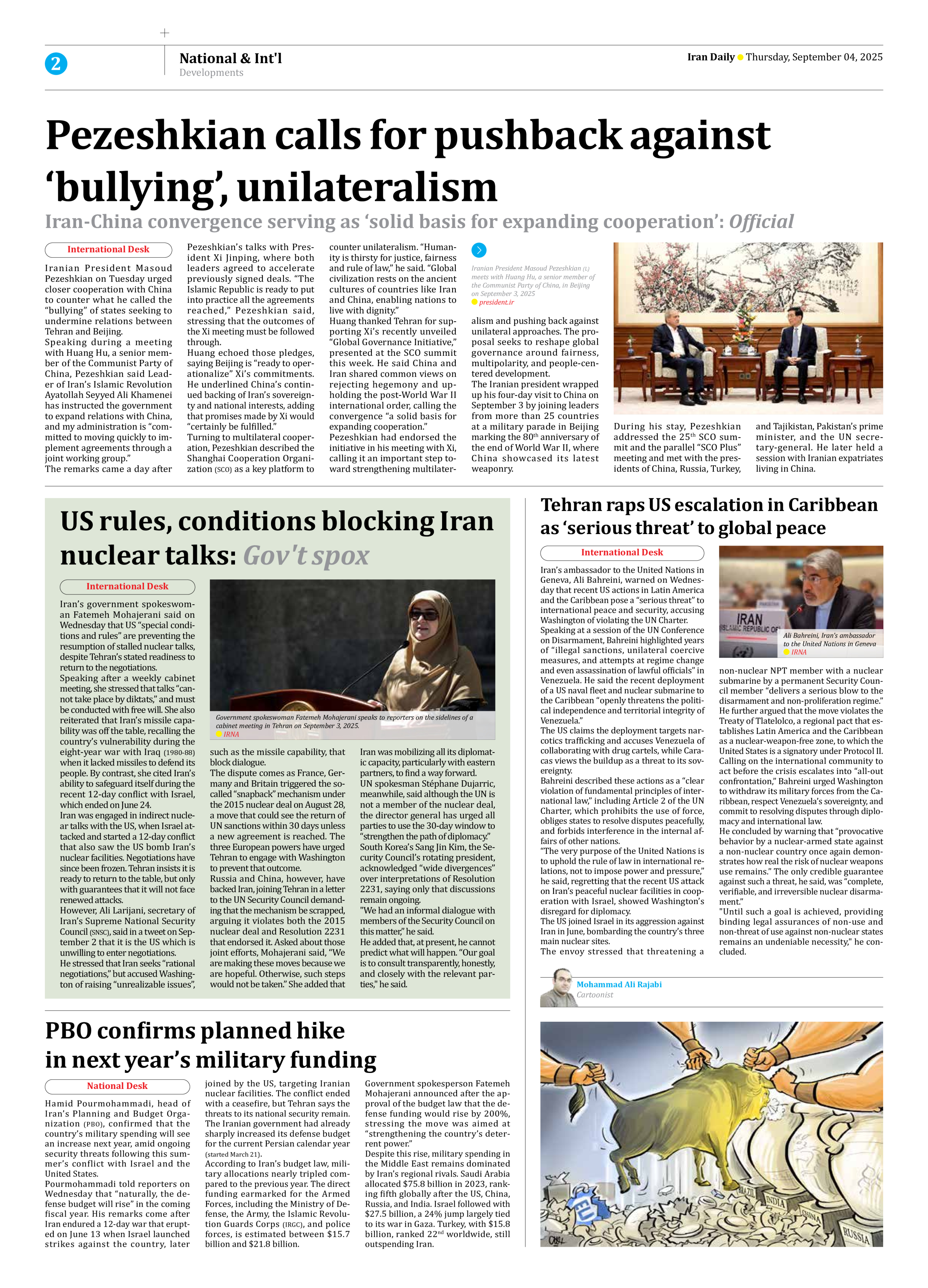
Iran’s government spokeswoman Fatemeh Mohajerani said on Wednesday that US “special conditions and rules” are preventing the resumption of stalled nuclear talks, despite Tehran’s stated readiness to return to the negotiations.
Speaking after a weekly cabinet meeting, she stressed that talks “cannot take place by diktats,” and must be conducted with free will. She also reiterated that Iran’s missile capability was off the table, recalling the country’s vulnerability during the eight-year war with Iraq (1980-88) when it lacked missiles to defend its people. By contrast, she cited Iran’s ability to safeguard itself during the recent 12-day conflict with Israel, which ended on June 24.
Iran was engaged in indirect nuclear talks with the US, when Israel attacked and started a 12-day conflict that also saw the US bomb Iran’s nuclear facilities. Negotiations have since been frozen. Tehran insists it is ready to return to the table, but only with guarantees that it will not face renewed attacks.
However, Ali Larijani, secretary of Iran’s Supreme National Security Council (SNSC), said in a tweet on September 2 that it is the US which is unwilling to enter negotiations.
He stressed that Iran seeks “rational negotiations,” but accused Washington of raising “unrealizable issues”, such as the missile capability, that block dialogue.
The dispute comes as France, Germany and Britain triggered the so-called “snapback” mechanism under the 2015 nuclear deal on August 28, a move that could see the return of UN sanctions within 30 days unless a new agreement is reached. The three European powers have urged Tehran to engage with Washington to prevent that outcome.
Russia and China, however, have backed Iran, joining Tehran in a letter to the UN Security Council demanding that the mechanism be scrapped, arguing it violates both the 2015 nuclear deal and Resolution 2231 that endorsed it. Asked about those joint efforts, Mohajerani said, “We are making these moves because we are hopeful. Otherwise, such steps would not be taken.” She added that Iran was mobilizing all its diplomatic capacity, particularly with eastern partners, to find a way forward.
UN spokesman Stéphane Dujarric, meanwhile, said although the UN is not a member of the nuclear deal, the director general has urged all parties to use the 30-day window to “strengthen the path of diplomacy.”
South Korea’s Sang Jin Kim, the Security Council’s rotating president, acknowledged “wide divergences” over interpretations of Resolution 2231, saying only that discussions remain ongoing.
"We had an informal dialogue with members of the Security Council on this matter,” he said.
He added that, at present, he cannot predict what will happen. “Our goal is to consult transparently, honestly, and closely with the relevant parties," he said.