







18th youth music festival kicks off
Minister calls festival, bridge between ‘ancient heritage, new creations’
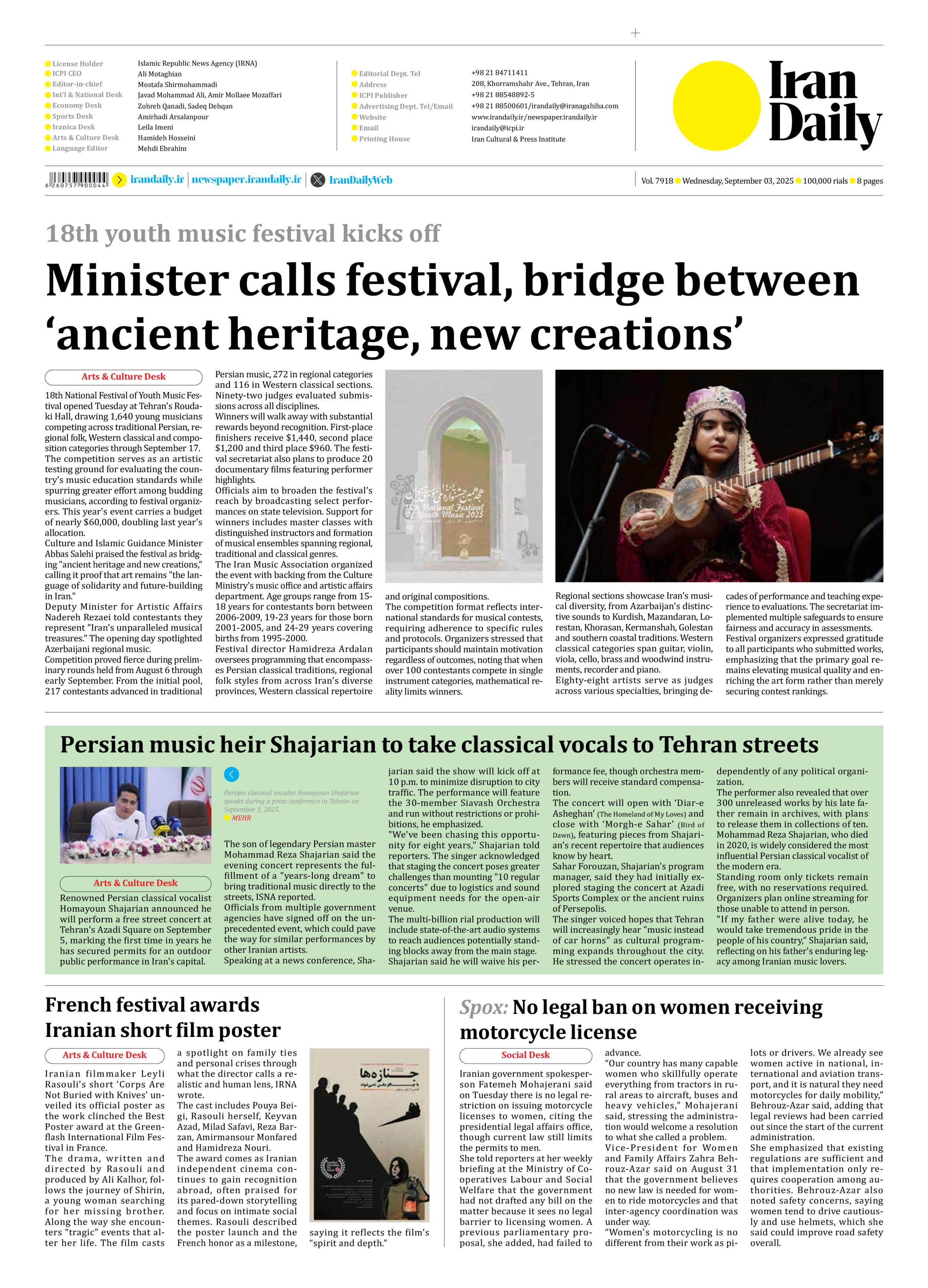
18th National Festival of Youth Music Festival opened Tuesday at Tehran's Roudaki Hall, drawing 1,640 young musicians competing across traditional Persian, regional folk, Western classical and composition categories through September 17.
The competition serves as an artistic testing ground for evaluating the country's music education standards while spurring greater effort among budding musicians, according to festival organizers. This year's event carries a budget of nearly $60,000, doubling last year's allocation.
Culture and Islamic Guidance Minister Abbas Salehi praised the festival as bridging "ancient heritage and new creations," calling it proof that art remains "the language of solidarity and future-building in Iran."
Deputy Minister for Artistic Affairs Nadereh Rezaei told contestants they represent "Iran's unparalleled musical treasures." The opening day spotlighted Azerbaijani regional music.
Competition proved fierce during preliminary rounds held from August 6 through early September. From the initial pool, 217 contestants advanced in traditional Persian music, 272 in regional categories and 116 in Western classical sections. Ninety-two judges evaluated submissions across all disciplines.
Winners will walk away with substantial rewards beyond recognition. First-place finishers receive $1,440, second place $1,200 and third place $960. The festival secretariat also plans to produce 20 documentary films featuring performer highlights.
Officials aim to broaden the festival's reach by broadcasting select performances on state television. Support for winners includes master classes with distinguished instructors and formation of musical ensembles spanning regional, traditional and classical genres.
The Iran Music Association organized the event with backing from the Culture Ministry's music office and artistic affairs department. Age groups range from 15-18 years for contestants born between 2006-2009, 19-23 years for those born 2001-2005, and 24-29 years covering births from 1995-2000.
Festival director Hamidreza Ardalan oversees programming that encompasses Persian classical traditions, regional folk styles from across Iran's diverse provinces, Western classical repertoire and original compositions.
The competition format reflects international standards for musical contests, requiring adherence to specific rules and protocols. Organizers stressed that participants should maintain motivation regardless of outcomes, noting that when over 100 contestants compete in single instrument categories, mathematical reality limits winners.
Regional sections showcase Iran's musical diversity, from Azarbaijan's distinctive sounds to Kurdish, Mazandaran, Lorestan, Khorasan, Kermanshah, Golestan and southern coastal traditions. Western classical categories span guitar, violin, viola, cello, brass and woodwind instruments, recorder and piano.
Eighty-eight artists serve as judges across various specialties, bringing decades of performance and teaching experience to evaluations. The secretariat implemented multiple safeguards to ensure fairness and accuracy in assessments.
Festival organizers expressed gratitude to all participants who submitted works, emphasizing that the primary goal remains elevating musical quality and enriching the art form rather than merely securing contest rankings.