





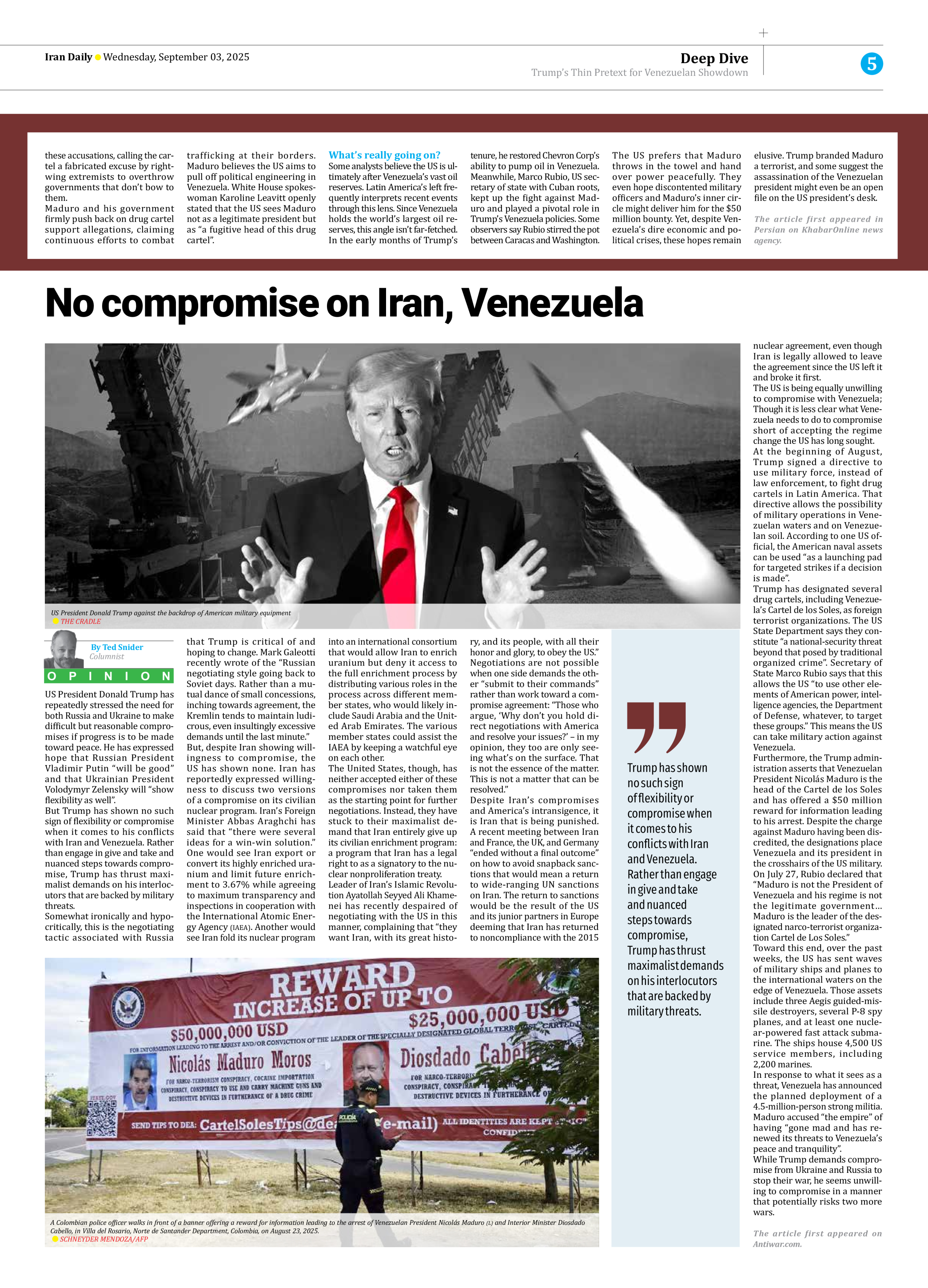


No compromise on Iran, Venezuela
By Ted Snider
Columnist
US President Donald Trump has repeatedly stressed the need for both Russia and Ukraine to make difficult but reasonable compromises if progress is to be made toward peace. He has expressed hope that Russian President Vladimir Putin “will be good” and that Ukrainian President Volodymyr Zelensky will “show flexibility as well”.
But Trump has shown no such sign of flexibility or compromise when it comes to his conflicts with Iran and Venezuela. Rather than engage in give and take and nuanced steps towards compromise, Trump has thrust maximalist demands on his interlocutors that are backed by military threats.
Somewhat ironically and hypocritically, this is the negotiating tactic associated with Russia that Trump is critical of and hoping to change. Mark Galeotti recently wrote of the “Russian negotiating style going back to Soviet days. Rather than a mutual dance of small concessions, inching towards agreement, the Kremlin tends to maintain ludicrous, even insultingly excessive demands until the last minute.”
But, despite Iran showing willingness to compromise, the US has shown none. Iran has reportedly expressed willingness to discuss two versions of a compromise on its civilian nuclear program. Iran’s Foreign Minister Abbas Araghchi has said that “there were several ideas for a win-win solution.” One would see Iran export or convert its highly enriched uranium and limit future enrichment to 3.67% while agreeing to maximum transparency and inspections in cooperation with the International Atomic Energy Agency (IAEA). Another would see Iran fold its nuclear program into an international consortium that would allow Iran to enrich uranium but deny it access to the full enrichment process by distributing various roles in the process across different member states, who would likely include Saudi Arabia and the United Arab Emirates. The various member states could assist the IAEA by keeping a watchful eye on each other.
The United States, though, has neither accepted either of these compromises nor taken them as the starting point for further negotiations. Instead, they have stuck to their maximalist demand that Iran entirely give up its civilian enrichment program: a program that Iran has a legal right to as a signatory to the nuclear nonproliferation treaty.
Leader of Iran’s Islamic Revolution Ayatollah Seyyed Ali Khamenei has recently despaired of negotiating with the US in this manner, complaining that “they want Iran, with its great history, and its people, with all their honor and glory, to obey the US.” Negotiations are not possible when one side demands the other “submit to their commands” rather than work toward a compromise agreement: “Those who argue, ‘Why don’t you hold direct negotiations with America and resolve your issues?’ – in my opinion, they too are only seeing what’s on the surface. That is not the essence of the matter. This is not a matter that can be resolved.”
Despite Iran’s compromises and America’s intransigence, it is Iran that is being punished. A recent meeting between Iran and France, the UK, and Germany “ended without a final outcome” on how to avoid snapback sanctions that would mean a return to wide-ranging UN sanctions on Iran. The return to sanctions would be the result of the US and its junior partners in Europe deeming that Iran has returned to noncompliance with the 2015 nuclear agreement, even though Iran is legally allowed to leave the agreement since the US left it and broke it first.
The US is being equally unwilling to compromise with Venezuela; Though it is less clear what Venezuela needs to do to compromise short of accepting the regime change the US has long sought.
At the beginning of August, Trump signed a directive to use military force, instead of law enforcement, to fight drug cartels in Latin America. That directive allows the possibility of military operations in Venezuelan waters and on Venezuelan soil. According to one US official, the American naval assets can be used “as a launching pad for targeted strikes if a decision is made”.
Trump has designated several drug cartels, including Venezuela’s Cartel de los Soles, as foreign terrorist organizations. The US State Department says they constitute “a national-security threat beyond that posed by traditional organized crime”. Secretary of State Marco Rubio says that this allows the US “to use other elements of American power, intelligence agencies, the Department of Defense, whatever, to target these groups.” This means the US can take military action against Venezuela.
Furthermore, the Trump administration asserts that Venezuelan President Nicolás Maduro is the head of the Cartel de los Soles and has offered a $50 million reward for information leading to his arrest. Despite the charge against Maduro having been discredited, the designations place Venezuela and its president in the crosshairs of the US military.
On July 27, Rubio declared that “Maduro is not the President of Venezuela and his regime is not the legitimate government… Maduro is the leader of the designated narco-terrorist organization Cartel de Los Soles.”
Toward this end, over the past weeks, the US has sent waves of military ships and planes to the international waters on the edge of Venezuela. Those assets include three Aegis guided-missile destroyers, several P-8 spy planes, and at least one nuclear-powered fast attack submarine. The ships house 4,500 US service members, including 2,200 marines.
In response to what it sees as a threat, Venezuela has announced the planned deployment of a 4.5-million-person strong militia. Maduro accused “the empire” of having “gone mad and has renewed its threats to Venezuela’s peace and tranquility”.
While Trump demands compromise from Ukraine and Russia to stop their war, he seems unwilling to compromise in a manner that potentially risks two more wars.
The article first appeared on
Antiwar.com.