





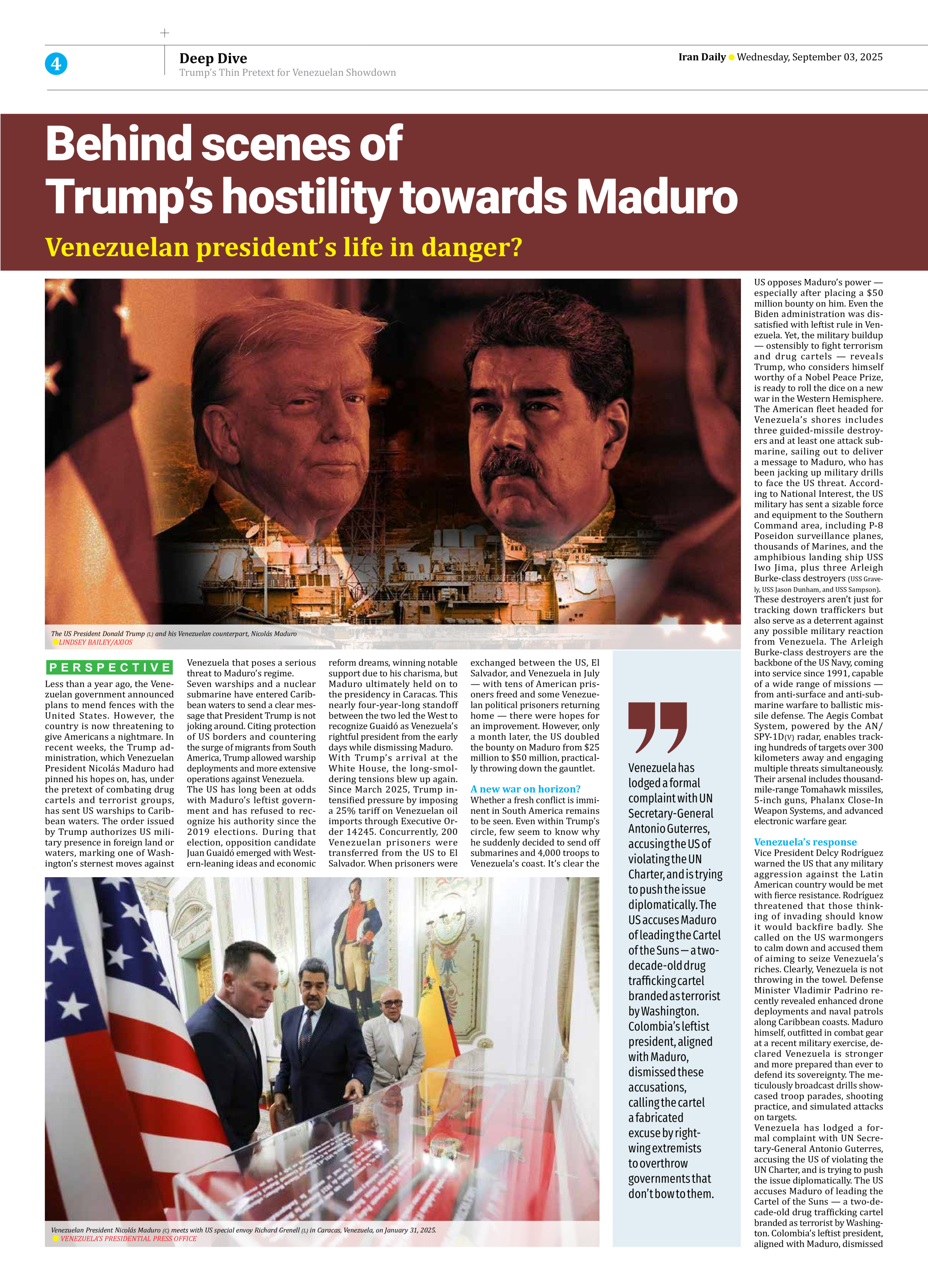


Behind scenes of Trump’s hostility towards Maduro
Venezuelan president’s life in danger?
Less than a year ago, the Venezuelan government announced plans to mend fences with the United States. However, the country is now threatening to give Americans a nightmare. In recent weeks, the Trump administration, which Venezuelan President Nicolás Maduro had pinned his hopes on, has, under the pretext of combating drug cartels and terrorist groups, has sent US warships to Caribbean waters. The order issued by Trump authorizes US military presence in foreign land or waters, marking one of Washington’s sternest moves against Venezuela that poses a serious threat to Maduro’s regime.
Seven warships and a nuclear submarine have entered Caribbean waters to send a clear message that President Trump is not joking around. Citing protection of US borders and countering the surge of migrants from South America, Trump allowed warship deployments and more extensive operations against Venezuela.
The US has long been at odds with Maduro’s leftist government and has refused to recognize his authority since the 2019 elections. During that election, opposition candidate Juan Guaidó emerged with Western-leaning ideas and economic reform dreams, winning notable support due to his charisma, but Maduro ultimately held on to the presidency in Caracas. This nearly four-year-long standoff between the two led the West to recognize Guaidó as Venezuela’s rightful president from the early days while dismissing Maduro.
With Trump’s arrival at the White House, the long-smoldering tensions blew up again. Since March 2025, Trump intensified pressure by imposing a 25% tariff on Venezuelan oil imports through Executive Order 14245. Concurrently, 200 Venezuelan prisoners were transferred from the US to El Salvador. When prisoners were exchanged between the US, El Salvador, and Venezuela in July — with tens of American prisoners freed and some Venezuelan political prisoners returning home — there were hopes for an improvement. However, only a month later, the US doubled the bounty on Maduro from $25 million to $50 million, practically throwing down the gauntlet.
A new war on horizon?
Whether a fresh conflict is imminent in South America remains to be seen. Even within Trump’s circle, few seem to know why he suddenly decided to send off submarines and 4,000 troops to Venezuela’s coast. It’s clear the US opposes Maduro’s power — especially after placing a $50 million bounty on him. Even the Biden administration was dissatisfied with leftist rule in Venezuela. Yet, the military buildup — ostensibly to fight terrorism and drug cartels — reveals Trump, who considers himself worthy of a Nobel Peace Prize, is ready to roll the dice on a new war in the Western Hemisphere.
The American fleet headed for Venezuela’s shores includes three guided-missile destroyers and at least one attack submarine, sailing out to deliver a message to Maduro, who has been jacking up military drills to face the US threat. According to National Interest, the US military has sent a sizable force and equipment to the Southern Command area, including P-8 Poseidon surveillance planes, thousands of Marines, and the amphibious landing ship USS Iwo Jima, plus three Arleigh Burke-class destroyers (USS Gravely, USS Jason Dunham, and USS Sampson).
These destroyers aren’t just for tracking down traffickers but also serve as a deterrent against any possible military reaction from Venezuela. The Arleigh Burke-class destroyers are the backbone of the US Navy, coming into service since 1991, capable of a wide range of missions — from anti-surface and anti-submarine warfare to ballistic missile defense. The Aegis Combat System, powered by the AN/SPY-1D(V) radar, enables tracking hundreds of targets over 300 kilometers away and engaging multiple threats simultaneously. Their arsenal includes thousand-mile-range Tomahawk missiles, 5-inch guns, Phalanx Close-In Weapon Systems, and advanced electronic warfare gear.
Venezuela’s response
Vice President Delcy Rodríguez warned the US that any military aggression against the Latin American country would be met with fierce resistance. Rodríguez threatened that those thinking of invading should know it would backfire badly. She called on the US warmongers to calm down and accused them of aiming to seize Venezuela’s riches. Clearly, Venezuela is not throwing in the towel. Defense Minister Vladimir Padrino recently revealed enhanced drone deployments and naval patrols along Caribbean coasts. Maduro himself, outfitted in combat gear at a recent military exercise, declared Venezuela is stronger and more prepared than ever to defend its sovereignty. The meticulously broadcast drills showcased troop parades, shooting practice, and simulated attacks on targets.
Venezuela has lodged a formal complaint with UN Secretary-General Antonio Guterres, accusing the US of violating the UN Charter, and is trying to push the issue diplomatically. The US accuses Maduro of leading the Cartel of the Suns — a two-decade-old drug trafficking cartel branded as terrorist by Washington. Colombia’s leftist president, aligned with Maduro, dismissed these accusations, calling the cartel a fabricated excuse by right-wing extremists to overthrow governments that don’t bow to them.
Maduro and his government firmly push back on drug cartel support allegations, claiming continuous efforts to combat trafficking at their borders. Maduro believes the US aims to pull off political engineering in Venezuela. White House spokeswoman Karoline Leavitt openly stated that the US sees Maduro not as a legitimate president but as “a fugitive head of this drug cartel”.
What’s really going on?
Some analysts believe the US is ultimately after Venezuela’s vast oil reserves. Latin America’s left frequently interprets recent events through this lens. Since Venezuela holds the world’s largest oil reserves, this angle isn’t far-fetched. In the early months of Trump’s tenure, he restored Chevron Corp’s ability to pump oil in Venezuela. Meanwhile, Marco Rubio, US secretary of state with Cuban roots, kept up the fight against Maduro and played a pivotal role in Trump’s Venezuela policies. Some observers say Rubio stirred the pot between Caracas and Washington.
The US prefers that Maduro throws in the towel and hand over power peacefully. They even hope discontented military officers and Maduro’s inner circle might deliver him for the $50 million bounty. Yet, despite Venezuela’s dire economic and political crises, these hopes remain elusive. Trump branded Maduro a terrorist, and some suggest the assassination of the Venezuelan president might even be an open file on the US president’s desk.
The article first appeared in
Persian on KhabarOnline news agency.