







FM spox: E3 leveraging diplomacy as cover for pressure tactics
Parliament vows ‘decisive’ payback to snapback of sanctions
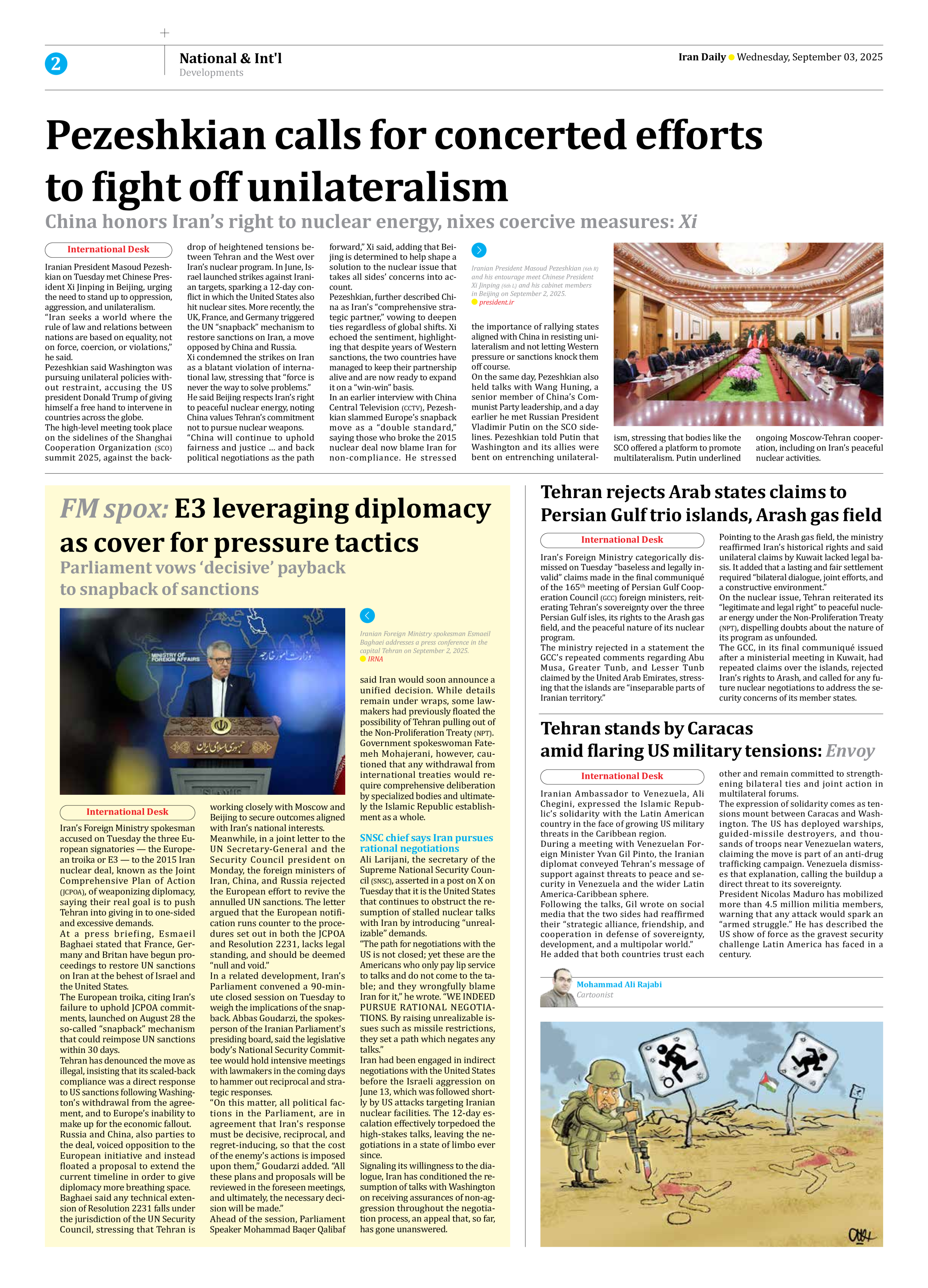
Iran’s Foreign Ministry spokesman accused on Tuesday the three European signatories — the European troika or E3 — to the 2015 Iran nuclear deal, known as the Joint Comprehensive Plan of Action (JCPOA), of weaponizing diplomacy, saying their real goal is to push Tehran into giving in to one-sided and excessive demands.
At a press briefing, Esmaeil Baghaei stated that France, Germany and Britan have begun proceedings to restore UN sanctions on Iran at the behest of Israel and the United States.
The European troika, citing Iran’s failure to uphold JCPOA commitments, launched on August 28 the so-called “snapback” mechanism that could reimpose UN sanctions within 30 days.
Tehran has denounced the move as illegal, insisting that its scaled-back compliance was a direct response to US sanctions following Washington’s withdrawal from the agreement, and to Europe’s inability to make up for the economic fallout.
Russia and China, also parties to the deal, voiced opposition to the European initiative and instead floated a proposal to extend the current timeline in order to give diplomacy more breathing space.
Baghaei said any technical extension of Resolution 2231 falls under the jurisdiction of the UN Security Council, stressing that Tehran is working closely with Moscow and Beijing to secure outcomes aligned with Iran’s national interests.
Meanwhile, in a joint letter to the UN Secretary-General and the Security Council president on Monday, the foreign ministers of Iran, China, and Russia rejected the European effort to revive the annulled UN sanctions. The letter argued that the European notification runs counter to the procedures set out in both the JCPOA and Resolution 2231, lacks legal standing, and should be deemed “null and void.”
In a related development, Iran’s Parliament convened a 90-minute closed session on Tuesday to weigh the implications of the snapback. Abbas Goudarzi, the spokesperson of the Iranian Parliament's presiding board, said the legislative body’s National Security Committee would hold intensive meetings with lawmakers in the coming days to hammer out reciprocal and strategic responses.
“On this matter, all political factions in the Parliament, are in agreement that Iran's response must be decisive, reciprocal, and regret-inducing, so that the cost of the enemy's actions is imposed upon them,” Goudarzi added. “All these plans and proposals will be reviewed in the foreseen meetings, and ultimately, the necessary decision will be made.”
Ahead of the session, Parliament Speaker Mohammad Baqer Qalibaf said Iran would soon announce a unified decision. While details remain under wraps, some lawmakers had previously floated the possibility of Tehran pulling out of the Non-Proliferation Treaty (NPT).
Government spokeswoman Fatemeh Mohajerani, however, cautioned that any withdrawal from international treaties would require comprehensive deliberation by specialized bodies and ultimately the Islamic Republic establishment as a whole.
SNSC chief says Iran pursues rational negotiations
Ali Larijani, the secretary of the Supreme National Security Council (SNSC), asserted in a post on X on Tuesday that it is the United States that continues to obstruct the resumption of stalled nuclear talks with Iran by introducing “unrealizable” demands.
“The path for negotiations with the US is not closed; yet these are the Americans who only pay lip service to talks and do not come to the table; and they wrongfully blame Iran for it,” he wrote. “WE INDEED PURSUE RATIONAL NEGOTIATIONS. By raising unrealizable issues such as missile restrictions, they set a path which negates any talks.”
Iran had been engaged in indirect negotiations with the United States before the Israeli aggression on June 13, which was followed shortly by US attacks targeting Iranian nuclear facilities. The 12-day escalation effectively torpedoed the high-stakes talks, leaving the negotiations in a state of limbo ever since.
Signaling its willingness to the dialogue, Iran has conditioned the resumption of talks with Washington on receiving assurances of non-aggression throughout the negotiation process, an appeal that, so far, has gone unanswered.