







E3 has once again fallen back on sanctions
Sign of strength or crisis in role-playing?
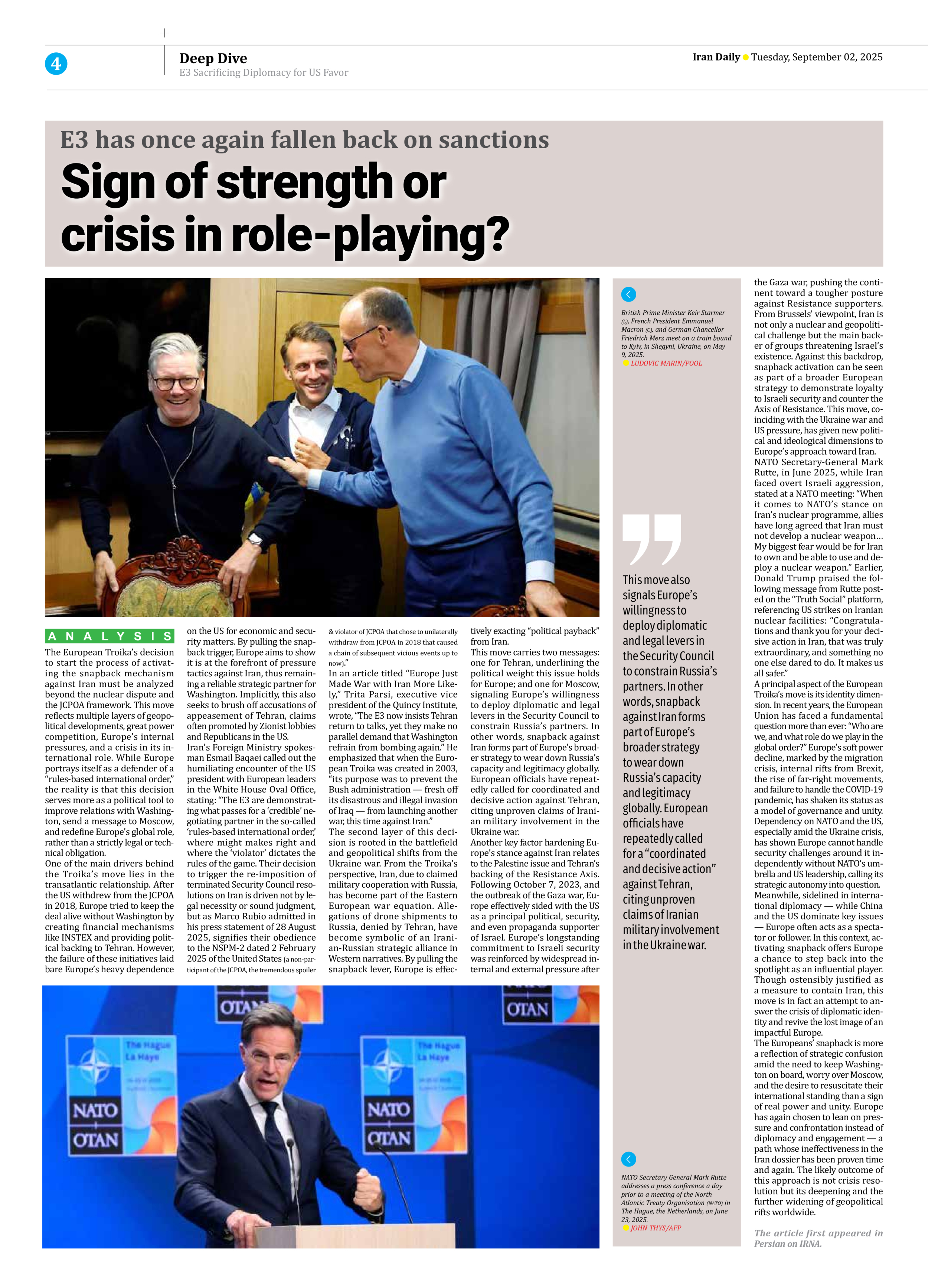
The European Troika’s decision to start the process of activating the snapback mechanism against Iran must be analyzed beyond the nuclear dispute and the JCPOA framework. This move reflects multiple layers of geopolitical developments, great power competition, Europe’s internal pressures, and a crisis in its international role. While Europe portrays itself as a defender of a “rules-based international order,” the reality is that this decision serves more as a political tool to improve relations with Washington, send a message to Moscow, and redefine Europe’s global role, rather than a strictly legal or technical obligation.
One of the main drivers behind the Troika’s move lies in the transatlantic relationship. After the US withdrew from the JCPOA in 2018, Europe tried to keep the deal alive without Washington by creating financial mechanisms like INSTEX and providing political backing to Tehran. However, the failure of these initiatives laid bare Europe’s heavy dependence on the US for economic and security matters. By pulling the snapback trigger, Europe aims to show it is at the forefront of pressure tactics against Iran, thus remaining a reliable strategic partner for Washington. Implicitly, this also seeks to brush off accusations of appeasement of Tehran, claims often promoted by Zionist lobbies and Republicans in the US.
Iran’s Foreign Ministry spokesman Esmail Baqaei called out the humiliating encounter of the US president with European leaders in the White House Oval Office, stating: “The E3 are demonstrating what passes for a ‘credible’ negotiating partner in the so-called ‘rules-based international order,’ where might makes right and where the ‘violator’ dictates the rules of the game. Their decision to trigger the re-imposition of terminated Security Council resolutions on Iran is driven not by legal necessity or sound judgment, but as Marco Rubio admitted in his press statement of 28 August 2025, signifies their obedience to the NSPM-2 dated 2 February 2025 of the United States (a non-participant of the JCPOA, the tremendous spoiler & violator of JCPOA that chose to unilaterally withdraw from JCPOA in 2018 that caused a chain of subsequent vicious events up to now).”
In an article titled “Europe Just Made War with Iran More Likely,” Trita Parsi, executive vice president of the Quincy Institute, wrote, “The E3 now insists Tehran return to talks, yet they make no parallel demand that Washington refrain from bombing again.” He emphasized that when the European Troika was created in 2003, “its purpose was to prevent the Bush administration — fresh off its disastrous and illegal invasion of Iraq — from launching another war, this time against Iran.”
The second layer of this decision is rooted in the battlefield and geopolitical shifts from the Ukraine war. From the Troika’s perspective, Iran, due to claimed military cooperation with Russia, has become part of the Eastern European war equation. Allegations of drone shipments to Russia, denied by Tehran, have become symbolic of an Iranian-Russian strategic alliance in Western narratives. By pulling the snapback lever, Europe is effectively exacting “political payback” from Iran.
This move carries two messages: one for Tehran, underlining the political weight this issue holds for Europe; and one for Moscow, signaling Europe’s willingness to deploy diplomatic and legal levers in the Security Council to constrain Russia’s partners. In other words, snapback against Iran forms part of Europe’s broader strategy to wear down Russia’s capacity and legitimacy globally. European officials have repeatedly called for coordinated and decisive action against Tehran, citing unproven claims of Iranian military involvement in the Ukraine war.
Another key factor hardening Europe’s stance against Iran relates to the Palestine issue and Tehran’s backing of the Resistance Axis. Following October 7, 2023, and the outbreak of the Gaza war, Europe effectively sided with the US as a principal political, security, and even propaganda supporter of Israel. Europe’s longstanding commitment to Israeli security was reinforced by widespread internal and external pressure after the Gaza war, pushing the continent toward a tougher posture against Resistance supporters. From Brussels’ viewpoint, Iran is not only a nuclear and geopolitical challenge but the main backer of groups threatening Israel’s existence. Against this backdrop, snapback activation can be seen as part of a broader European strategy to demonstrate loyalty to Israeli security and counter the Axis of Resistance. This move, coinciding with the Ukraine war and US pressure, has given new political and ideological dimensions to Europe’s approach toward Iran.
NATO Secretary-General Mark Rutte, in June 2025, while Iran faced overt Israeli aggression, stated at a NATO meeting: “When it comes to NATO’s stance on Iran’s nuclear programme, allies have long agreed that Iran must not develop a nuclear weapon… My biggest fear would be for Iran to own and be able to use and deploy a nuclear weapon.” Earlier, Donald Trump praised the following message from Rutte posted on the “Truth Social” platform, referencing US strikes on Iranian nuclear facilities: “Congratulations and thank you for your decisive action in Iran, that was truly extraordinary, and something no one else dared to do. It makes us all safer.”
A principal aspect of the European Troika’s move is its identity dimension. In recent years, the European Union has faced a fundamental question more than ever: “Who are we, and what role do we play in the global order?” Europe’s soft power decline, marked by the migration crisis, internal rifts from Brexit, the rise of far-right movements, and failure to handle the COVID-19 pandemic, has shaken its status as a model of governance and unity. Dependency on NATO and the US, especially amid the Ukraine crisis, has shown Europe cannot handle security challenges around it independently without NATO’s umbrella and US leadership, calling its strategic autonomy into question.
Meanwhile, sidelined in international diplomacy — while China and the US dominate key issues — Europe often acts as a spectator or follower. In this context, activating snapback offers Europe a chance to step back into the spotlight as an influential player. Though ostensibly justified as a measure to contain Iran, this move is in fact an attempt to answer the crisis of diplomatic identity and revive the lost image of an impactful Europe.
The Europeans’ snapback is more a reflection of strategic confusion amid the need to keep Washington on board, worry over Moscow, and the desire to resuscitate their international standing than a sign of real power and unity. Europe has again chosen to lean on pressure and confrontation instead of diplomacy and engagement — a path whose ineffectiveness in the Iran dossier has been proven time and again. The likely outcome of this approach is not crisis resolution but its deepening and the further widening of geopolitical rifts worldwide.
The article first appeared in Persian on IRNA.