





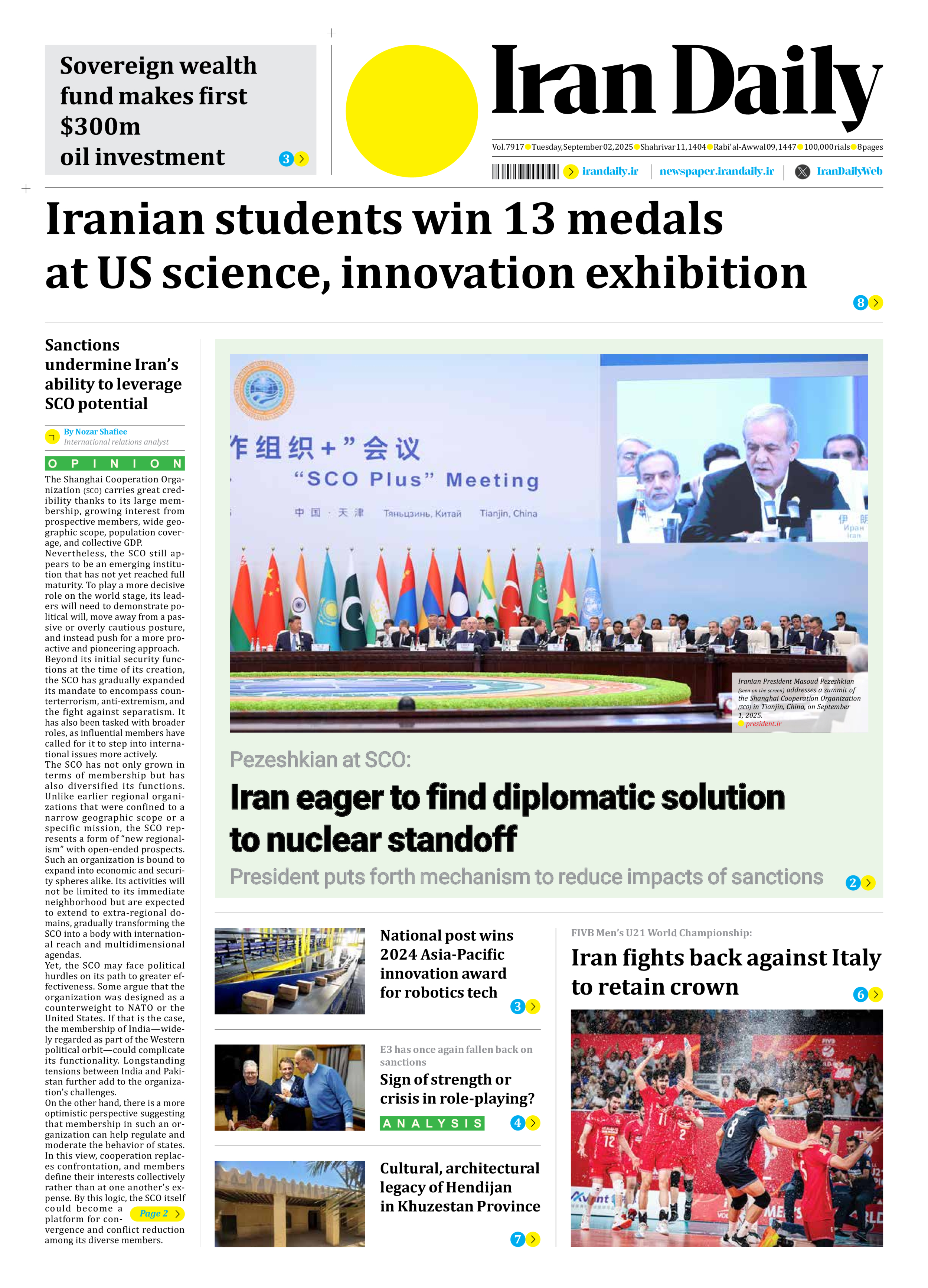


Sanctions undermine Iran’s ability to leverage SCO potential
By Nozar Shafiee
International relations analyst
The Shanghai Cooperation Organization (SCO) carries great credibility thanks to its large membership, growing interest from prospective members, wide geographic scope, population coverage, and collective GDP.
Nevertheless, the SCO still appears to be an emerging institution that has not yet reached full maturity. To play a more decisive role on the world stage, its leaders will need to demonstrate political will, move away from a passive or overly cautious posture, and instead push for a more proactive and pioneering approach.
Beyond its initial security functions at the time of its creation, the SCO has gradually expanded its mandate to encompass counterterrorism, anti-extremism, and the fight against separatism. It has also been tasked with broader roles, as influential members have called for it to step into international issues more actively.
The SCO has not only grown in terms of membership but has also diversified its functions. Unlike earlier regional organizations that were confined to a narrow geographic scope or a specific mission, the SCO represents a form of “new regionalism” with open-ended prospects. Such an organization is bound to expand into economic and security spheres alike. Its activities will not be limited to its immediate neighborhood but are expected to extend to extra-regional domains, gradually transforming the SCO into a body with international reach and multidimensional agendas.
Yet, the SCO may face political hurdles on its path to greater effectiveness. Some argue that the organization was designed as a counterweight to NATO or the United States. If that is the case, the membership of India—widely regarded as part of the Western political orbit—could complicate its functionality. Longstanding tensions between India and Pakistan further add to the organization’s challenges.
On the other hand, there is a more optimistic perspective suggesting that membership in such an organization can help regulate and moderate the behavior of states. In this view, cooperation replaces confrontation, and members define their interests collectively rather than at one another’s expense. By this logic, the SCO itself could become a platform for convergence and conflict reduction among its diverse members.
Page 2