







Trump’s Iran war mulligan
By Andrew Day
Senior editor, scholar
In June, President Donald Trump granted a longtime wish of Israel’s Prime Minister Benjamin Netanyahu.
For decades, Netanyahu pressured American presidents to bomb Iran. Each one resisted, including Trump in his first term, when he griped that the Israeli premier was “willing to fight Iran to the last American soldier”. But in Trump’s second term, Bibi finally got what he wanted. Two months ago, as the Israel–Iran war raged, the president authorized strikes by air and sea on Tehran’s nuclear energy facilities.
Now, Netanyahu wants Trump to attack Iran again, and this time on a massive scale. If the president still intends to stay out of forever wars in the Middle East — as he promised to do — then he must rein in Netanyahu and preemptively signal a refusal to fight the enemies of an out-of-control client entity, which is what Israel has plainly become. In June, Trump managed to avoid getting embroiled in a protracted and escalating conflict. Next time, he might not be so lucky.
Trita Parsi, a veteran analyst of US–Iran relations, has forecasted that Israel likely will launch another war this year, perhaps before September. Unlike last time, Parsi writes in Foreign Policy, Iran will hit back hard right away to demonstrate its resilience:
“As a result, the coming war will likely be far bloodier than the first. If US President Donald Trump caves to Israeli pressure again and joins the fight, the United States could face a full-blown war with Iran that will make Iraq look easy by comparison.”
Obviously, an Iraq War 2.0 would pose considerable risks for the US and for Trump, who came out of the “12-Day War” mostly unscathed. Only a slim majority of Americans opposed the US strikes in June, even as a supermajority — 78 percent — expressed concern that America would get drawn into a direct war with Iran, according to polling from Quinnipiac. Another survey found that Americans were more supportive of the strikes after being told they were limited to Iran’s nuclear facilities. These findings suggest that many Americans oppose war with Iran but tolerated Trump’s discreet and targeted bombing raid.
The voters, in essence, have given Trump a pass, a redo, or, in golfer’s terms, a mulligan. Soon, the president will have another shot to avoid the sand trap of a Mideast war. This time, he can’t afford to miss, and he’ll have less room to maneuver.
Both Israeli and Iranian officials seem to consider the present moment a kind of intermission, a lull in the fighting, rather than a stable post-war period. “We are not in a cease-fire, we are in a stage of war,” a top adviser to the Leader of Iran’s Islamic Revolution Ayatollah Seyyed Ali Khamanei is reported to have said recently. “No protocol, regulation, or agreement has been written between us and the US or Israel.”
Over in Israel, the former intelligence officer Jacques Neriah warned of a looming “second round” of the 12-day war. “There is a sense that a war is coming, that Iranian revenge is in the works,” Neriah said on an Israeli radio program.
With Tehran agitated and its threat perception heightened, “Israel must launch a preemptive strike against Iran in its present state as a large part of its military capabilities is paralyzed,” Neriah claimed. Senior Israeli officials agree. War Minister Israel Katz has warned Iran’s leaders of an imminent Israeli offensive. Katz even suggested that this time Israel will assassinate Ayatollah Khamenei, advising the Iranian leader to “lift his eyes to the sky and listen carefully to every buzz”. Other Israeli officials, including Foreign Minister Gideon Saar and Chief of Staff Eyal Zamir, have also hinted at further attacks to neutralize the perceived threat from Iran.
Israel is not only making plans for another preemptive war but urging the Trump administration to join, according to Asharq Al-Awsat, a daily pan-Arab newspaper, which cited unnamed security sources in Israel. The outlet said that if Trump refuses, Israel will seek the president’s green light to go it alone.
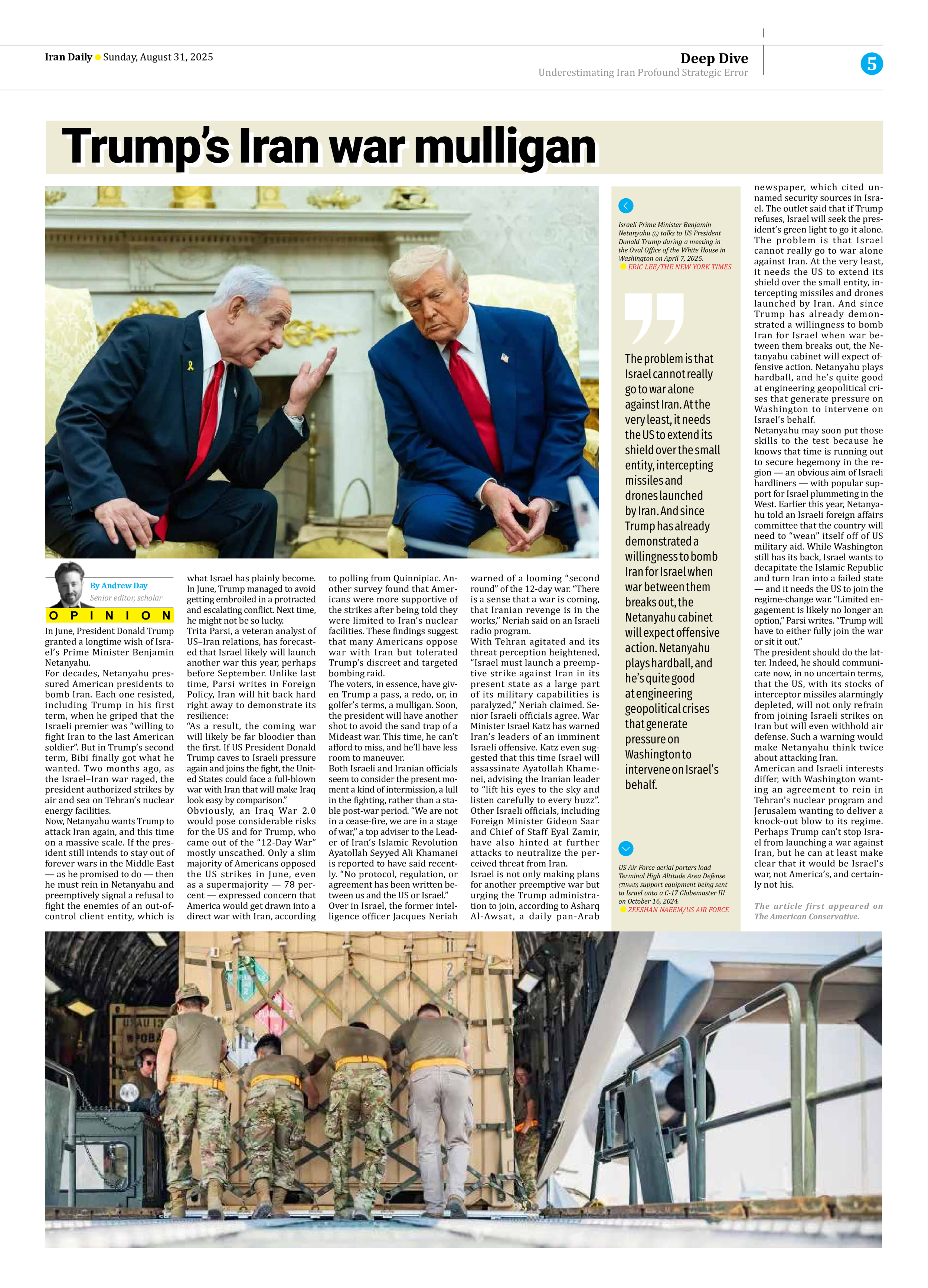
The problem is that Israel cannot really go to war alone against Iran. At the very least, it needs the US to extend its shield over the small entity, intercepting missiles and drones launched by Iran. And since Trump has already demonstrated a willingness to bomb Iran for Israel when war between them breaks out, the Netanyahu cabinet will expect offensive action. Netanyahu plays hardball, and he’s quite good at engineering geopolitical crises that generate pressure on Washington to intervene on Israel’s behalf.
Netanyahu may soon put those skills to the test because he knows that time is running out to secure hegemony in the region — an obvious aim of Israeli hardliners — with popular support for Israel plummeting in the West. Earlier this year, Netanyahu told an Israeli foreign affairs committee that the country will need to “wean” itself off of US military aid. While Washington still has its back, Israel wants to decapitate the Islamic Republic and turn Iran into a failed state — and it needs the US to join the regime-change war. “Limited engagement is likely no longer an option,” Parsi writes. “Trump will have to either fully join the war or sit it out.”
The president should do the latter. Indeed, he should communicate now, in no uncertain terms, that the US, with its stocks of interceptor missiles alarmingly depleted, will not only refrain from joining Israeli strikes on Iran but will even withhold air defense. Such a warning would make Netanyahu think twice about attacking Iran.
American and Israeli interests differ, with Washington wanting an agreement to rein in Tehran’s nuclear program and Jerusalem wanting to deliver a knock-out blow to its regime. Perhaps Trump can’t stop Israel from launching a war against Iran, but he can at least make clear that it would be Israel’s war, not America’s, and certainly not his.
The article first appeared on
The American Conservative.