







12 water, energy projects launched in Zanjan
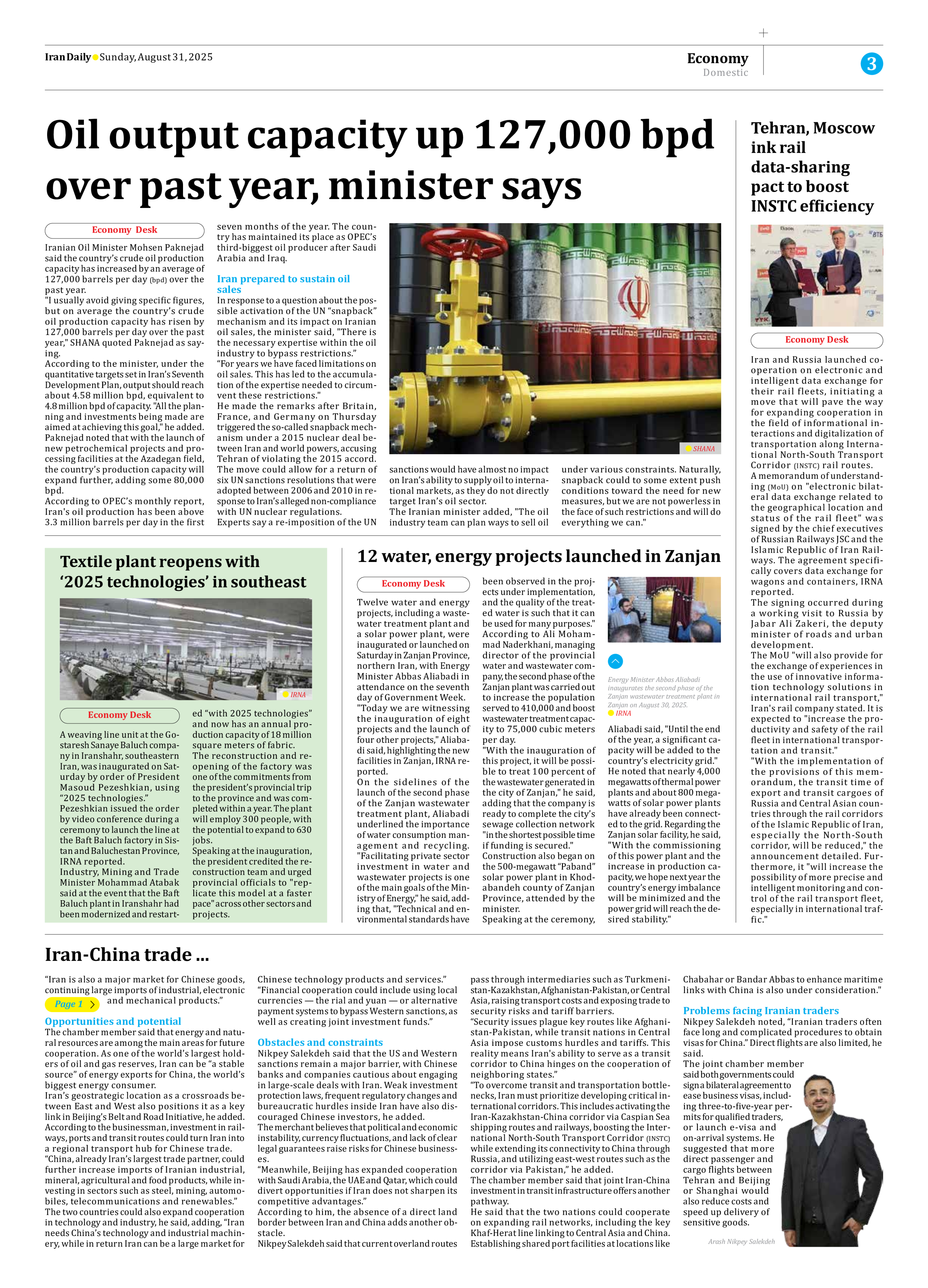
Twelve water and energy projects, including a wastewater treatment plant and a solar power plant, were inaugurated or launched on Saturday in Zanjan Province, northern Iran, with Energy Minister Abbas Aliabadi in attendance on the seventh day of Government Week.
"Today we are witnessing the inauguration of eight projects and the launch of four other projects," Aliabadi said, highlighting the new facilities in Zanjan, IRNA reported.
On the sidelines of the launch of the second phase of the Zanjan wastewater treatment plant, Aliabadi underlined the importance of water consumption management and recycling. "Facilitating private sector investment in water and wastewater projects is one of the main goals of the Ministry of Energy," he said, adding that, "Technical and environmental standards have been observed in the projects under implementation, and the quality of the treated water is such that it can be used for many purposes."
According to Ali Mohammad Naderkhani, managing director of the provincial water and wastewater company, the second phase of the Zanjan plant was carried out to increase the population served to 410,000 and boost wastewater treatment capacity to 75,000 cubic meters per day.
"With the inauguration of this project, it will be possible to treat 100 percent of the wastewater generated in the city of Zanjan," he said, adding that the company is ready to complete the city’s sewage collection network "in the shortest possible time if funding is secured."
Construction also began on the 500-megawatt “Paband” solar power plant in Khodabandeh county of Zanjan Province, attended by the minister.
Speaking at the ceremony, Aliabadi said, "Until the end of the year, a significant capacity will be added to the country’s electricity grid."
He noted that nearly 4,000 megawatts of thermal power plants and about 800 megawatts of solar power plants have already been connected to the grid. Regarding the Zanjan solar facility, he said, "With the commissioning of this power plant and the increase in production capacity, we hope next year the country’s energy imbalance will be minimized and the power grid will reach the desired stability."