





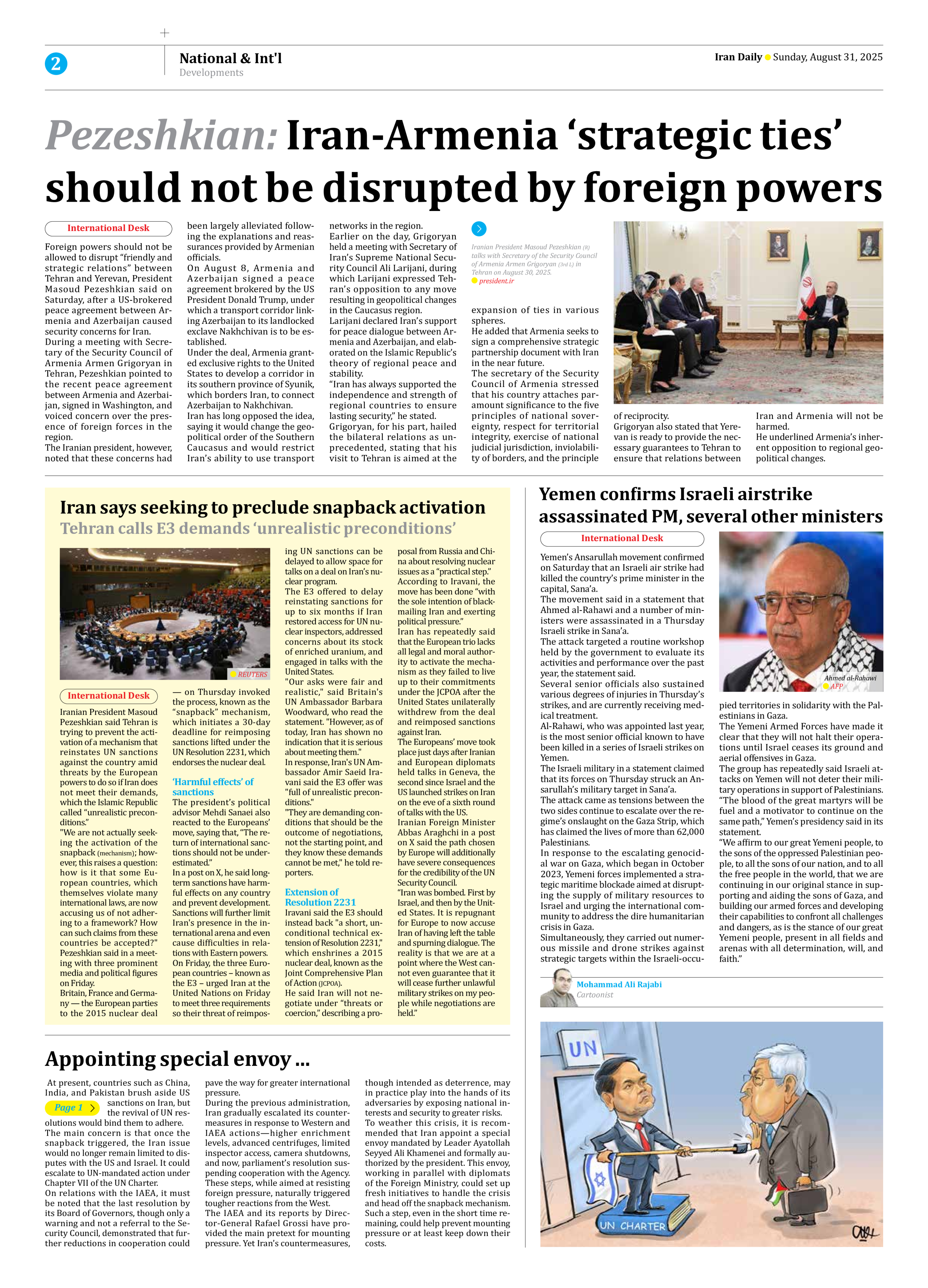


Iran says seeking to preclude snapback activation
Tehran calls E3 demands ‘unrealistic preconditions’
Iranian President Masoud Pezeshkian said Tehran is trying to prevent the activation of a mechanism that reinstates UN sanctions against the country amid threats by the European powers to do so if Iran does not meet their demands, which the Islamic Republic called “unrealistic preconditions.”
"We are not actually seeking the activation of the snapback (mechanism); however, this raises a question: how is it that some European countries, which themselves violate many international laws, are now accusing us of not adhering to a framework? How can such claims from these countries be accepted?" Pezeshkian said in a meeting with three prominent media and political figures on Friday.
Britain, France and Germany — the European parties to the 2015 nuclear deal — on Thursday invoked the process, known as the “snapback” mechanism, which initiates a 30-day deadline for reimposing sanctions lifted under the UN Resolution 2231, which endorses the nuclear deal.
‘Harmful effects’ of sanctions
The president’s political advisor Mehdi Sanaei also reacted to the Europeans’ move, saying that, “The return of international sanctions should not be underestimated.”
In a post on X, he said long-term sanctions have harmful effects on any country and prevent development. Sanctions will further limit Iran's presence in the international arena and even cause difficulties in relations with Eastern powers.
On Friday, the three European countries – known as the E3 – urged Iran at the United Nations on Friday to meet three requirements so their threat of reimposing UN sanctions can be delayed to allow space for talks on a deal on Iran’s nuclear program.
The E3 offered to delay reinstating sanctions for up to six months if Iran restored access for UN nuclear inspectors, addressed concerns about its stock of enriched uranium, and engaged in talks with the United States.
"Our asks were fair and realistic," said Britain's UN Ambassador Barbara Woodward, who read the statement. "However, as of today, Iran has shown no indication that it is serious about meeting them."
In response, Iran's UN Ambassador Amir Saeid Iravani said the E3 offer was "full of unrealistic preconditions."
"They are demanding conditions that should be the outcome of negotiations, not the starting point, and they know these demands cannot be met," he told reporters.
Extension of Resolution 2231
Iravani said the E3 should instead back "a short, unconditional technical extension of Resolution 2231," which enshrines a 2015 nuclear deal, known as the Joint Comprehensive Plan of Action (JCPOA).
He said Iran will not negotiate under “threats or coercion,” describing a proposal from Russia and China about resolving nuclear issues as a “practical step.”
According to Iravani, the move has been done “with the sole intention of blackmailing Iran and exerting political pressure.”
Iran has repeatedly said that the European trio lacks all legal and moral authority to activate the mechanism as they failed to live up to their commitments under the JCPOA after the United States unilaterally withdrew from the deal and reimposed sanctions against Iran.
The Europeans’ move took place just days after Iranian and European diplomats held talks in Geneva, the second since Israel and the US launched strikes on Iran on the eve of a sixth round of talks with the US.
Iranian Foreign Minister Abbas Araghchi in a post on X said the path chosen by Europe will additionally have severe consequences for the credibility of the UN Security Council.
“Iran was bombed. First by Israel, and then by the United States. It is repugnant for Europe to now accuse Iran of having left the table and spurning dialogue. The reality is that we are at a point where the West cannot even guarantee that it will cease further unlawful military strikes on my people while negotiations are held.”