







From Putin’s prestige to humiliation of European leaders
By Saad Naji Jawad
Iraqi expert on political affairs
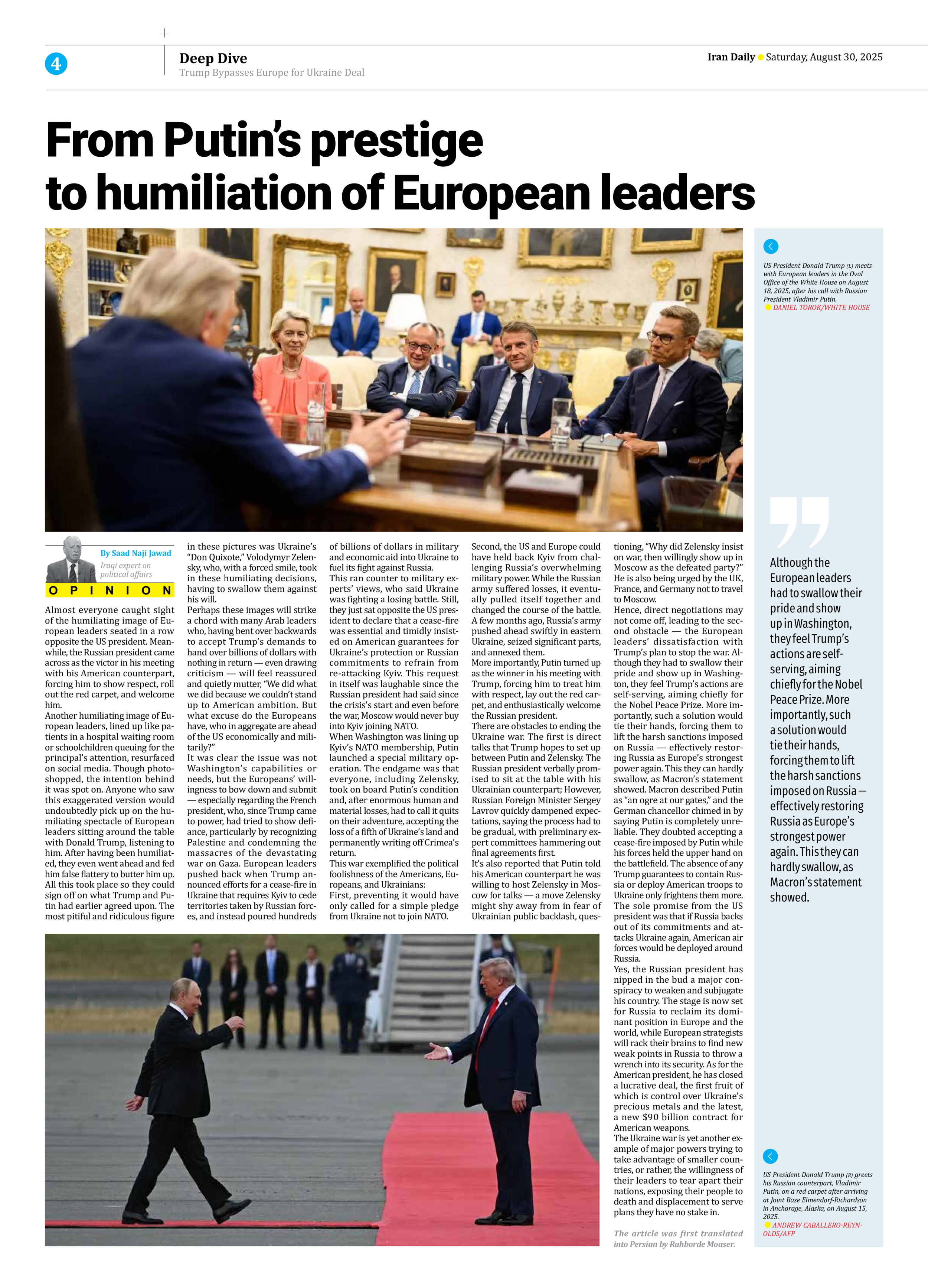
Almost everyone caught sight of the humiliating image of European leaders seated in a row opposite the US president. Meanwhile, the Russian president came across as the victor in his meeting with his American counterpart, forcing him to show respect, roll out the red carpet, and welcome him.
Another humiliating image of European leaders, lined up like patients in a hospital waiting room or schoolchildren queuing for the principal’s attention, resurfaced on social media. Though photoshopped, the intention behind it was spot on. Anyone who saw this exaggerated version would undoubtedly pick up on the humiliating spectacle of European leaders sitting around the table with Donald Trump, listening to him. After having been humiliated, they even went ahead and fed him false flattery to butter him up.
All this took place so they could sign off on what Trump and Putin had earlier agreed upon. The most pitiful and ridiculous figure in these pictures was Ukraine’s “Don Quixote,” Volodymyr Zelensky, who, with a forced smile, took in these humiliating decisions, having to swallow them against his will.
Perhaps these images will strike a chord with many Arab leaders who, having bent over backwards to accept Trump’s demands to hand over billions of dollars with nothing in return — even drawing criticism — will feel reassured and quietly mutter, “We did what we did because we couldn’t stand up to American ambition. But what excuse do the Europeans have, who in aggregate are ahead of the US economically and militarily?”
It was clear the issue was not Washington’s capabilities or needs, but the Europeans’ willingness to bow down and submit — especially regarding the French president, who, since Trump came to power, had tried to show defiance, particularly by recognizing Palestine and condemning the massacres of the devastating war on Gaza. European leaders pushed back when Trump announced efforts for a cease-fire in Ukraine that requires Kyiv to cede territories taken by Russian forces, and instead poured hundreds of billions of dollars in military and economic aid into Ukraine to fuel its fight against Russia.
This ran counter to military experts’ views, who said Ukraine was fighting a losing battle. Still, they just sat opposite the US president to declare that a cease-fire was essential and timidly insisted on American guarantees for Ukraine’s protection or Russian commitments to refrain from re-attacking Kyiv. This request in itself was laughable since the Russian president had said since the crisis’s start and even before the war, Moscow would never buy into Kyiv joining NATO.
When Washington was lining up Kyiv’s NATO membership, Putin launched a special military operation. The endgame was that everyone, including Zelensky, took on board Putin’s condition and, after enormous human and material losses, had to call it quits on their adventure, accepting the loss of a fifth of Ukraine’s land and permanently writing off Crimea’s return.
This war exemplified the political foolishness of the Americans, Europeans, and Ukrainians:
First, preventing it would have only called for a simple pledge from Ukraine not to join NATO.
Second, the US and Europe could have held back Kyiv from challenging Russia’s overwhelming military power. While the Russian army suffered losses, it eventually pulled itself together and changed the course of the battle. A few months ago, Russia’s army pushed ahead swiftly in eastern Ukraine, seized significant parts, and annexed them.
More importantly, Putin turned up as the winner in his meeting with Trump, forcing him to treat him with respect, lay out the red carpet, and enthusiastically welcome the Russian president.
There are obstacles to ending the Ukraine war. The first is direct talks that Trump hopes to set up between Putin and Zelensky. The Russian president verbally promised to sit at the table with his Ukrainian counterpart; However, Russian Foreign Minister Sergey Lavrov quickly dampened expectations, saying the process had to be gradual, with preliminary expert committees hammering out final agreements first.
It’s also reported that Putin told his American counterpart he was willing to host Zelensky in Moscow for talks — a move Zelensky might shy away from in fear of Ukrainian public backlash, questioning, “Why did Zelensky insist on war, then willingly show up in Moscow as the defeated party?” He is also being urged by the UK, France, and Germany not to travel to Moscow.
Hence, direct negotiations may not come off, leading to the second obstacle — the European leaders’ dissatisfaction with Trump’s plan to stop the war. Although they had to swallow their pride and show up in Washington, they feel Trump’s actions are self-serving, aiming chiefly for the Nobel Peace Prize. More importantly, such a solution would tie their hands, forcing them to lift the harsh sanctions imposed on Russia — effectively restoring Russia as Europe’s strongest power again. This they can hardly swallow, as Macron’s statement showed. Macron described Putin as “an ogre at our gates,” and the German chancellor chimed in by saying Putin is completely unreliable. They doubted accepting a cease-fire imposed by Putin while his forces held the upper hand on the battlefield. The absence of any Trump guarantees to contain Russia or deploy American troops to Ukraine only frightens them more. The sole promise from the US president was that if Russia backs out of its commitments and attacks Ukraine again, American air forces would be deployed around Russia.
Yes, the Russian president has nipped in the bud a major conspiracy to weaken and subjugate his country. The stage is now set for Russia to reclaim its dominant position in Europe and the world, while European strategists will rack their brains to find new weak points in Russia to throw a wrench into its security. As for the American president, he has closed a lucrative deal, the first fruit of which is control over Ukraine’s precious metals and the latest, a new $90 billion contract for American weapons.
The Ukraine war is yet another example of major powers trying to take advantage of smaller countries, or rather, the willingness of their leaders to tear apart their nations, exposing their people to death and displacement to serve plans they have no stake in.
The article was first translated
into Persian by Rahborde Moaser.