







President remotely launches two oil pipelines, 722 industrial projects
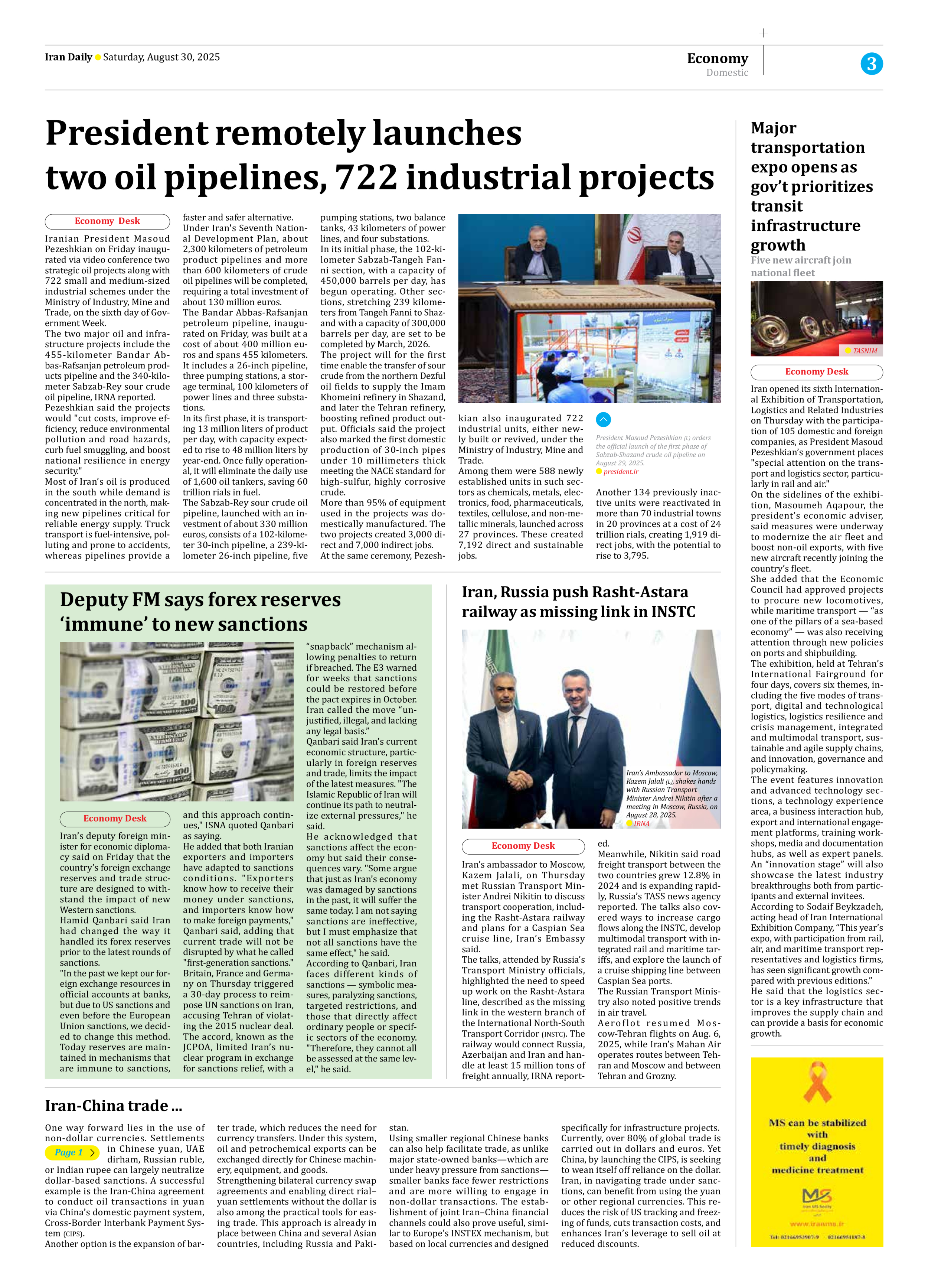
Iranian President Masoud Pezeshkian on Friday inaugurated via video conference two strategic oil projects along with 722 small and medium-sized industrial schemes under the Ministry of Industry, Mine and Trade, on the sixth day of Government Week.
The two major oil and infrastructure projects include the 455-kilometer Bandar Abbas-Rafsanjan petroleum products pipeline and the 340-kilometer Sabzab-Rey sour crude oil pipeline, IRNA reported.
Pezeshkian said the projects would "cut costs, improve efficiency, reduce environmental pollution and road hazards, curb fuel smuggling, and boost national resilience in energy security."
Most of Iran’s oil is produced in the south while demand is concentrated in the north, making new pipelines critical for reliable energy supply. Truck transport is fuel-intensive, polluting and prone to accidents, whereas pipelines provide a faster and safer alternative.
Under Iran's Seventh National Development Plan, about 2,300 kilometers of petroleum product pipelines and more than 600 kilometers of crude oil pipelines will be completed, requiring a total investment of about 130 million euros.
The Bandar Abbas-Rafsanjan petroleum pipeline, inaugurated on Friday, was built at a cost of about 400 million euros and spans 455 kilometers. It includes a 26-inch pipeline, three pumping stations, a storage terminal, 100 kilometers of power lines and three substations.
In its first phase, it is transporting 13 million liters of product per day, with capacity expected to rise to 48 million liters by year-end. Once fully operational, it will eliminate the daily use of 1,600 oil tankers, saving 60 trillion rials in fuel.
The Sabzab-Rey sour crude oil pipeline, launched with an investment of about 330 million euros, consists of a 102-kilometer 30-inch pipeline, a 239-kilometer 26-inch pipeline, five pumping stations, two balance tanks, 43 kilometers of power lines, and four substations.
In its initial phase, the 102-kilometer Sabzab-Tangeh Fanni section, with a capacity of 450,000 barrels per day, has begun operating. Other sections, stretching 239 kilometers from Tangeh Fanni to Shazand with a capacity of 300,000 barrels per day, are set to be completed by March, 2026.
The project will for the first time enable the transfer of sour crude from the northern Dezful oil fields to supply the Imam Khomeini refinery in Shazand, and later the Tehran refinery, boosting refined product output. Officials said the project also marked the first domestic production of 30-inch pipes under 10 millimeters thick meeting the NACE standard for high-sulfur, highly corrosive crude.
More than 95% of equipment used in the projects was domestically manufactured. The two projects created 3,000 direct and 7,000 indirect jobs.
At the same ceremony, Pezeshkian also inaugurated 722 industrial units, either newly built or revived, under the Ministry of Industry, Mine and Trade.
Among them were 588 newly established units in such sectors as chemicals, metals, electronics, food, pharmaceuticals, textiles, cellulose, and non-metallic minerals, launched across 27 provinces. These created 7,192 direct and sustainable jobs.
Another 134 previously inactive units were reactivated in more than 70 industrial towns in 20 provinces at a cost of 24 trillion rials, creating 1,919 direct jobs, with the potential to rise to 3,795.