





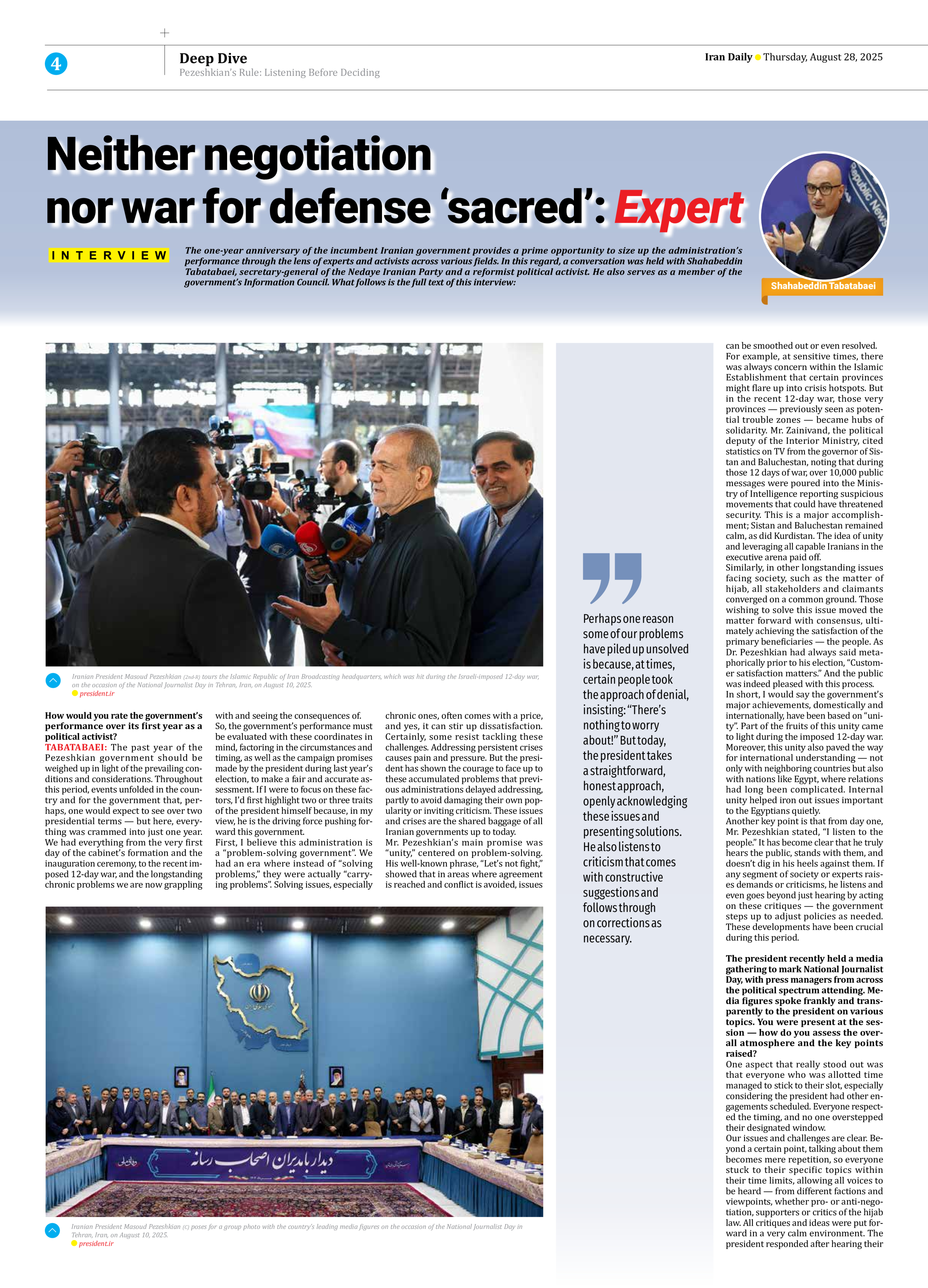


Neither negotiation nor war for defense ‘sacred’: Expert
The one-year anniversary of the incumbent Iranian government provides a prime opportunity to size up the administration’s performance through the lens of experts and activists across various fields. In this regard, a conversation was held with Shahabeddin Tabatabaei, secretary-general of the Nedaye Iranian Party and a reformist political activist. He also serves as a member of the government’s Information Council. What follows is the full text of this interview:
How would you rate the government’s performance over its first year as a political activist?
Tabatabaei: The past year of the Pezeshkian government should be weighed up in light of the prevailing conditions and considerations. Throughout this period, events unfolded in the country and for the government that, perhaps, one would expect to see over two presidential terms — but here, everything was crammed into just one year. We had everything from the very first day of the cabinet’s formation and the inauguration ceremony, to the recent imposed 12-day war, and the longstanding chronic problems we are now grappling with and seeing the consequences of.
So, the government’s performance must be evaluated with these coordinates in mind, factoring in the circumstances and timing, as well as the campaign promises made by the president during last year’s election, to make a fair and accurate assessment. If I were to focus on these factors, I’d first highlight two or three traits of the president himself because, in my view, he is the driving force pushing forward this government.
First, I believe this administration is a “problem-solving government”. We had an era where instead of “solving problems,” they were actually “carrying problems”. Solving issues, especially chronic ones, often comes with a price, and yes, it can stir up dissatisfaction. Certainly, some resist tackling these challenges. Addressing persistent crises causes pain and pressure. But the president has shown the courage to face up to these accumulated problems that previous administrations delayed addressing, partly to avoid damaging their own popularity or inviting criticism. These issues and crises are the shared baggage of all Iranian governments up to today.
Mr. Pezeshkian’s main promise was “unity,” centered on problem-solving. His well-known phrase, “Let’s not fight,” showed that in areas where agreement is reached and conflict is avoided, issues can be smoothed out or even resolved.
For example, at sensitive times, there was always concern within the Islamic Establishment that certain provinces might flare up into crisis hotspots. But in the recent 12-day war, those very provinces — previously seen as potential trouble zones — became hubs of solidarity. Mr. Zainivand, the political deputy of the Interior Ministry, cited statistics on TV from the governor of Sistan and Baluchestan, noting that during those 12 days of war, over 10,000 public messages were poured into the Ministry of Intelligence reporting suspicious movements that could have threatened security. This is a major accomplishment; Sistan and Baluchestan remained calm, as did Kurdistan. The idea of unity and leveraging all capable Iranians in the executive arena paid off.
Similarly, in other longstanding issues facing society, such as the matter of hijab, all stakeholders and claimants converged on a common ground. Those wishing to solve this issue moved the matter forward with consensus, ultimately achieving the satisfaction of the primary beneficiaries — the people. As Dr. Pezeshkian had always said metaphorically prior to his election, “Customer satisfaction matters.” And the public was indeed pleased with this process.
In short, I would say the government’s major achievements, domestically and internationally, have been based on “unity”. Part of the fruits of this unity came to light during the imposed 12-day war. Moreover, this unity also paved the way for international understanding — not only with neighboring countries but also with nations like Egypt, where relations had long been complicated. Internal unity helped iron out issues important to the Egyptians quietly.
Another key point is that from day one, Mr. Pezeshkian stated, “I listen to the people.” It has become clear that he truly hears the public, stands with them, and doesn’t dig in his heels against them. If any segment of society or experts raises demands or criticisms, he listens and even goes beyond just hearing by acting on these critiques — the government steps up to adjust policies as needed. These developments have been crucial during this period.
The president recently held a media gathering to mark National Journalist Day, with press managers from across the political spectrum attending. Media figures spoke frankly and transparently to the president on various topics. You were present at the session — how do you assess the overall atmosphere and the key points raised?
One aspect that really stood out was that everyone who was allotted time managed to stick to their slot, especially considering the president had other engagements scheduled. Everyone respected the timing, and no one overstepped their designated window.
Our issues and challenges are clear. Beyond a certain point, talking about them becomes mere repetition, so everyone stuck to their specific topics within their time limits, allowing all voices to be heard — from different factions and viewpoints, whether pro- or anti-negotiation, supporters or critics of the hijab law. All critiques and ideas were put forward in a very calm environment. The president responded after hearing their points, and it was evident that his replies were rooted in the country’s priorities and the matters that truly resonate with the public.
Could you highlight the most important issues raised during that meeting?
The president addressed the chronic problems the country is currently facing — issues like shortages in energy and water supplies. When a matter is completely transparent and exposed in society, a notable feature of Mr. Pezeshkian is that he neither denies nor hides it. Perhaps one reason some of our problems have piled up unsolved is because, at times, certain people took the approach of denial, insisting: “There’s nothing to worry about!” But today, the president takes a straightforward, honest approach, openly acknowledging these issues and presenting solutions. He also listens to criticism that comes with constructive suggestions and follows through on corrections as necessary.
As someone who has always maintained a critical perspective, I believe this approach sets us on track toward problem-solving. That day, the president candidly discussed the various challenges with the assembled media heads and requested their support. He urged journalists to help, offer proposals, and share these matters openly and honestly with the public. The outcome of the session was a real sense of sympathy among participants of all views, acknowledging that the president is sincerely raising these issues and seeking help from the media.
As you pointed out, the president, not only in this meeting but also on other occasions, reached out to the media for solutions and to help move forward with various issues. In your view, how can the media pitch in to assist the government? For instance, we are currently facing a crisis of shortages; Water and electricity problems exist in Tehran and several other provinces. How can the media lay out these issues for the public, and what role can it play in alleviating these challenges?
I always believe that the media must strike a balance between two points. While setting out the problems and crises — which people have a right to know because an informed public will, when needed, step up to help — the media also walks a fine line where overemphasizing issues can tip over into despair and a dead-end narrative. There’s a big difference between saying “these problems exist and nothing can be done” and breaking down the issues step by step for the public, explaining where we currently stand, what the challenges and characteristics are, then bringing in the perspectives and solutions of experts and officials who are responsible for tackling these problems and opening up the conversation with the people.
The media is the platform for dialogue, something that sometimes gets lost in translation in our society. We even need to brush up on talking to ourselves — and the media is exactly the space where this begins to take shape. I believe that major influential media outlets, shaped by the past year and the spirit of unity, can pull off this achievement. Yesterday’s session with the president was one such example. These are signs of progress in the media sector, which I think could lead to another positive breakthrough.
Another important point I want to stress concerns the president’s remarks on negotiations during that day’s meeting, followed by interpretations of his remarks circulating in the media and online. I must clarify that what guarantees the national interests and preserves the country’s territorial integrity is sacred. That’s the thing that gives weight to our words, speech, and actions. But neither negotiation in itself is sacred, nor is war for the purpose of defense sacred. Each carries value only according to its specific context and realities.
Mr. Pezeshkian, who said in front of media managers that “we must enter this space (negotiation),” is the same person who showed that during the imposed 12-day war, he stood firm in the heart of the battlefield, managing the country with courage, zeal, and patriotism. So, if that same man says negotiation is a solution one day, and we also saw him stand his ground in defense during war, frequently emphasizing that what he does is fully in line with the Leader of Iran’s Islamic Revolution, then we should give credit to this president and let him get on with his work with the least distraction and speculation.
Of course, Dr. Pezeshkian has demonstrated that he welcomes criticism — even when it sometimes lands in the territory of sarcasm or accusations — because he feels that all voices need to be heard and the best decisions made.
Hence, I want to say that sometimes we need to stand shoulder to shoulder in defense of the homeland and the people, and at other times, we need to step into negotiation. All this is to safeguard national interests in the best possible way so that no one can breach the country’s territorial integrity. Therefore, I believe the president’s important remarks on negotiation were clear, honest, and straightforward within this framework. We should not put on a pedestal things that are not sacred by nature or bicker over them; If conflict and war are necessary, they belong elsewhere. Today, if the president says, in coordination with the Leader, “We want to negotiate,” let us trust this president.
The interview first appeared in Persian on IRNA.