







Malayer carpets crafting identity through pattern, color
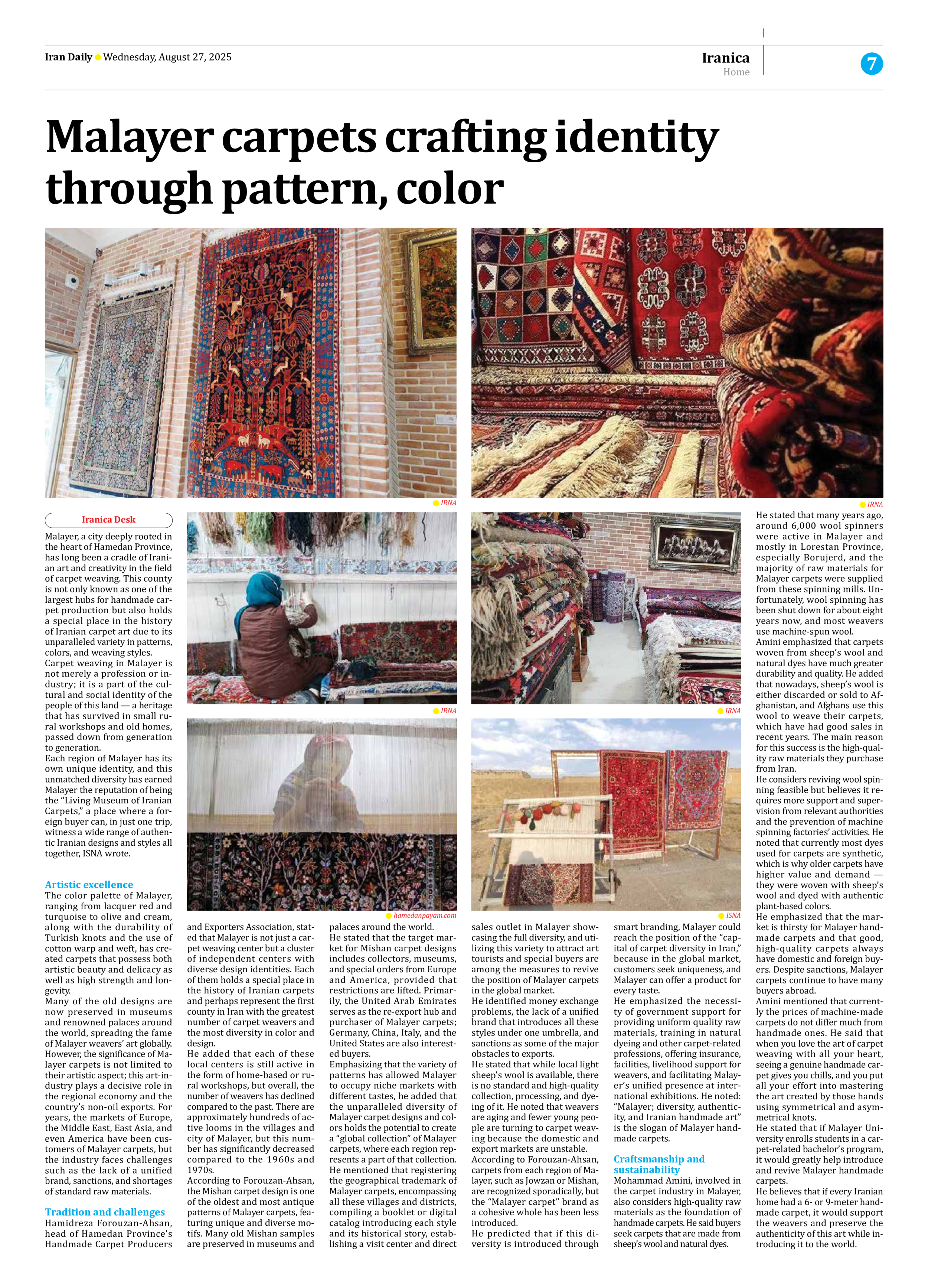
Malayer, a city deeply rooted in the heart of Hamedan Province, has long been a cradle of Iranian art and creativity in the field of carpet weaving. This county is not only known as one of the largest hubs for handmade carpet production but also holds a special place in the history of Iranian carpet art due to its unparalleled variety in patterns, colors, and weaving styles.
Carpet weaving in Malayer is not merely a profession or industry; it is a part of the cultural and social identity of the people of this land — a heritage that has survived in small rural workshops and old homes, passed down from generation to generation.
Each region of Malayer has its own unique identity, and this unmatched diversity has earned Malayer the reputation of being the “Living Museum of Iranian Carpets,” a place where a foreign buyer can, in just one trip, witness a wide range of authentic Iranian designs and styles all together, ISNA wrote.
Artistic excellence
The color palette of Malayer, ranging from lacquer red and turquoise to olive and cream, along with the durability of Turkish knots and the use of cotton warp and weft, has created carpets that possess both artistic beauty and delicacy as well as high strength and longevity.
Many of the old designs are now preserved in museums and renowned palaces around the world, spreading the fame of Malayer weavers’ art globally.
However, the significance of Malayer carpets is not limited to their artistic aspect; this art-industry plays a decisive role in the regional economy and the country’s non-oil exports. For years, the markets of Europe, the Middle East, East Asia, and even America have been customers of Malayer carpets, but the industry faces challenges such as the lack of a unified brand, sanctions, and shortages of standard raw materials.
Tradition and challenges
Hamidreza Forouzan-Ahsan, head of Hamedan Province’s Handmade Carpet Producers and Exporters Association, stated that Malayer is not just a carpet weaving center but a cluster of independent centers with diverse design identities. Each of them holds a special place in the history of Iranian carpets and perhaps represent the first county in Iran with the greatest number of carpet weavers and the most diversity in color and design.
He added that each of these local centers is still active in the form of home-based or rural workshops, but overall, the number of weavers has declined compared to the past. There are approximately hundreds of active looms in the villages and city of Malayer, but this number has significantly decreased compared to the 1960s and 1970s.
According to Forouzan-Ahsan, the Mishan carpet design is one of the oldest and most antique patterns of Malayer carpets, featuring unique and diverse motifs. Many old Mishan samples are preserved in museums and palaces around the world.
He stated that the target market for Mishan carpet designs includes collectors, museums, and special orders from Europe and America, provided that restrictions are lifted. Primarily, the United Arab Emirates serves as the re-export hub and purchaser of Malayer carpets; Germany, China, Italy, and the United States are also interested buyers.
Emphasizing that the variety of patterns has allowed Malayer to occupy niche markets with different tastes, he added that the unparalleled diversity of Malayer carpet designs and colors holds the potential to create a “global collection” of Malayer carpets, where each region represents a part of that collection.
He mentioned that registering the geographical trademark of Malayer carpets, encompassing all these villages and districts, compiling a booklet or digital catalog introducing each style and its historical story, establishing a visit center and direct sales outlet in Malayer showcasing the full diversity, and utilizing this variety to attract art tourists and special buyers are among the measures to revive the position of Malayer carpets in the global market.
He identified money exchange problems, the lack of a unified brand that introduces all these styles under one umbrella, and sanctions as some of the major obstacles to exports.
He stated that while local light sheep’s wool is available, there is no standard and high-quality collection, processing, and dyeing of it. He noted that weavers are aging and fewer young people are turning to carpet weaving because the domestic and export markets are unstable.
According to Forouzan-Ahsan, carpets from each region of Malayer, such as Jowzan or Mishan, are recognized sporadically, but the “Malayer carpet” brand as a cohesive whole has been less introduced.
He predicted that if this diversity is introduced through smart branding, Malayer could reach the position of the “capital of carpet diversity in Iran,” because in the global market, customers seek uniqueness, and Malayer can offer a product for every taste.
He emphasized the necessity of government support for providing uniform quality raw materials, training in natural dyeing and other carpet-related professions, offering insurance, facilities, livelihood support for weavers, and facilitating Malayer’s unified presence at international exhibitions. He noted: “Malayer; diversity, authenticity, and Iranian handmade art” is the slogan of Malayer handmade carpets.
Craftsmanship and sustainability
Mohammad Amini, involved in the carpet industry in Malayer, also considers high-quality raw materials as the foundation of handmade carpets. He said buyers seek carpets that are made from sheep’s wool and natural dyes.
He stated that many years ago, around 6,000 wool spinners were active in Malayer and mostly in Lorestan Province, especially Borujerd, and the majority of raw materials for Malayer carpets were supplied from these spinning mills. Unfortunately, wool spinning has been shut down for about eight years now, and most weavers use machine-spun wool.
Amini emphasized that carpets woven from sheep’s wool and natural dyes have much greater durability and quality. He added that nowadays, sheep’s wool is either discarded or sold to Afghanistan, and Afghans use this wool to weave their carpets, which have had good sales in recent years. The main reason for this success is the high-quality raw materials they purchase from Iran.
He considers reviving wool spinning feasible but believes it requires more support and supervision from relevant authorities and the prevention of machine spinning factories’ activities. He noted that currently most dyes used for carpets are synthetic, which is why older carpets have higher value and demand — they were woven with sheep’s wool and dyed with authentic plant-based colors.
He emphasized that the market is thirsty for Malayer handmade carpets and that good, high-quality carpets always have domestic and foreign buyers. Despite sanctions, Malayer carpets continue to have many buyers abroad.
Amini mentioned that currently the prices of machine-made carpets do not differ much from handmade ones. He said that when you love the art of carpet weaving with all your heart, seeing a genuine handmade carpet gives you chills, and you put all your effort into mastering the art created by those hands using symmetrical and asymmetrical knots.
He stated that if Malayer University enrolls students in a carpet-related bachelor’s program, it would greatly help introduce and revive Malayer handmade carpets.
He believes that if every Iranian home had a 6- or 9-meter handmade carpet, it would support the weavers and preserve the authenticity of this art while introducing it to the world.