







12 months of effort, 12 days of defense
Pezeshkian; voice of the voiceless
A year has rolled by since the incumbent Iranian government took office; After winning the people’s vote, Masoud Pezeshkian stepped up from the parliament to the presidency. He put together a government under the banner of “national unity,” one that brought on board all political factions. Even in appointing governors, Pezeshkian’s administration called in capable and efficient figures from various groups, regardless of whom they voted for in elections. He lined up the governors and gave this second cabinet the necessary authority to act as the provincial presidents “for Iran,” spearheading significant and valuable initiatives. Over the past 12 months, a special guest showed up regularly in most governors’ meetings; Pezeshkian would head out from his office to Fatemi Square and the Ministry of Interior building, where he spoke about a road map that must be drawn up and put into play jointly with experts and specialists for Iran’s development and progress.
His government also broke new ground with several “firsts”. For the first time, a woman was handed over the Iranian government’s spokesperson role. The president, who repeatedly promised to tap into the capacities of elites and ethnic groups, appointed for the first time an Arab governor for the Khuzestan Province, effectively breaking the spell. These measures all served one purpose. Pezeshkian had pinned two wings and a motto on his administration: “justice” and “fairness” as the right and left wings, respectively, and “National unity” as the government’s slogan. Accordingly, he stuck to this approach and motto in all his moves and appointments. Earlier, Fatemeh Mohajerani, the government spokesperson, stated in an interview that the realization of justice and fairness is only within reach through national unity. She identified the full implementation of the Seventh Development Plan as the government’s primary goal and stressed the necessity of justice in sectors like education and health, seen as the infrastructure for development.
So, what key actions has Pezeshkian’s government carried out over the past year? The Government Week offered an opportunity to lay out the achievements and plans of the executive branch for balanced development across the country, prioritizing underprivileged and deprived areas, along with implementing justice, eradicating discrimination and injustice with transparency and honesty.
National unity
At the very start, Pezeshkian, campaigning with the “national unity” slogan, managed to win over parliament to fully endorse all proposed cabinet members. Although midway, Abdolnasser Hemmati, minister of Economy, got off the government train following impeachment by parliamentarians, citing the need to solve the economic crisis and lower the foreign currency exchange rates, the unity remained intact. Since then, the chief executive has consistently kept the government on track toward unity.
Over the last year, regular sessions between heads of branches have been held at the presidential compound. Under this banner of unity and cooperation, other agencies and bodies also came on board. On February 4 last year, a meeting was called together to tackle people’s issues, attended by heads and deputies of the three branches.
Though Pezeshkian, by his own admission, does not belong to any political party, once he became the president, he sat down to discuss matters with all political parties and groups — from the conservative parties as government critics to the moderate and reformist parties and the central council of the House of Parties. He took on board their views and concerns. To keep things rolling more efficiently, the president even appointed a political parties and associations advisor, ensuring plans were implemented with tenacity and ideas didn’t gather dust in archives. Consequently, Pezeshkian’s unity approach over the past year has been greeted warmly by politicians.
Gov’t, Parliament converge for unity
In any case, political experts from all three camps — conservative, reformist, and moderate — agree that the government and Pezeshkian himself have been moving positively toward national unity. This means the president has not only remembered his slogan but has vigorously pursued it. He does not see unity as one-sided; He believes “Iran is for all Iranians,” and thus it is essential to lend an ear to all who care about the country. Over the year, Pezeshkian’s regular meetings with provincial assemblies of lawmakers have become one of the most important symbols of government-Parliament interaction; A chance that not only serves as a platform for airing constituency concerns but also can pave the way for synergy between branches to solve people’s issues.
Masoud Pezeshkian, with five parliamentary terms under his belt and essentially a “child of the parliament,” has shown from the start that this relationship is a strategic priority. With careful planning of provincial sessions and direct presence in parliament, he has fostered a constructive level of working relations with representatives. His regular consultative meetings with these provincial parliamentary assemblies stand as a primary channel for direct interaction between the executive and legislative branches.
These sessions open the door for issues and demands of constituencies to be conveyed directly by parliamentarians to the highest executive office in the country. Within this framework, the president has shown special attention to the continuity and effectiveness of this connection. Not only has he kept meetings with provincial assemblies in his regular schedule, but by attending multiple parliamentary sessions, he sent a clear message about the importance of unity and constructive cooperation between government and parliament to the lawmakers.
Gov’t stands alongside people
During election campaigns, Pezeshkian spoke candidly with the people, showed up among them, and heard their concerns and demands for the future president. Even after securing their votes, nothing about him changed; He remains the same Pezeshkian. He continues to show up alongside the people and has taken the caravan of unity from Tehran to the provinces to prove that centralized, headquarters-based management is not his style. Field supervision has become one of the fixed parts of his work, regularly checking in on most governmental bodies and ministries.
Pezeshkian does not bow down to ceremonial protocols but remains true to the Nahj al-Balagha teachings of Imam Ali (PBUH). His red line is flattery and excessive praise, which he cautions his close aides and colleagues against. On July 31, in an unannounced trip, he dropped by Zanjan Province, and at a session on the school-building movement and educational justice, he sincerely gave a heads-up to his longtime friend Mohammad Jafar Qaempanah, the executive deputy to the president, urging him to keep talking about the issues instead of praising him. When he went to Ilam Province and listened to a young woman’s account of problems with school construction, he could not hold back his tears; His eyes filled with moisture as he said, “If the people step up and get involved, they can do things the government [managers and officials] cannot.” Pezeshkian’s tearful words carry a message: He is one of the people. He feels their pain deeply and strives, far from slogans, to iron out their problems and challenges.
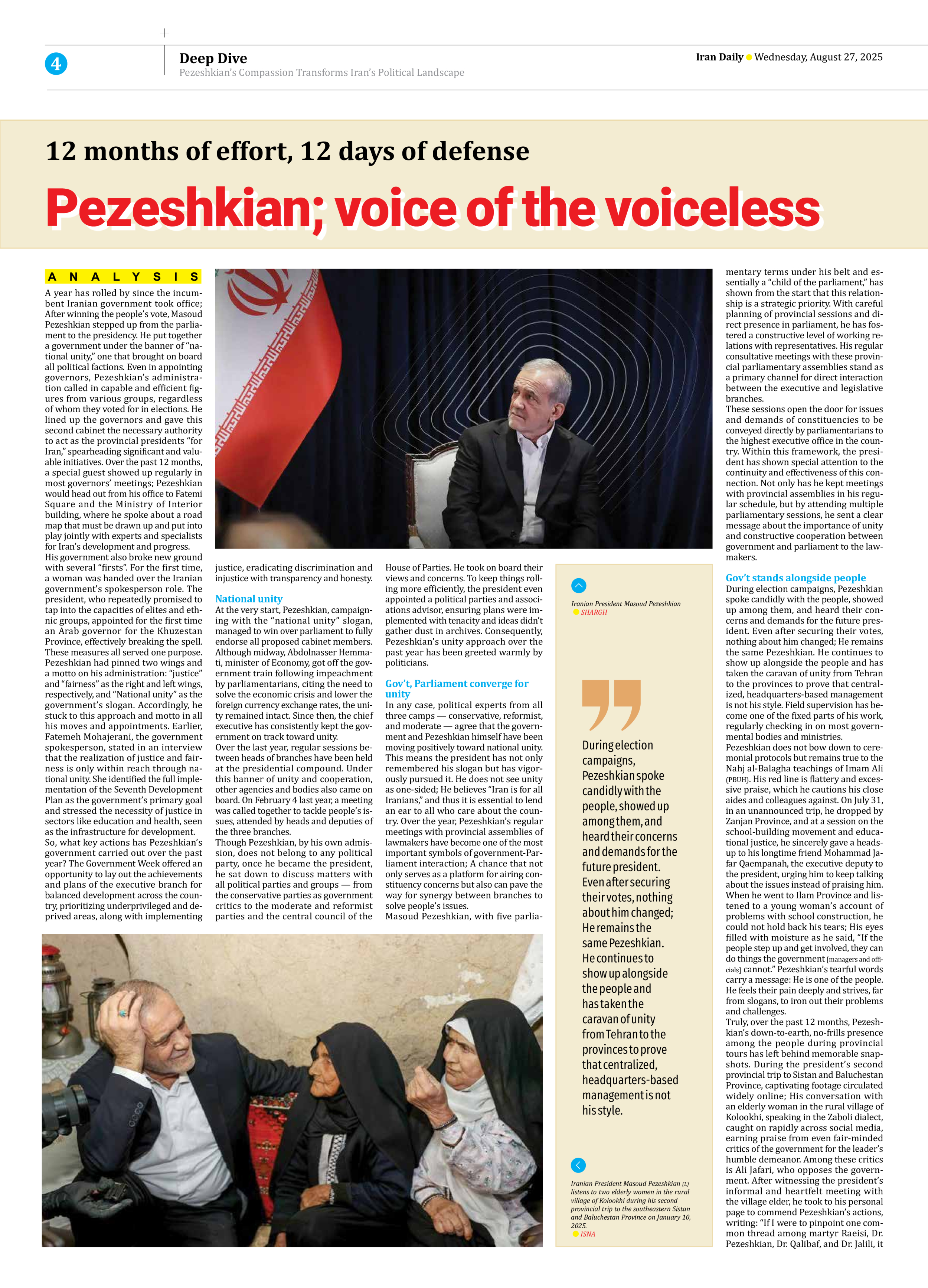
Truly, over the past 12 months, Pezeshkian’s down-to-earth, no-frills presence among the people during provincial tours has left behind memorable snapshots. During the president’s second provincial trip to Sistan and Baluchestan Province, captivating footage circulated widely online; His conversation with an elderly woman in the rural village of Kolookhi, speaking in the Zaboli dialect, caught on rapidly across social media, earning praise from even fair-minded critics of the government for the leader’s humble demeanor. Among these critics is Ali Jafari, who opposes the government. After witnessing the president’s informal and heartfelt meeting with the village elder, he took to his personal page to commend Pezeshkian’s actions, writing: “If I were to pinpoint one common thread among martyr Raeisi, Dr. Pezeshkian, Dr. Qalibaf, and Dr. Jalili, it would be nothing but a spirit of public relations and humility toward the underprivileged. Despite all theoretical and performance criticisms critics may throw at these dear figures, this spirit is invaluable. Even if we write off these images as mere showmanship, they deserve appreciation and reinforcement.”
Since August 2024 through September 2025, the president of the government of national unity has shown up on provincial trips not only to be the voice of the voiceless but to follow up on their concerns and demands. He makes it a point to hold back from speeches and prefers to be a listener, so he can practically work out solutions to their issues. Therefore, one can confidently say: Pezeshkian has truly carried out the Leader’s directive from August 27, 2024, urging government officials to be present among the people despite accusations that provincial trips amount to “populism or demagoguery”. The Leader emphasized that understanding the real lives of people cannot be done through paperwork or reports alone, hence the importance of direct visits, especially to rural areas, and making decisions based on firsthand observations and input. Pezeshkian has put this into action and kept the government close to the people.
Educational justice
Education is recognized as one of the essential pillars of sustainable development, but challenges within the education system may throw a wrench into achieving educational justice. Accordingly, focusing on this matter is crucial, and “educational justice” has become a key phrase of the government of unity.
The core program Pezeshkian follows up on during provincial tours is the construction of schools and achieving educational justice through the “school-building movement” and the elimination of educational discrimination. He simply cannot visit a province without taking stock of the movement to expand educational justice. In this vein, the president himself rolled up his sleeves and laid down the symbolic “first brick” of the educational justice movement: During a trip to Khuzestan Province, Pezeshkian took part in the bricklaying of a 15-classroom school in a deprived and densely populated area of Ahvaz. This demonstrated his commitment to his promise to even serve as a laborer if needed to bridge the shortage of educational facilities.
The president has frequently expressed deep concern about children studying in makeshift, thatched-roof schools and stressed that while building schools is crucial, the transformation of education cannot stop at infrastructure. Building schools is just the first step; Improving the quality of education in schools is the real crux. He believes that we must teach the youth of this land in a way that brings their talents to light, so they can move forward on the path of growth and development — only then will the country be prosperous.
Engaging the public has always been Pezeshkian’s core trait and belief. Throughout his various roles — from dean of the Medical Sciences Faculty at Tabriz University of Medical Sciences to minister of Health and lawmaker from Tabriz city — he has emphasized public involvement and participation. Now, as president of the Islamic Republic of Iran, he continues to hold this conviction. Hence, he has stepped up to say that everyone must pitch in for reconstruction efforts. The president has even shown he is ready to pick up a shovel, despite some calling it “populism” or demagoguery, to break a sweat for educational justice and send a clear message to officials about its priority. Moreover, the current government has, over the past year, called on the capacities of other organizations such as the Mostazafan Foundation and the Basij Organization to join forces for educational justice, aiming to resolve the long-standing issue of thatched-roof schools and build facilities worthy of Iran and its people, and raising the flag of justice in the education system.
If we call “educational justice” the most important achievement of the incumbent government, it would not be an exaggeration. In this area, Pezeshkian has, like in two other sectors, managed to establish an acceptable record. Of course, this does not mean that the work is done. There is plenty left to do, yet it must be acknowledged that Pezeshkian and his administration are wholeheartedly committed to breathing fresh air into the education system through public participation. They have clearly demonstrated how deeply they care about educational justice over this past year.
Strengthening neighborhood diplomacy
Maintaining internal unity and cohesion alongside dialogue and interaction with the world is the cornerstone of Pezeshkian’s government policy. He does not see the world limited to Europe and the West but has forged good and amicable ties with other countries, especially neighbors.
“Our first priority in foreign policy is to beef up relations with neighbors. We must strengthen ties with neighboring countries like Turkey, Turkmenistan, Azerbaijan, Afghanistan, Pakistan, Iraq, and the Persian Gulf states.”
Pezeshkian made this clear with an oral directive to the Foreign Ministry on July 25, 2024, signaling that his vision and that of the government center on relations with neighbors and aligned countries. Accordingly, he recently took off for Armenia, Belarus, and Pakistan, underlining that the focal point of Iran’s foreign policy is its neighbors. Despite enemies’ conspiracies and obstacles, Pezeshkian’s government has sought to carry on pursuing national interests through good neighborliness policies and balanced engagement. The president’s visits to friendly and neighboring countries like Iraq, Qatar, Tajikistan, Azerbaijan, Oman, and Turkmenistan have become a clear symbol of the commitment to strengthen and develop regional relations.
On September 25, 2024, during his first speech at the United Nations, Pezeshkian shared his programs with other heads of state, recalling that he entered the election race with a platform based on “reforms,” “national unity,” “constructive engagement with the world,” and “economic development,” and succeeded in earning the trust of Iranians at the ballot box. He stated his intention to lay firm foundations for his country’s entry into a new era and constructive, effective participation in the emerging global order, to iron out challenges and to restructure his nation’s relations based on the demands and realities of today’s world.
Furthermore, his government — within the framework of balanced interaction with countries such as Russia and Egypt and by participating in regional and international organizations — has sought multilateralism and enhanced economic ties with other countries in the world.
One cannot brush past the extraordinary coordination that has come about between the different wings of the Islamic Establishment in the era of unity. Since the post-election period, Pezeshkian has established a fortunate link between “the field” and “diplomacy,” vividly demonstrated in the crushing True Promise III Operation, which delivered a firm response to the Israeli aggressor.
During that imposed war, not only the armed forces defended the Islamic Republic’s integrity in the war room, but Foreign Minister Abbas Araghchi, through his travels and negotiations, spoke up in the language of diplomacy to regional and European counterparts, affirming Iran’s right to legitimate self-defense.
Majid Nasirpour, representative of Sarab city and member of parliament’s Social Committee, noted in an interview with IRNA: “To run the country effectively, we inevitably need to show up actively in all arenas. Just as everyone acknowledges our military as a deterrent, naturally, many issues in international fields require follow-up and negotiation. During this time, we have witnessed full coordination between the field and diplomacy, both moving in tandem toward our national goals and interests.”
Iranian statesmen also give props to the collaboration between the armed forces and diplomats. Araghchi, during Pezeshkian’s visit to the Foreign Ministry, highlighted the blessed bond formed between diplomacy and the field in the era of unity. He said: “Just as our armed forces defended the country with full power, our diplomats also defended Iran’s just cause, victimhood, and legitimacy with strength, and the government’s performance in this regard was remarkable.”
Security, Education, and Healthcare stand as three key sectors for the incumbent Iranian government. Mohammad-Sadegh Javadihesar, spokesperson for the Etemad Melli Party, considers Pezeshkian’s performance in security highly commendable. Maintaining that Pezeshkian is one of the humblest presidents in national security, he added: “Dr. Pezeshkian has acted fully in line with the Leader’s guidance, fully recognizing and embracing their role in managing the country’s macro affairs. Some may doubt the president’s scope of authority, but in my view, he has operated well within his powers and excellently maintained necessary coordination with the Leader in appropriate cases.”
All in all, the current government has taken steps forward in developing international relations, and Pezeshkian has come out with his head held high by fulfilling another demand of the Leader of Iran’s Islamic Revolution Ayatollah Seyyed Ali Khamenei to strengthen relations with neighbors.
Now, with Pezeshkian’s successful foreign policy performance, we can make a fair judgment about what has been accomplished in the past year.
Energy consumption pattern reform
Earlier this year, the president opened up about a major program he personally keeps tabs on daily. On April 17, 2025, Pezeshkian stated, “I personally follow up day by day on resolving energy shortages, and this issue is at the very top of the government’s action plan.”
In line with this, a crucial move was made. Now, public sector offices, ministries, and agencies will have to cover most of their electricity needs through solar energy. Hence, the government kicked off tackling the power shortage. On June 8, 2025, with the executive deputy president attending, solar panels were installed at the presidential compound, sending a clear message that the current government is serious about addressing power shortage via solar energy as the initiative started right at government headquarters.
But why is the president so keen on public sector bodies upping their use of solar energy? The reality is that public offices and the public sector have a significant and growing share of electricity consumption. Studies show the country’s total peak electricity demand reaches 90,000 megawatts. The current electrical deficit is approximately 30,000 megawatts, which the government aims to wipe out by March 2026 — with public cooperation in electricity consumption, of course. These figures highlight the importance of managing consumption and expanding renewable energy sources like solar panels in government offices and other sectors, such as industrial parks, to ease the strain on the country’s power network.
Final word
Healthcare justice, increasing the role of culture and art communities in cultural governance, reforming procedures, and cost-saving measures can also be checked off among the successful and promising achievements of the Pezeshkian government over the past year. For instance, when energy shortages intensified, at the president’s order, all lights and lamps at the presidential office’s compound were switched off.
All in all, what has been outlined is just a snapshot of the most important activities of the government of national unity over the past year. Officials in various executive and administrative sectors will soon hand over a report of the measures taken. However, a quick review of accomplishments shows Pezeshkian has, over the past year, kept away from “political sloganeering and campaign rhetoric,” worked genuinely for the people and for Iran, did not make promises that he could not fulfill, and dedicated himself and his government to realizing the Leader’s directives. He has not fed into polarization, commotions, or political games, consistently believing that moments of service must be used for more work and effort. Accordingly, after the election, he put aside competition and shook hands with his rivals to collectively piece together the puzzle of Iran’s development and progress.
Naturally, during Government Week, we heard more about completed and forthcoming projects. Based on available data, the government of national unity’s hands are fully loaded to publicly defend a respectable record on its first anniversary.
The full article first appeared in Persian on IRNA.