







Tar virtuoso birthday
Alizadeh turns every note into a new chapter of Iran’s musical story
By Neda Sijani
Staff writer
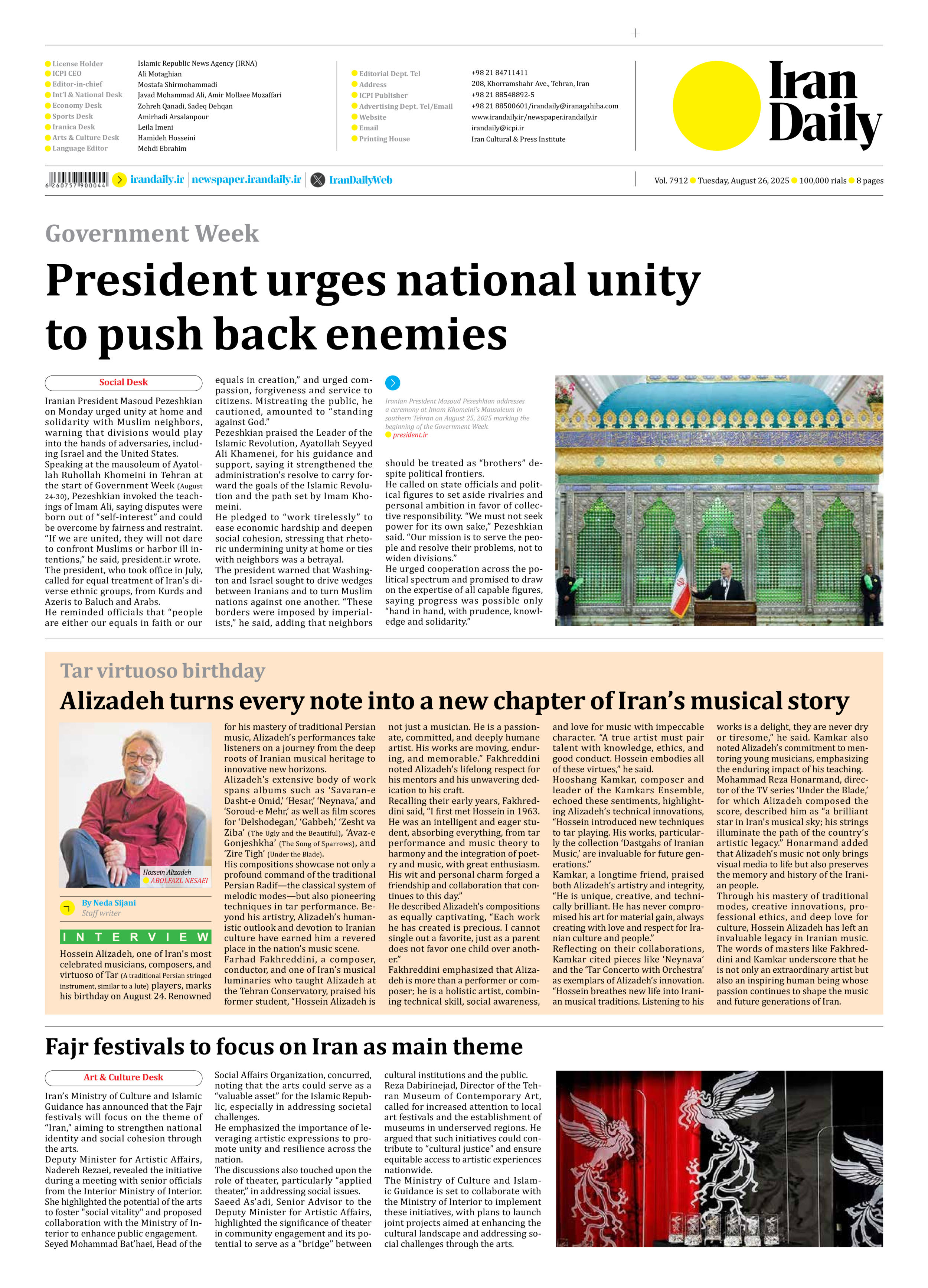
Hossein Alizadeh, one of Iran’s most celebrated musicians, composers, and virtuoso of Tar (A traditional Persian stringed instrument, similar to a lute) players, marks his birthday on August 24. Renowned for his mastery of traditional Persian music, Alizadeh’s performances take listeners on a journey from the deep roots of Iranian musical heritage to innovative new horizons.
Alizadeh’s extensive body of work spans albums such as ‘Savaran-e Dasht-e Omid,’ ‘Hesar,’ ‘Neynava,’ and ‘Soroud-e Mehr,’ as well as film scores for ‘Delshodegan,’ ‘Gabbeh,’ ‘Zesht va Ziba’ (The Ugly and the Beautiful), ‘Avaz-e Gonjeshkha’ (The Song of Sparrows), and ‘Zire Tigh’ (Under the Blade).
His compositions showcase not only a profound command of the traditional Persian Radif—the classical system of melodic modes—but also pioneering techniques in tar performance. Beyond his artistry, Alizadeh’s humanistic outlook and devotion to Iranian culture have earned him a revered place in the nation’s music scene.
Farhad Fakhreddini, a composer, conductor, and one of Iran’s musical luminaries who taught Alizadeh at the Tehran Conservatory, praised his former student, “Hossein Alizadeh is not just a musician. He is a passionate, committed, and deeply humane artist. His works are moving, enduring, and memorable.” Fakhreddini noted Alizadeh’s lifelong respect for his mentors and his unwavering dedication to his craft.
Recalling their early years, Fakhreddini said, “I first met Hossein in 1963. He was an intelligent and eager student, absorbing everything, from tar performance and music theory to harmony and the integration of poetry and music, with great enthusiasm. His wit and personal charm forged a friendship and collaboration that continues to this day.”
He described Alizadeh’s compositions as equally captivating, “Each work he has created is precious. I cannot single out a favorite, just as a parent does not favor one child over another.”
Fakhreddini emphasized that Alizadeh is more than a performer or composer; he is a holistic artist, combining technical skill, social awareness, and love for music with impeccable character. “A true artist must pair talent with knowledge, ethics, and good conduct. Hossein embodies all of these virtues,” he said.
Hooshang Kamkar, composer and leader of the Kamkars Ensemble, echoed these sentiments, highlighting Alizadeh’s technical innovations, “Hossein introduced new techniques to tar playing. His works, particularly the collection ‘Dastgahs of Iranian Music,’ are invaluable for future generations.”
Kamkar, a longtime friend, praised both Alizadeh’s artistry and integrity, “He is unique, creative, and technically brilliant. He has never compromised his art for material gain, always creating with love and respect for Iranian culture and people.”
Reflecting on their collaborations, Kamkar cited pieces like ‘Neynava’ and the ‘Tar Concerto with Orchestra’ as exemplars of Alizadeh’s innovation. “Hossein breathes new life into Iranian musical traditions. Listening to his works is a delight, they are never dry or tiresome,” he said. Kamkar also noted Alizadeh’s commitment to mentoring young musicians, emphasizing the enduring impact of his teaching.
Mohammad Reza Honarmand, director of the TV series ‘Under the Blade,’ for which Alizadeh composed the score, described him as “a brilliant star in Iran’s musical sky; his strings illuminate the path of the country’s artistic legacy.” Honarmand added that Alizadeh’s music not only brings visual media to life but also preserves the memory and history of the Iranian people.
Through his mastery of traditional modes, creative innovations, professional ethics, and deep love for culture, Hossein Alizadeh has left an invaluable legacy in Iranian music. The words of masters like Fakhreddini and Kamkar underscore that he is not only an extraordinary artist but also an inspiring human being whose passion continues to shape the music and future generations of Iran.