





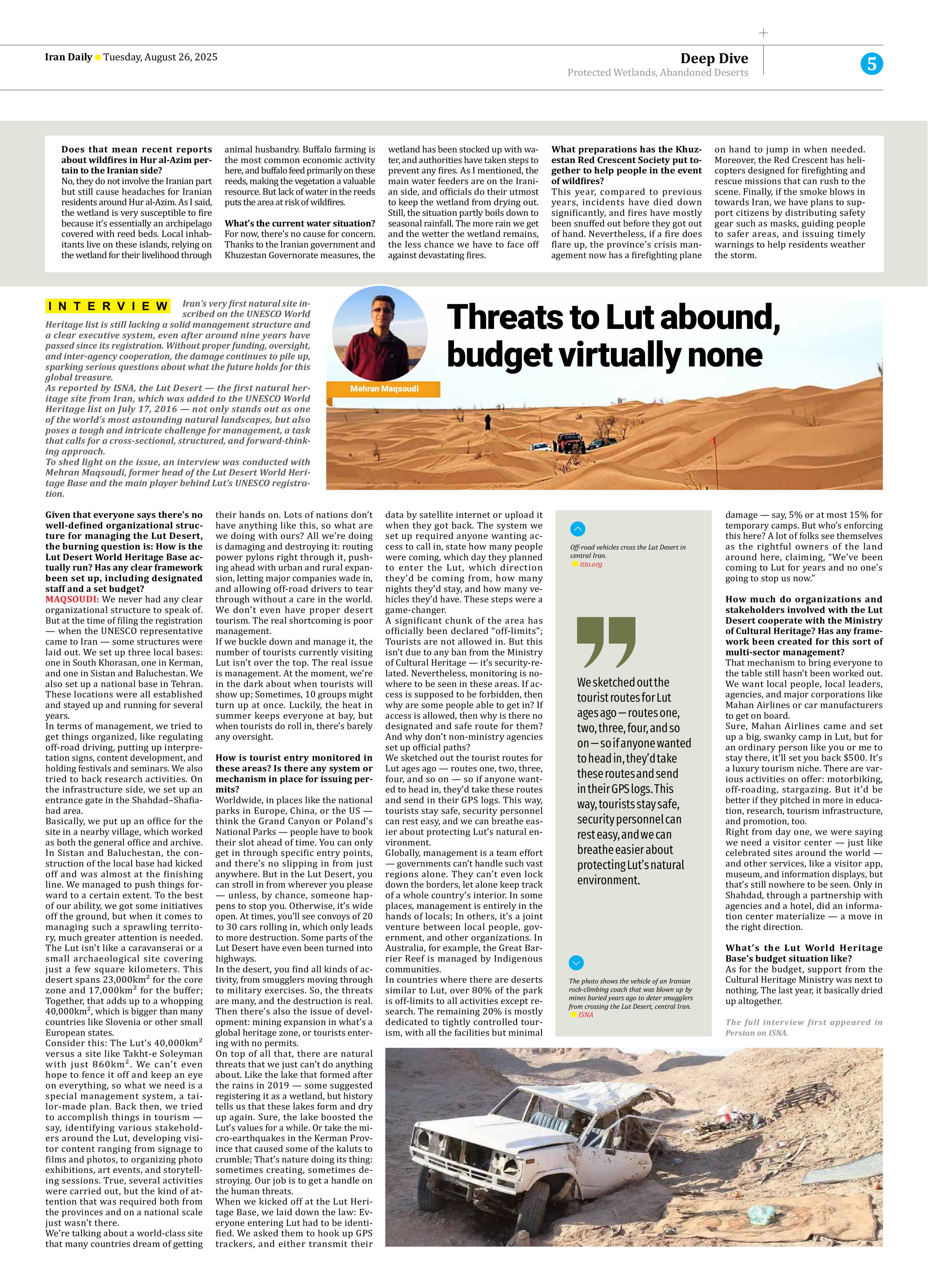


Threats to Lut abound, budget virtually none
Iran’s very first natural site inscribed on the UNESCO World Heritage list is still lacking a solid management structure and a clear executive system, even after around nine years have passed since its registration. Without proper funding, oversight, and inter-agency cooperation, the damage continues to pile up, sparking serious questions about what the future holds for this global treasure. As reported by ISNA, the Lut Desert — the first natural heritage site from Iran, which was added to the UNESCO World Heritage list on July 17, 2016 — not only stands out as one of the world’s most astounding natural landscapes, but also poses a tough and intricate challenge for management, a task that calls for a cross-sectional, structured, and forward-thinking approach. To shed light on the issue, an interview was conducted with Mehran Maqsoudi, former head of the Lut Desert World Heritage Base and the main player behind Lut’s UNESCO registration.
Given that everyone says there’s no well-defined organizational structure for managing the Lut Desert, the burning question is: How is the Lut Desert World Heritage Base actually run? Has any clear framework been set up, including designated staff and a set budget?
MAQSOUDI: We never had any clear organizational structure to speak of. But at the time of filing the registration — when the UNESCO representative came to Iran — some structures were laid out. We set up three local bases: one in South Khorasan, one in Kerman, and one in Sistan and Baluchestan. We also set up a national base in Tehran. These locations were all established and stayed up and running for several years.
In terms of management, we tried to get things organized, like regulating off-road driving, putting up interpretation signs, content development, and holding festivals and seminars. We also tried to back research activities. On the infrastructure side, we set up an entrance gate in the Shahdad–Shafiabad area.
Basically, we put up an office for the site in a nearby village, which worked as both the general office and archive. In Sistan and Baluchestan, the construction of the local base had kicked off and was almost at the finishing line. We managed to push things forward to a certain extent. To the best of our ability, we got some initiatives off the ground, but when it comes to managing such a sprawling territory, much greater attention is needed. The Lut isn’t like a caravanserai or a small archaeological site covering just a few square kilometers. This desert spans 23,000km² for the core zone and 17,000km² for the buffer; Together, that adds up to a whopping 40,000km², which is bigger than many countries like Slovenia or other small European states.
Consider this: The Lut’s 40,000km² versus a site like Takht-e Soleyman with just 860km². We can’t even hope to fence it off and keep an eye on everything, so what we need is a special management system, a tailor-made plan. Back then, we tried to accomplish things in tourism — say, identifying various stakeholders around the Lut, developing visitor content ranging from signage to films and photos, to organizing photo exhibitions, art events, and storytelling sessions. True, several activities were carried out, but the kind of attention that was required both from the provinces and on a national scale just wasn’t there.
We’re talking about a world-class site that many countries dream of getting their hands on. Lots of nations don’t have anything like this, so what are we doing with ours? All we’re doing is damaging and destroying it: routing power pylons right through it, pushing ahead with urban and rural expansion, letting major companies wade in, and allowing off-road drivers to tear through without a care in the world. We don’t even have proper desert tourism. The real shortcoming is poor management.
If we buckle down and manage it, the number of tourists currently visiting Lut isn’t over the top. The real issue is management. At the moment, we’re in the dark about when tourists will show up; Sometimes, 10 groups might turn up at once. Luckily, the heat in summer keeps everyone at bay, but when tourists do roll in, there’s barely any oversight.
How is tourist entry monitored in these areas? Is there any system or mechanism in place for issuing permits?
Worldwide, in places like the national parks in Europe, China, or the US — think the Grand Canyon or Poland’s National Parks — people have to book their slot ahead of time. You can only get in through specific entry points, and there’s no slipping in from just anywhere. But in the Lut Desert, you can stroll in from wherever you please — unless, by chance, someone happens to stop you. Otherwise, it’s wide open. At times, you’ll see convoys of 20 to 30 cars rolling in, which only leads to more destruction. Some parts of the Lut Desert have even been turned into highways.
In the desert, you find all kinds of activity, from smugglers moving through to military exercises. So, the threats are many, and the destruction is real. Then there’s also the issue of development: mining expansion in what’s a global heritage zone, or tourists entering with no permits.
On top of all that, there are natural threats that we just can’t do anything about. Like the lake that formed after the rains in 2019 — some suggested registering it as a wetland, but history tells us that these lakes form and dry up again. Sure, the lake boosted the Lut’s values for a while. Or take the micro-earthquakes in the Kerman Province that caused some of the kaluts to crumble; That’s nature doing its thing: sometimes creating, sometimes destroying. Our job is to get a handle on the human threats.
When we kicked off at the Lut Heritage Base, we laid down the law: Everyone entering Lut had to be identified. We asked them to hook up GPS trackers, and either transmit their data by satellite internet or upload it when they got back. The system we set up required anyone wanting access to call in, state how many people were coming, which day they planned to enter the Lut, which direction they’d be coming from, how many nights they’d stay, and how many vehicles they’d have. These steps were a game-changer.
A significant chunk of the area has officially been declared “off-limits”; Tourists are not allowed in. But this isn’t due to any ban from the Ministry of Cultural Heritage — it’s security-related. Nevertheless, monitoring is nowhere to be seen in these areas. If access is supposed to be forbidden, then why are some people able to get in? If access is allowed, then why is there no designated and safe route for them? And why don’t non-ministry agencies set up official paths?
We sketched out the tourist routes for Lut ages ago — routes one, two, three, four, and so on — so if anyone wanted to head in, they’d take these routes and send in their GPS logs. This way, tourists stay safe, security personnel can rest easy, and we can breathe easier about protecting Lut’s natural environment.
Globally, management is a team effort — governments can’t handle such vast regions alone. They can’t even lock down the borders, let alone keep track of a whole country’s interior. In some places, management is entirely in the hands of locals; In others, it’s a joint venture between local people, government, and other organizations. In Australia, for example, the Great Barrier Reef is managed by Indigenous communities.
In countries where there are deserts similar to Lut, over 80% of the park is off-limits to all activities except research. The remaining 20% is mostly dedicated to tightly controlled tourism, with all the facilities but minimal damage — say, 5% or at most 15% for temporary camps. But who’s enforcing this here? A lot of folks see themselves as the rightful owners of the land around here, claiming, “We’ve been coming to Lut for years and no one’s going to stop us now.”
How much do organizations and stakeholders involved with the Lut Desert cooperate with the Ministry of Cultural Heritage? Has any framework been created for this sort of multi-sector management?
That mechanism to bring everyone to the table still hasn’t been worked out. We want local people, local leaders, agencies, and major corporations like Mahan Airlines or car manufacturers to get on board.
Sure, Mahan Airlines came and set up a big, swanky camp in Lut, but for an ordinary person like you or me to stay there, it’ll set you back $500. It’s a luxury tourism niche. There are various activities on offer: motorbiking, off-roading, stargazing. But it’d be better if they pitched in more in education, research, tourism infrastructure, and promotion, too.
Right from day one, we were saying we need a visitor center — just like celebrated sites around the world — and other services, like a visitor app, museum, and information displays, but that’s still nowhere to be seen. Only in Shahdad, through a partnership with agencies and a hotel, did an information center materialize — a move in the right direction.
What’s the Lut World Heritage Base’s budget situation like?
As for the budget, support from the Cultural Heritage Ministry was next to nothing. The last year, it basically dried up altogether.
The full interview first appeared in
Persian on ISNA.