







Head of Khuzestan Province Red Crescent Society:
‘Iranians pay price’ for Hur al-Azim’s wildfire in Iraq
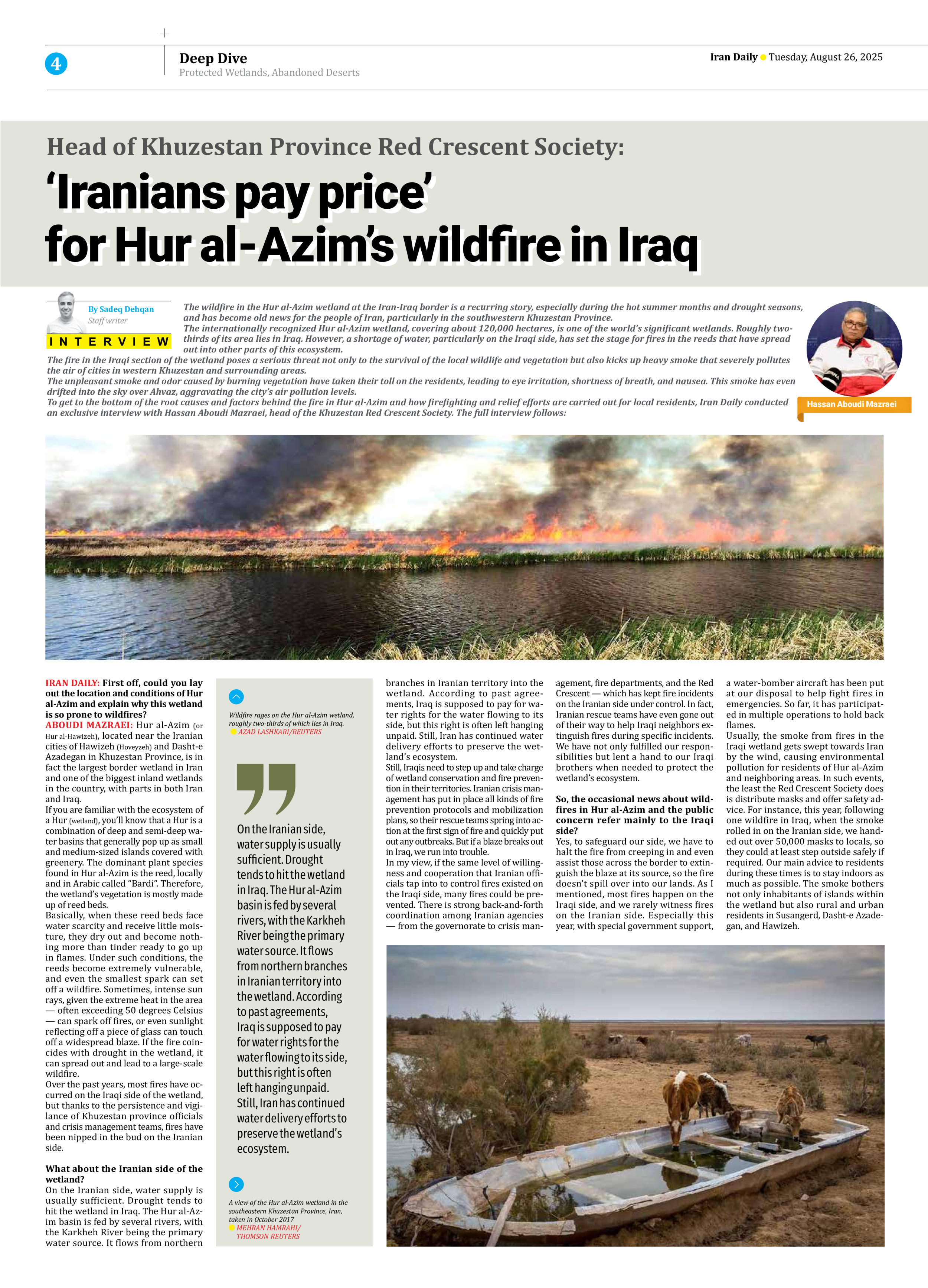
The wildfire in the Hur al-Azim wetland at the Iran-Iraq border is a recurring story, especially during the hot summer months and drought seasons, and has become old news for the people of Iran, particularly in the southwestern Khuzestan Province. The internationally recognized Hur al-Azim wetland, covering about 120,000 hectares, is one of the world’s significant wetlands. Roughly two-thirds of its area lies in Iraq. However, a shortage of water, particularly on the Iraqi side, has set the stage for fires in the reeds that have spread out into other parts of this ecosystem. The fire in the Iraqi section of the wetland poses a serious threat not only to the survival of the local wildlife and vegetation but also kicks up heavy smoke that severely pollutes the air of cities in western Khuzestan and surrounding areas. The unpleasant smoke and odor caused by burning vegetation have taken their toll on the residents, leading to eye irritation, shortness of breath, and nausea. This smoke has even drifted into the sky over Ahvaz, aggravating the city’s air pollution levels. To get to the bottom of the root causes and factors behind the fire in Hur al-Azim and how firefighting and relief efforts are carried out for local residents, Iran Daily conducted an exclusive interview with Hassan Aboudi Mazraei, head of the Khuzestan Red Crescent Society. The full interview follows:
By Sadeq Dehqan
Staff writer
IRAN DAILY: First off, could you lay out the location and conditions of Hur al-Azim and explain why this wetland is so prone to wildfires?
ABOUDI MAZRAEI: Hur al-Azim (or Hur al-Hawizeh), located near the Iranian cities of Hawizeh (Hoveyzeh) and Dasht-e Azadegan in Khuzestan Province, is in fact the largest border wetland in Iran and one of the biggest inland wetlands in the country, with parts in both Iran and Iraq.
If you are familiar with the ecosystem of a Hur (wetland), you’ll know that a Hur is a combination of deep and semi-deep water basins that generally pop up as small and medium-sized islands covered with greenery. The dominant plant species found in Hur al-Azim is the reed, locally and in Arabic called “Bardi”. Therefore, the wetland’s vegetation is mostly made up of reed beds.
Basically, when these reed beds face water scarcity and receive little moisture, they dry out and become nothing more than tinder ready to go up in flames. Under such conditions, the reeds become extremely vulnerable, and even the smallest spark can set off a wildfire. Sometimes, intense sun rays, given the extreme heat in the area — often exceeding 50 degrees Celsius — can spark off fires, or even sunlight reflecting off a piece of glass can touch off a widespread blaze. If the fire coincides with drought in the wetland, it can spread out and lead to a large-scale wildfire.
Over the past years, most fires have occurred on the Iraqi side of the wetland, but thanks to the persistence and vigilance of Khuzestan province officials and crisis management teams, fires have been nipped in the bud on the Iranian side.
What about the Iranian side of the wetland?
On the Iranian side, water supply is usually sufficient. Drought tends to hit the wetland in Iraq. The Hur al-Azim basin is fed by several rivers, with the Karkheh River being the primary water source. It flows from northern branches in Iranian territory into the wetland. According to past agreements, Iraq is supposed to pay for water rights for the water flowing to its side, but this right is often left hanging unpaid. Still, Iran has continued water delivery efforts to preserve the wetland’s ecosystem.
Still, Iraqis need to step up and take charge of wetland conservation and fire prevention in their territories. Iranian crisis management has put in place all kinds of fire prevention protocols and mobilization plans, so their rescue teams spring into action at the first sign of fire and quickly put out any outbreaks. But if a blaze breaks out in Iraq, we run into trouble.
In my view, if the same level of willingness and cooperation that Iranian officials tap into to control fires existed on the Iraqi side, many fires could be prevented. There is strong back-and-forth coordination among Iranian agencies — from the governorate to crisis management, fire departments, and the Red Crescent — which has kept fire incidents on the Iranian side under control. In fact, Iranian rescue teams have even gone out of their way to help Iraqi neighbors extinguish fires during specific incidents. We have not only fulfilled our responsibilities but lent a hand to our Iraqi brothers when needed to protect the wetland’s ecosystem.
So, the occasional news about wildfires in Hur al-Azim and the public concern refer mainly to the Iraqi side?
Yes, to safeguard our side, we have to halt the fire from creeping in and even assist those across the border to extinguish the blaze at its source, so the fire doesn’t spill over into our lands. As I mentioned, most fires happen on the Iraqi side, and we rarely witness fires on the Iranian side. Especially this year, with special government support, a water-bomber aircraft has been put at our disposal to help fight fires in emergencies. So far, it has participated in multiple operations to hold back flames.
Usually, the smoke from fires in the Iraqi wetland gets swept towards Iran by the wind, causing environmental pollution for residents of Hur al-Azim and neighboring areas. In such events, the least the Red Crescent Society does is distribute masks and offer safety advice. For instance, this year, following one wildfire in Iraq, when the smoke rolled in on the Iranian side, we handed out over 50,000 masks to locals, so they could at least step outside safely if required. Our main advice to residents during these times is to stay indoors as much as possible. The smoke bothers not only inhabitants of islands within the wetland but also rural and urban residents in Susangerd, Dasht-e Azadegan, and Hawizeh.
Does that mean recent reports about wildfires in Hur al-Azim pertain to the Iranian side?
No, they do not involve the Iranian part but still cause headaches for Iranian residents around Hur al-Azim. As I said, the wetland is very susceptible to fire because it’s essentially an archipelago covered with reed beds. Local inhabitants live on these islands, relying on the wetland for their livelihood through animal husbandry. Buffalo farming is the most common economic activity here, and buffalo feed primarily on these reeds, making the vegetation a valuable resource. But lack of water in the reeds puts the area at risk of wildfires.
What’s the current water situation?
For now, there’s no cause for concern. Thanks to the Iranian government and Khuzestan Governorate measures, the wetland has been stocked up with water, and authorities have taken steps to prevent any fires. As I mentioned, the main water feeders are on the Iranian side, and officials do their utmost to keep the wetland from drying out. Still, the situation partly boils down to seasonal rainfall. The more rain we get and the wetter the wetland remains, the less chance we have to face off against devastating fires.
What preparations has the Khuzestan Red Crescent Society put together to help people in the event of wildfires?
This year, compared to previous years, incidents have died down significantly, and fires have mostly been snuffed out before they got out of hand. Nevertheless, if a fire does flare up, the province’s crisis management now has a firefighting plane on hand to jump in when needed. Moreover, the Red Crescent has helicopters designed for firefighting and rescue missions that can rush to the scene. Finally, if the smoke blows in towards Iran, we have plans to support citizens by distributing safety gear such as masks, guiding people to safer areas, and issuing timely warnings to help residents weather the storm.