





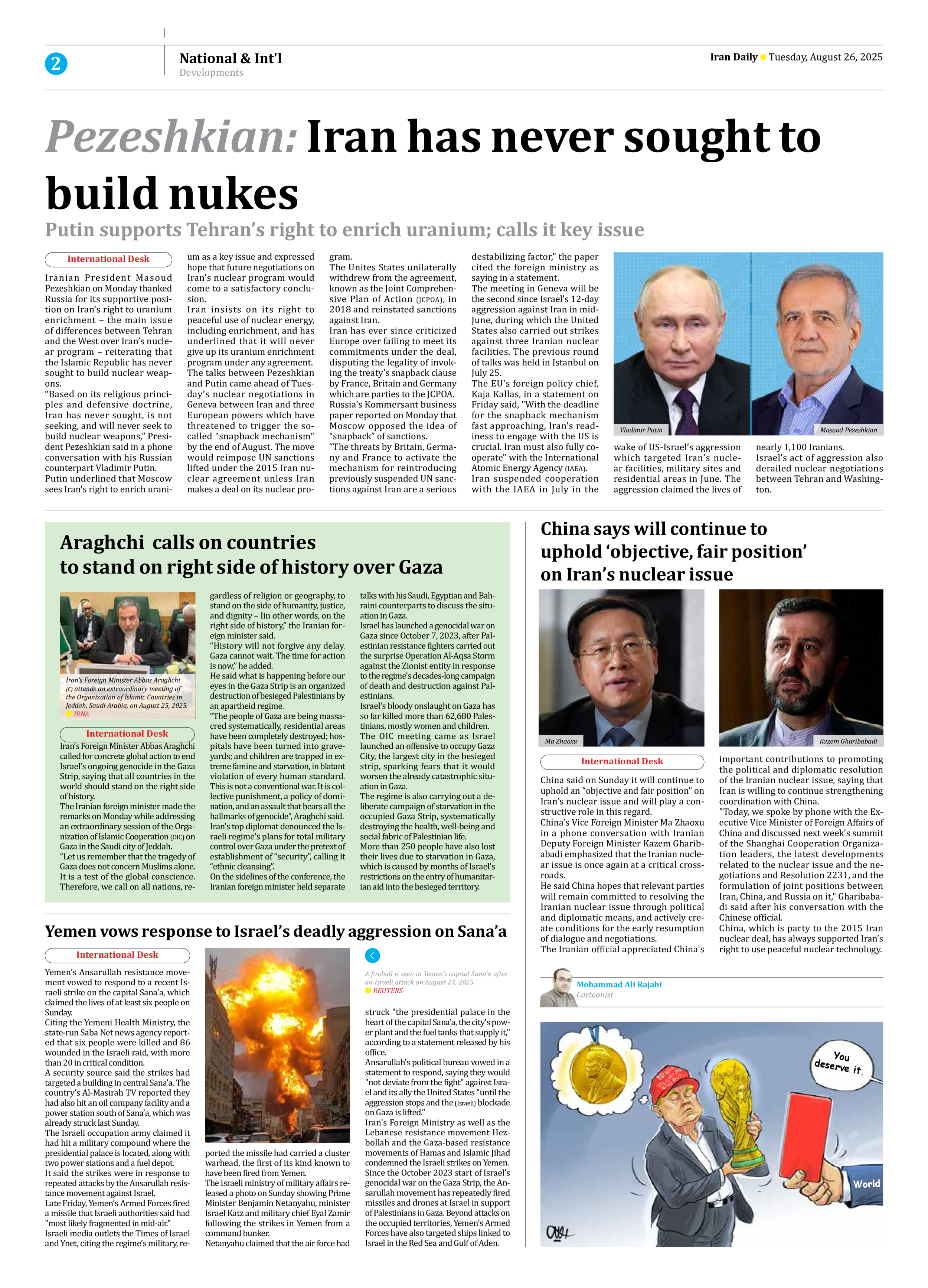


Pezeshkian: Iran has never sought to build nukes
Putin supports Tehran’s right to enrich uranium; calls it key issue
Iranian President Masoud Pezeshkian on Monday thanked Russia for its supportive position on Iran’s right to uranium enrichment – the main issue of differences between Tehran and the West over Iran’s nuclear program – reiterating that the Islamic Republic has never sought to build nuclear weapons.
“Based on its religious principles and defensive doctrine, Iran has never sought, is not seeking, and will never seek to build nuclear weapons,” President Pezeshkian said in a phone conversation with his Russian counterpart Vladimir Putin.
Putin underlined that Moscow sees Iran's right to enrich uranium as a key issue and expressed hope that future negotiations on Iran’s nuclear program would come to a satisfactory conclusion.
Iran insists on its right to peaceful use of nuclear energy, including enrichment, and has underlined that it will never give up its uranium enrichment program under any agreement.
The talks between Pezeshkian and Putin came ahead of Tuesday’s nuclear negotiations in Geneva between Iran and three European powers which have threatened to trigger the so-called "snapback mechanism" by the end of August. The move would reimpose UN sanctions lifted under the 2015 Iran nuclear agreement unless Iran makes a deal on its nuclear program.
The Unites States unilaterally withdrew from the agreement, known as the Joint Comprehensive Plan of Action (JCPOA), in 2018 and reinstated sanctions against Iran.
Iran has ever since criticized Europe over failing to meet its commitments under the deal, disputing the legality of invoking the treaty’s snapback clause by France, Britain and Germany which are parties to the JCPOA.
Russia’s Kommersant business paper reported on Monday that Moscow opposed the idea of “snapback” of sanctions.
“The threats by Britain, Germany and France to activate the mechanism for reintroducing previously suspended UN sanctions against Iran are a serious destabilizing factor,” the paper cited the foreign ministry as saying in a statement.
The meeting in Geneva will be the second since Israel’s 12-day aggression against Iran in mid-June, during which the United States also carried out strikes against three Iranian nuclear facilities. The previous round of talks was held in Istanbul on July 25.
The EU's foreign policy chief, Kaja Kallas, in a statement on Friday said, "With the deadline for the snapback mechanism fast approaching, Iran's readiness to engage with the US is crucial. Iran must also fully cooperate" with the International Atomic Energy Agency (IAEA).
Iran suspended cooperation with the IAEA in July in the wake of US-Israel’s aggression which targeted Iran’s nuclear facilities, military sites and residential areas in June. The aggression claimed the lives of nearly 1,100 Iranians.
Israel’s act of aggression also derailed nuclear negotiations between Tehran and Washington.