







‘Refuge of the Persian Gulf ’:
History, heritage, ocean meet in Kharg Island
In the heart of the Persian Gulf lies an island that is not very large but is profoundly significant in the history of Iran; Kharg, a historical gem that, although today better known for oil exports and massive energy platforms, holds in the hidden layers of its soil and shores the footprints of thousands of years of history, civilization, and seafaring.
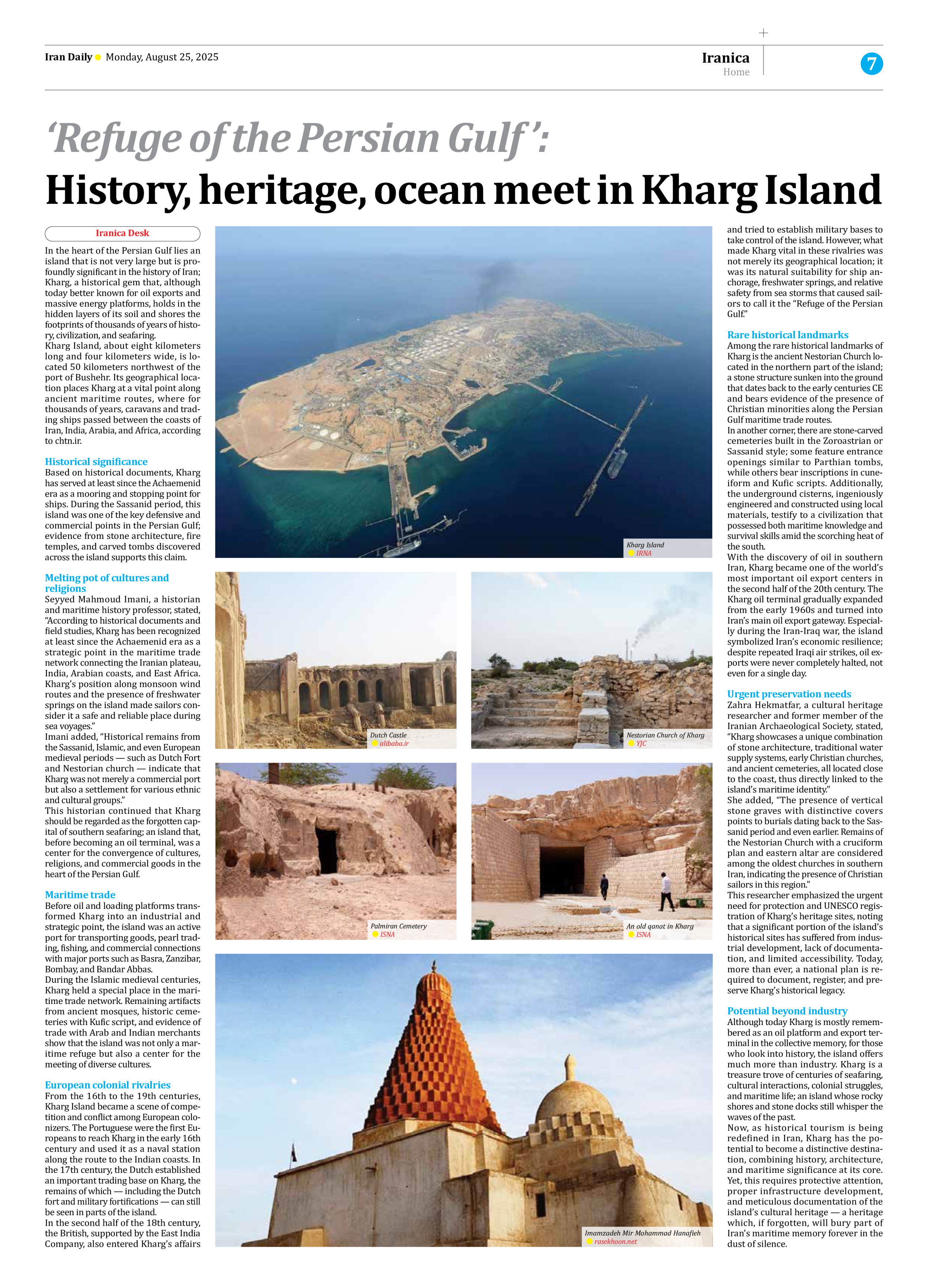
Kharg Island, about eight kilometers long and four kilometers wide, is located 50 kilometers northwest of the port of Bushehr. Its geographical location places Kharg at a vital point along ancient maritime routes, where for thousands of years, caravans and trading ships passed between the coasts of Iran, India, Arabia, and Africa, according to chtn.ir.
Historical significance
Based on historical documents, Kharg has served at least since the Achaemenid era as a mooring and stopping point for ships. During the Sassanid period, this island was one of the key defensive and commercial points in the Persian Gulf; evidence from stone architecture, fire temples, and carved tombs discovered across the island supports this claim.
Melting pot of cultures and religions
Seyyed Mahmoud Imani, a historian and maritime history professor, stated, “According to historical documents and field studies, Kharg has been recognized at least since the Achaemenid era as a strategic point in the maritime trade network connecting the Iranian plateau, India, Arabian coasts, and East Africa. Kharg’s position along monsoon wind routes and the presence of freshwater springs on the island made sailors consider it a safe and reliable place during sea voyages.”
Imani added, “Historical remains from the Sassanid, Islamic, and even European medieval periods — such as Dutch Fort and Nestorian church — indicate that Kharg was not merely a commercial port but also a settlement for various ethnic and cultural groups.”
This historian continued that Kharg should be regarded as the forgotten capital of southern seafaring; an island that, before becoming an oil terminal, was a center for the convergence of cultures, religions, and commercial goods in the heart of the Persian Gulf.
Maritime trade
Before oil and loading platforms transformed Kharg into an industrial and strategic point, the island was an active port for transporting goods, pearl trading, fishing, and commercial connections with major ports such as Basra, Zanzibar, Bombay, and Bandar Abbas.
During the Islamic medieval centuries, Kharg held a special place in the maritime trade network. Remaining artifacts from ancient mosques, historic cemeteries with Kufic script, and evidence of trade with Arab and Indian merchants show that the island was not only a maritime refuge but also a center for the meeting of diverse cultures.
European colonial rivalries
From the 16th to the 19th centuries, Kharg Island became a scene of competition and conflict among European colonizers. The Portuguese were the first Europeans to reach Kharg in the early 16th century and used it as a naval station along the route to the Indian coasts. In the 17th century, the Dutch established an important trading base on Kharg, the remains of which — including the Dutch fort and military fortifications — can still be seen in parts of the island.
In the second half of the 18th century, the British, supported by the East India Company, also entered Kharg’s affairs and tried to establish military bases to take control of the island. However, what made Kharg vital in these rivalries was not merely its geographical location; it was its natural suitability for ship anchorage, freshwater springs, and relative safety from sea storms that caused sailors to call it the “Refuge of the Persian Gulf.”
Rare historical landmarks
Among the rare historical landmarks of Kharg is the ancient Nestorian Church located in the northern part of the island; a stone structure sunken into the ground that dates back to the early centuries CE and bears evidence of the presence of Christian minorities along the Persian Gulf maritime trade routes.
In another corner, there are stone-carved cemeteries built in the Zoroastrian or Sassanid style; some feature entrance openings similar to Parthian tombs, while others bear inscriptions in cuneiform and Kufic scripts. Additionally, the underground cisterns, ingeniously engineered and constructed using local materials, testify to a civilization that possessed both maritime knowledge and survival skills amid the scorching heat of the south.
With the discovery of oil in southern Iran, Kharg became one of the world’s most important oil export centers in the second half of the 20th century. The Kharg oil terminal gradually expanded from the early 1960s and turned into Iran’s main oil export gateway. Especially during the Iran-Iraq war, the island symbolized Iran’s economic resilience; despite repeated Iraqi air strikes, oil exports were never completely halted, not even for a single day.
Urgent preservation needs
Zahra Hekmatfar, a cultural heritage researcher and former member of the Iranian Archaeological Society, stated, “Kharg showcases a unique combination of stone architecture, traditional water supply systems, early Christian churches, and ancient cemeteries, all located close to the coast, thus directly linked to the island’s maritime identity.”
She added, “The presence of vertical stone graves with distinctive covers points to burials dating back to the Sassanid period and even earlier. Remains of the Nestorian Church with a cruciform plan and eastern altar are considered among the oldest churches in southern Iran, indicating the presence of Christian sailors in this region.”
This researcher emphasized the urgent need for protection and UNESCO registration of Kharg’s heritage sites, noting that a significant portion of the island’s historical sites has suffered from industrial development, lack of documentation, and limited accessibility. Today, more than ever, a national plan is required to document, register, and preserve Kharg’s historical legacy.
Potential beyond industry
Although today Kharg is mostly remembered as an oil platform and export terminal in the collective memory, for those who look into history, the island offers much more than industry. Kharg is a treasure trove of centuries of seafaring, cultural interactions, colonial struggles, and maritime life; an island whose rocky shores and stone docks still whisper the waves of the past.
Now, as historical tourism is being redefined in Iran, Kharg has the potential to become a distinctive destination, combining history, architecture, and maritime significance at its core. Yet, this requires protective attention, proper infrastructure development, and meticulous documentation of the island’s cultural heritage — a heritage which, if forgotten, will bury part of Iran’s maritime memory forever in the dust of silence.