





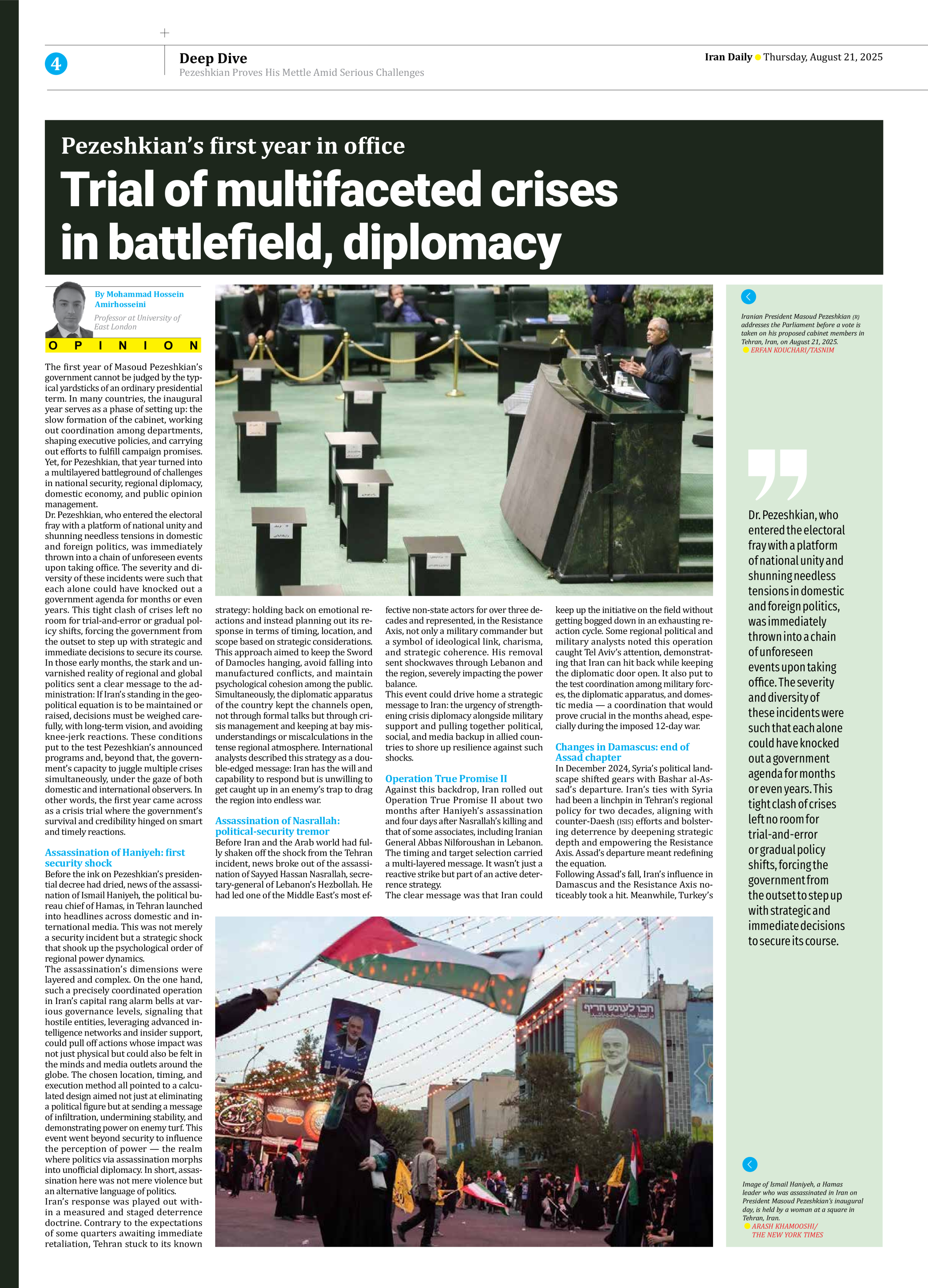


Pezeshkian’s first year in office
Trial of multifaceted crises in battlefield, diplomacy
By Mohammad Hossein Amirhosseini
Professor at University of
East London
The first year of Masoud Pezeshkian’s government cannot be judged by the typical yardsticks of an ordinary presidential term. In many countries, the inaugural year serves as a phase of setting up: the slow formation of the cabinet, working out coordination among departments, shaping executive policies, and carrying out efforts to fulfill campaign promises. Yet, for Pezeshkian, that year turned into a multilayered battleground of challenges in national security, regional diplomacy, domestic economy, and public opinion management.
Dr. Pezeshkian, who entered the electoral fray with a platform of national unity and shunning needless tensions in domestic and foreign politics, was immediately thrown into a chain of unforeseen events upon taking office. The severity and diversity of these incidents were such that each alone could have knocked out a government agenda for months or even years. This tight clash of crises left no room for trial-and-error or gradual policy shifts, forcing the government from the outset to step up with strategic and immediate decisions to secure its course.
In those early months, the stark and unvarnished reality of regional and global politics sent a clear message to the administration: If Iran’s standing in the geopolitical equation is to be maintained or raised, decisions must be weighed carefully, with long-term vision, and avoiding knee-jerk reactions. These conditions put to the test Pezeshkian’s announced programs and, beyond that, the government’s capacity to juggle multiple crises simultaneously, under the gaze of both domestic and international observers. In other words, the first year came across as a crisis trial where the government’s survival and credibility hinged on smart and timely reactions.
Assassination of Haniyeh: first security shock
Before the ink on Pezeshkian’s presidential decree had dried, news of the assassination of Ismail Haniyeh, the political bureau chief of Hamas, in Tehran launched into headlines across domestic and international media. This was not merely a security incident but a strategic shock that shook up the psychological order of regional power dynamics.
The assassination’s dimensions were layered and complex. On the one hand, such a precisely coordinated operation in Iran’s capital rang alarm bells at various governance levels, signaling that hostile entities, leveraging advanced intelligence networks and insider support, could pull off actions whose impact was not just physical but could also be felt in the minds and media outlets around the globe. The chosen location, timing, and execution method all pointed to a calculated design aimed not just at eliminating a political figure but at sending a message of infiltration, undermining stability, and demonstrating power on enemy turf. This event went beyond security to influence the perception of power — the realm where politics via assassination morphs into unofficial diplomacy. In short, assassination here was not mere violence but an alternative language of politics.
Iran’s response was played out within a measured and staged deterrence doctrine. Contrary to the expectations of some quarters awaiting immediate retaliation, Tehran stuck to its known strategy: holding back on emotional reactions and instead planning out its response in terms of timing, location, and scope based on strategic considerations. This approach aimed to keep the Sword of Damocles hanging, avoid falling into manufactured conflicts, and maintain psychological cohesion among the public.
Simultaneously, the diplomatic apparatus of the country kept the channels open, not through formal talks but through crisis management and keeping at bay misunderstandings or miscalculations in the tense regional atmosphere. International analysts described this strategy as a double-edged message: Iran has the will and capability to respond but is unwilling to get caught up in an enemy’s trap to drag the region into endless war.
Assassination of Nasrallah: political-security tremor
Before Iran and the Arab world had fully shaken off the shock from the Tehran incident, news broke out of the assassination of Sayyed Hassan Nasrallah, secretary-general of Lebanon’s Hezbollah. He had led one of the Middle East’s most effective non-state actors for over three decades and represented, in the Resistance Axis, not only a military commander but a symbol of ideological link, charisma, and strategic coherence. His removal sent shockwaves through Lebanon and the region, severely impacting the power balance.
This event could drive home a strategic message to Iran: the urgency of strengthening crisis diplomacy alongside military support and pulling together political, social, and media backup in allied countries to shore up resilience against such shocks.
Operation True Promise II
Against this backdrop, Iran rolled out Operation True Promise II about two months after Haniyeh’s assassination and four days after Nasrallah’s killing and that of some associates, including Iranian General Abbas Nilforoushan in Lebanon. The timing and target selection carried a multi-layered message. It wasn’t just a reactive strike but part of an active deterrence strategy.
The clear message was that Iran could keep up the initiative on the field without getting bogged down in an exhausting reaction cycle. Some regional political and military analysts noted this operation caught Tel Aviv’s attention, demonstrating that Iran can hit back while keeping the diplomatic door open. It also put to the test coordination among military forces, the diplomatic apparatus, and domestic media — a coordination that would prove crucial in the months ahead, especially during the imposed 12-day war.
Changes in Damascus: end of Assad chapter
In December 2024, Syria’s political landscape shifted gears with Bashar al-Assad’s departure. Iran’s ties with Syria had been a linchpin in Tehran’s regional policy for two decades, aligning with counter-Daesh (ISIS) efforts and bolstering deterrence by deepening strategic depth and empowering the Resistance Axis. Assad’s departure meant redefining the equation.
Following Assad’s fall, Iran’s influence in Damascus and the Resistance Axis noticeably took a hit. Meanwhile, Turkey’s forces, Persian Gulf countries, and the Zionist regime stepped up as key players in Syria. These changes marked a major test for Iran’s foreign policy flexibility in facing structural shifts in regional power balances.
Return of diplomacy amid crisis
Pezeshkian’s government came into power on a platform of national unity domestically and rationality in foreign diplomacy. Right from the start, the incumbent administration made moves to pull Iran out of foreign policy deadlocks from the previous administration.
A key element of Pezeshkian’s foreign policy was bolstering neighborly diplomacy — a stance that the administration sought to redefine with a more constructive and fresh outlook. Presidential visits to Iraq, Qatar, Turkmenistan, Azerbaijan, and Tajikistan underscore the prioritization of regional foreign policy.
At the same time, the nuclear negotiations file made a comeback as a primary foreign policy priority. Amid the security and regional crises, a quieter diplomatic layer was taking shape: the start of a new round of indirect talks between Iran and the United States. These discussions began in April 2025, after Donald Trump’s second presidential term in the US kicked off and Washington sought to revive dialogue channels with Tehran.
Earlier, in March 2025, Trump had sent a letter to the Leader of Iran’s Islamic Revolution as an initial signal for talks. Iran’s response was a green light for the indirect negotiations held on Omani soil and in Rome, mediated by Omanis and some European channels. Although these talks were happening against the backdrop of regional and field crises, their strategic significance was undeniable. Iran aimed to stick to its principles while avoiding being cornered diplomatically. Up until the imposed 12-day war, five rounds of these talks had taken place. However, with the onset of Israel’s military aggression, the sixth round was cancelled, putting talks on ice.
Imposed 12-day war: multifront confrontation
The peak of Pezeshkian’s government security challenges came about in June 2025 — just as the sixth round of nuclear talks with the US was looming — when Israel opened up a military front against Iran. Tel Aviv pursued multiple objectives in this aggression: dismantling Iran’s nuclear program and defensive missile capabilities and exploiting psychological warfare, internal rifts, and social discontent to shake up Iran’s political structure and governance. This military assault was accompanied by a targeted media war against Iran.
On one hand, the Zionist regime tried to pass off its aggression as self-defense in Western media and public opinion. On the other hand, it sought to steer internal Iranian public opinion through Persian-language anti-Iran media like Iran International. Moreover, fears of the conflict spilling over into a regional war ran high and were compounded by America’s direct involvement, turning up the stakes.
Iran kicked off Operation True Promise III in response to the attacks by the Zionist regime, marking a new level of military capability compared to the previous two operations. This new wave stepped up in volume of strikes, accuracy of targeting, technical complexity, and number of operations.
By hitting military, security, and strategic targets of the Zionist regime, Iran demonstrated not only its capacity for firing back, but also its ability to consistently show off its tactical and strategic power. Unlike earlier conflict patterns, which typically wrapped up with a focused Iranian response, this time Iran turned up the heat by emphasizing the sustainability of its countermeasures and unveiling a new dimension of military strength and calculations.
Close coordination and tight cooperation between the government and military, security, and diplomatic institutions played a key role here. This institutional synergy helped the Pezeshkian government pull off quick and precise decisions to keep a lid on the critical domestic situation while aligning the message of Operation True Promise III internationally with the political and diplomatic discourse of the government. This made the battlefield and diplomacy two complementary arms working within a common strategic framework. The proactive and targeted efforts by the Iranian Ministry of Foreign Affairs during the war, along with combating the Zionist regime’s media narrative and cementing the notion on the international stage that Israel’s attacks were clear aggression rather than legitimate self-defense, filled in the blanks of the synergy between battlefield actions and diplomacy.
Cease-fire, post-war atmosphere
After 12 days of clashes and with the direct involvement of the United States, relentless diplomatic efforts brought about a cease-fire mediated by Qatar. The importance of this cease-fire lay in the fact that Iran was not the proposer, and Israel, for the first time, came around to accept a cease-fire without preconditions. International observers regarded this as unprecedented in the history of Israeli military conflicts, signaling the failure of Israel to fully carry out its objectives in the war, especially given that the final, highly destructive and costly attack came from Iran.
From the government’s viewpoint, this outcome was a dual achievement: On one hand, it headed off a protracted war and rising human and economic costs, and on the other, it painted Iran as a wise and calculating actor that, even amid battle, did not lose sight of diplomacy while fiercely defending itself against external aggression.
However, experience demonstrated that post-war moments can be tougher than the war itself as a fresh field of political, media, and economic competition sets in, equally sensitive. In the post-war atmosphere, the national unity forged during the crisis stands as the Pezeshkian government’s greatest political asset. Increased public trust in the government and armed forces, alongside a temporary easing of factional tensions, opened up a space that could serve as fertile ground for launching structural reforms.
Yet, as Iran’s modern history and experiences elsewhere show, such capital quickly evaporates unless it converts into tangible economic and social achievements in the short term. Pezeshkian’s government now faces a strategic crossroads: Either build on this national solidarity as a springboard for economic and political reforms or let it fizzle out, allowing political rifts and mistrust to creep back in.
Meanwhile, resolving the nuclear crisis and continuing negotiations in the post-war environment are considerably more complicated than before, especially with Europe turning up the pressure by threatening to activate the snapback mechanism, which means reinstating UN Security Council sanctions, potentially dealing a heavy blow to Iran’s economy.
In the post-war setting, part of the Iranian society sees any negotiation as a sign of retreat, while another segment blames the lack of talks for worsening economic woes and political isolation. Overall, domestic public opinion has turned more skeptical about any agreement. Internal political fissures have also thrown a wrench into coordination efforts. Iran’s diplomatic apparatus is thus forced to both uphold the country’s nuclear red lines and keep diplomacy doors from slamming shut.
National unity: from slogan to mechanism
Pezeshkian has sought to move beyond the slogan of national unity he championed during his campaign to the realm of designing operational mechanisms. This goal was pursued through various means, including holding a national dialogue conference attended by leading theorists and representatives from diverse political factions. The cabinet also became more diverse than before, although there remains a need for stronger representation of women and minorities.
To realize national unity, the current government has not only focused on fostering political dialogue but also paid special attention to the integrative role of media and narrative management in crisis times. The experience of the imposed 12-day war and its surrounding incidents proved that internal cohesion cannot be complete without synchronization in the media arena. Moreover, regional and global public opinion is shaped not by military and diplomatic decisions but through the media. Active media diplomacy and initiatives such as Pezeshkian’s interview with Tucker Carlson reflected the government’s growing sensitivity to the media’s role in foreign policy and leveraging regional and international media capacities.
Political sincerity: return to realism in governance
A closer look at Iran’s past governments and governance trends in recent years reveals that the main problem was not sincerity but secrecy, exaggeration, delusion, and unreal narratives — approaches that not only failed to improve the country’s situation but also widened the gap between the government and the public and eroded the foundations of social capital.
It seems Pezeshkian, fully aware of the costs, has deliberately taken a different road. He has repeatedly emphasized that the people are the genuine owners of the country and deserve to hear the truth — however bitter — from officials rather than from foreign media or enemy leaders. Although this governing style might open him up to political attacks in the short term, within the legitimacy-building theories of governance, it is precisely at the point where social capital reconstruction takes off — between bitter reality and responsible honesty. Pezeshkian believes authority doesn’t come from hiding the country’s problems and crises but from stepping up with courage to accept those crises and a transparent will to face them.
Within international relations theory, the approach of the incumbent government toward candidly stating facts and avoiding exaggerated narratives can be analyzed as legitimacy-building through transparency and soft power. According to Constructivism and Liberal Institutionalism perspectives, transparency and sincere dialogue with the domestic society not only strengthen social capital but send a clear signal to external actors: The government has genuine popular backing and acts based on data and realities. Furthermore, transparency can crack down on rivals’ psychological warfare and curb foreign propaganda effectiveness, making it harder for hostile narratives to take root.
However, Realism theorists caution that exposing too many limitations might be seen by competitors as a weakness. In international political economy, emphasizing domestic problems could negatively impact investors’ and trade partners’ risk assessments, pushing up the costs of attracting foreign capital — which, given sanctions and hurdles, may be less relevant currently.
Therefore, this strategy works best when honesty is paired with smart message management — so alongside highlighting problems, practical solutions and tangible signs of overcoming challenges are also presented. This combination can turn sincerity into soft capital and a tool to advance Iran’s foreign policy aims in a competitive, multipolar environment.
Crisis-experienced gov’t with forward-looking face
The first year of Masoud Pezeshkian’s government painted a clear picture of a crisis-tested administration that weathered serious multi-layered challenges in its early months. A standout feature of this period was the conscious effort to strike a balance between field and diplomacy. While previously one area often overshadowed the other, Pezeshkian aimed to prove that it is possible to be firm on the ground and active in diplomacy simultaneously.
Entering the second year is a more sensitive and decisive phase. Widening rifts between the United States and Europe over handling Middle East crises, especially the Gaza war, have opened up a fresh opportunity to redefine and energize balanced diplomacy with the European continent. Meanwhile, leaving Persian Gulf countries to take the lead in mediating Iran-US talks and turning these into mostly bilateral talks has pushed Europe to the sidelines and heightened feelings of neglect in European capitals. These concerns, paired with nuclear issues, have contributed to Europe seriously ramping up talk of activating the snapback mechanism.
Conversely, Iran’s simultaneous engagement with Eastern cooperation frameworks like BRICS and the Shanghai Cooperation Organisation, the possibility of linking these memberships to China’s Belt and Road Initiative, and expanding ties with neighbors have set a new stage for leaps in trade, transit, and technology. The possible return of regional investors if diplomatic tensions somewhat ease could fuel economic infrastructure improvements. Channeling some of this capital into innovation, especially AI development and application, could raise Iran’s share in the growing regional economy. Achieving AI roadmap goals will impact not only the economy but also culture, education, media, healthcare, security, and politics, helping redefine national power and Iran’s place in the international system.
Still, in its second year, the incumbent government faces looming threats of harsher sanctions, worsening economic troubles, energy and water crises, and shifting geopolitical balances. Smartly seizing existing opportunities and timely spotting new ones while maintaining active diplomacy will be key to navigating through these challenges successfully. Given that snapback activation and UN sanctions return could choke off a significant portion of these opportunities, foreign policy and diplomacy will play an even more critical role in this second year. If the government sticks to this approach rightly, there is hope Iran will gradually weather its current crises and sustainably boost its standing in the international arena.
The full article first appeared in Persian on IRNA.