







Women artisans revive, sustain Morvar weaving tradition in Malayer
The hard work of women artisans in handicrafts reflects their extraordinary commitment, creativity, and perseverance in both preserving and developing traditional arts. As true guardians of cultural and artistic heritage, they continue their work despite social and economic challenges, playing a vital role in ensuring that handicrafts remain alive and relevant.
Many women artisans, by learning crafts such as carpet weaving, pottery, embroidery, and wood carving from previous generations, have safeguarded these arts and passed them on to future generations, preventing these traditions from fading into oblivion. By blending traditional designs with contemporary styles, these women create unique works that are simultaneously authentic and harmonized with modern tastes, IRNA wrote.
Countless women, alongside their family responsibilities, devote themselves to handicrafts with love, patience, and artistry. In rural and underprivileged areas, these arts are more than a passion — they represent an essential source of livelihood. Women’s efforts not only contribute to the welfare and prosperity of their families but also promote local economic development.
For Iranian women, art is deeply intertwined with their essence; by creating, they not only produce art but also impart love, cultural memory, and identity. This heritage is faithfully passed down from mothers and grandmothers to future generations. Preserving and reviving these crafts means passing on an authentic and noble legacy that strengthens cultural connections across time.
The hands of Iranian women are filled with artistry, and their lives are interwoven with sacrifice. Each handicraft made by these skilled women is more than an object — it tells a story. A Persian carpet woven by a woman carries years of patience within its knots; a pottery piece from Lalehjin of Hamedan Province preserves the warmth of the artist’s touch; the ornate work of carving, kilim weaving, and mat weaving carries an infinite love.
These women create invaluable masterpieces with the fewest resources. Yet, they need to be seen, recognized, and supported so that their art continues to thrive. Handicrafts are not simply handmade products; they embody spirit, memory, and the very soul of culture.
The art of Morvar weaving (Morvar Bafi) in Malayer, a city in Hamedan Province, is one of the handicrafts with great potential to serve as a lifeline for the local economy. Through the establishment of small workshops, this craft can generate new income for families and help reduce unemployment in rural communities.
Morvar weaving holds a prominent position among the handicraft branches of the region. Alongside the renowned wood-carved furniture industry, it plays an important role in both the local and national markets. Although some view this art as male-dominated, many women and girls in Malayer actively engage in basket and Morvar weaving, establishing workshops of their own and becoming successful entrepreneurs.
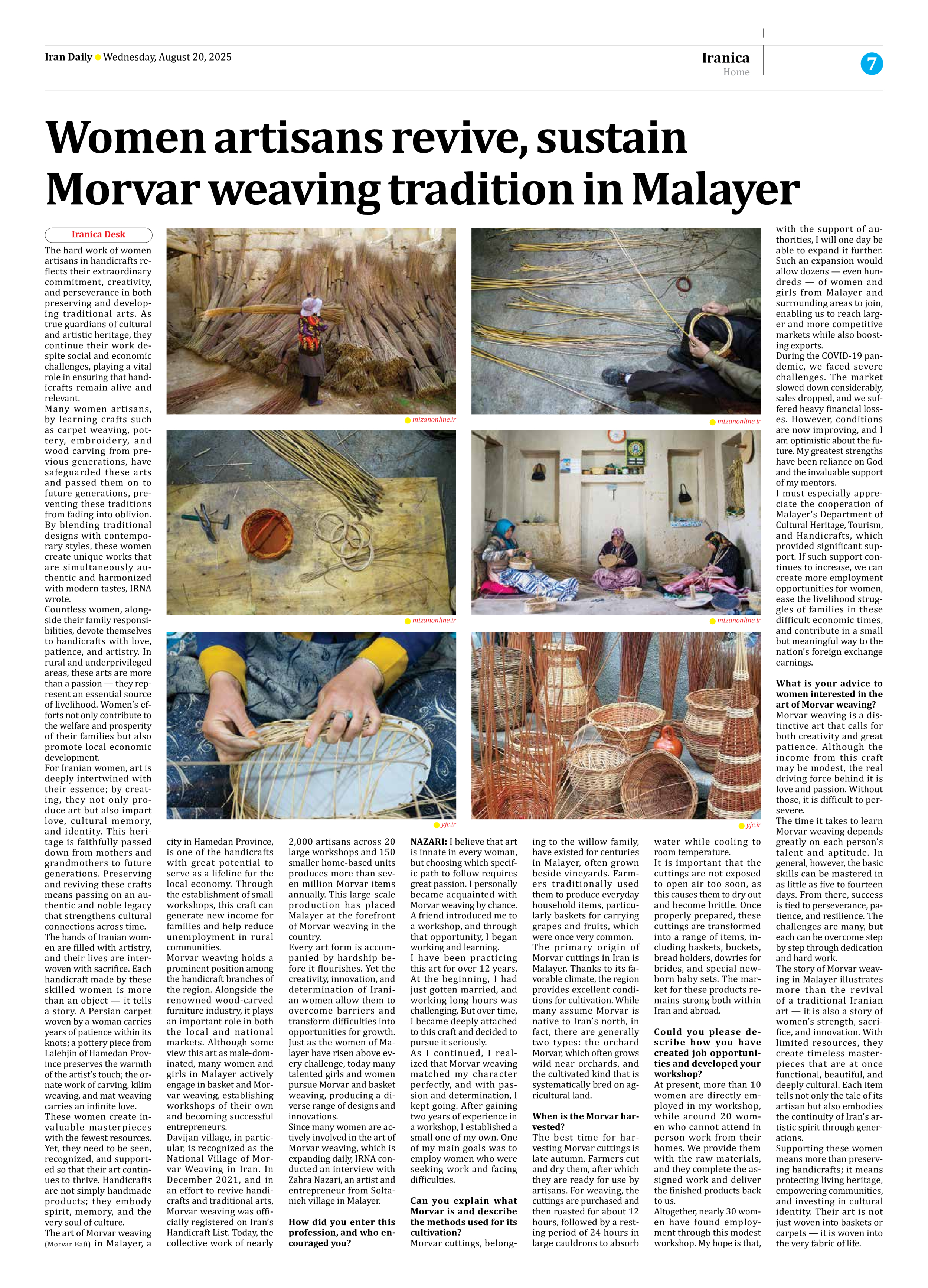
Davijan village, in particular, is recognized as the National Village of Morvar Weaving in Iran. In December 2021, and in an effort to revive handicrafts and traditional arts, Morvar weaving was officially registered on Iran’s Handicraft List. Today, the collective work of nearly 2,000 artisans across 20 large workshops and 150 smaller home-based units produces more than seven million Morvar items annually. This large-scale production has placed Malayer at the forefront of Morvar weaving in the country.
Every art form is accompanied by hardship before it flourishes. Yet the creativity, innovation, and determination of Iranian women allow them to overcome barriers and transform difficulties into opportunities for growth. Just as the women of Malayer have risen above every challenge, today many talented girls and women pursue Morvar and basket weaving, producing a diverse range of designs and innovations.
Since many women are actively involved in the art of Morvar weaving, which is expanding daily, IRNA conducted an interview with Zahra Nazari, an artist and entrepreneur from Soltanieh village in Malayer.
How did you enter this profession, and who encouraged you?
Nazari: I believe that art is innate in every woman, but choosing which specific path to follow requires great passion. I personally became acquainted with Morvar weaving by chance. A friend introduced me to a workshop, and through that opportunity, I began working and learning.
I have been practicing this art for over 12 years. At the beginning, I had just gotten married, and working long hours was challenging. But over time, I became deeply attached to this craft and decided to pursue it seriously.
As I continued, I realized that Morvar weaving matched my character perfectly, and with passion and determination, I kept going. After gaining two years of experience in a workshop, I established a small one of my own. One of my main goals was to employ women who were seeking work and facing difficulties.
Can you explain what Morvar is and describe the methods used for its cultivation?
Morvar cuttings, belonging to the willow family, have existed for centuries in Malayer, often grown beside vineyards. Farmers traditionally used them to produce everyday household items, particularly baskets for carrying grapes and fruits, which were once very common.
The primary origin of Morvar cuttings in Iran is Malayer. Thanks to its favorable climate, the region provides excellent conditions for cultivation. While many assume Morvar is native to Iran’s north, in fact, there are generally two types: the orchard Morvar, which often grows wild near orchards, and the cultivated kind that is systematically bred on agricultural land.
When is the Morvar harvested?
The best time for harvesting Morvar cuttings is late autumn. Farmers cut and dry them, after which they are ready for use by artisans. For weaving, the cuttings are purchased and then roasted for about 12 hours, followed by a resting period of 24 hours in large cauldrons to absorb water while cooling to room temperature.
It is important that the cuttings are not exposed to open air too soon, as this causes them to dry out and become brittle. Once properly prepared, these cuttings are transformed into a range of items, including baskets, buckets, bread holders, dowries for brides, and special newborn baby sets. The market for these products remains strong both within Iran and abroad.
Could you please describe how you have created job opportunities and developed your workshop?
At present, more than 10 women are directly employed in my workshop, while around 20 women who cannot attend in person work from their homes. We provide them with the raw materials, and they complete the assigned work and deliver the finished products back to us.
Altogether, nearly 30 women have found employment through this modest workshop. My hope is that, with the support of authorities, I will one day be able to expand it further. Such an expansion would allow dozens — even hundreds — of women and girls from Malayer and surrounding areas to join, enabling us to reach larger and more competitive markets while also boosting exports.
During the COVID-19 pandemic, we faced severe challenges. The market slowed down considerably, sales dropped, and we suffered heavy financial losses. However, conditions are now improving, and I am optimistic about the future. My greatest strengths have been reliance on God and the invaluable support of my mentors.
I must especially appreciate the cooperation of Malayer’s Department of Cultural Heritage, Tourism, and Handicrafts, which provided significant support. If such support continues to increase, we can create more employment opportunities for women, ease the livelihood struggles of families in these difficult economic times, and contribute in a small but meaningful way to the nation’s foreign exchange earnings.
What is your advice to women interested in the art of Morvar weaving?
Morvar weaving is a distinctive art that calls for both creativity and great patience. Although the income from this craft may be modest, the real driving force behind it is love and passion. Without those, it is difficult to persevere.
The time it takes to learn Morvar weaving depends greatly on each person’s talent and aptitude. In general, however, the basic skills can be mastered in as little as five to fourteen days. From there, success is tied to perseverance, patience, and resilience. The challenges are many, but each can be overcome step by step through dedication and hard work.
The story of Morvar weaving in Malayer illustrates more than the revival of a traditional Iranian art — it is also a story of women’s strength, sacrifice, and innovation. With limited resources, they create timeless masterpieces that are at once functional, beautiful, and deeply cultural. Each item tells not only the tale of its artisan but also embodies the continuity of Iran’s artistic spirit through generations.
Supporting these women means more than preserving handicrafts; it means protecting living heritage, empowering communities, and investing in cultural identity. Their art is not just woven into baskets or carpets — it is woven into the very fabric of life.