







Pezeshkian never says he inherited wreck: Experts
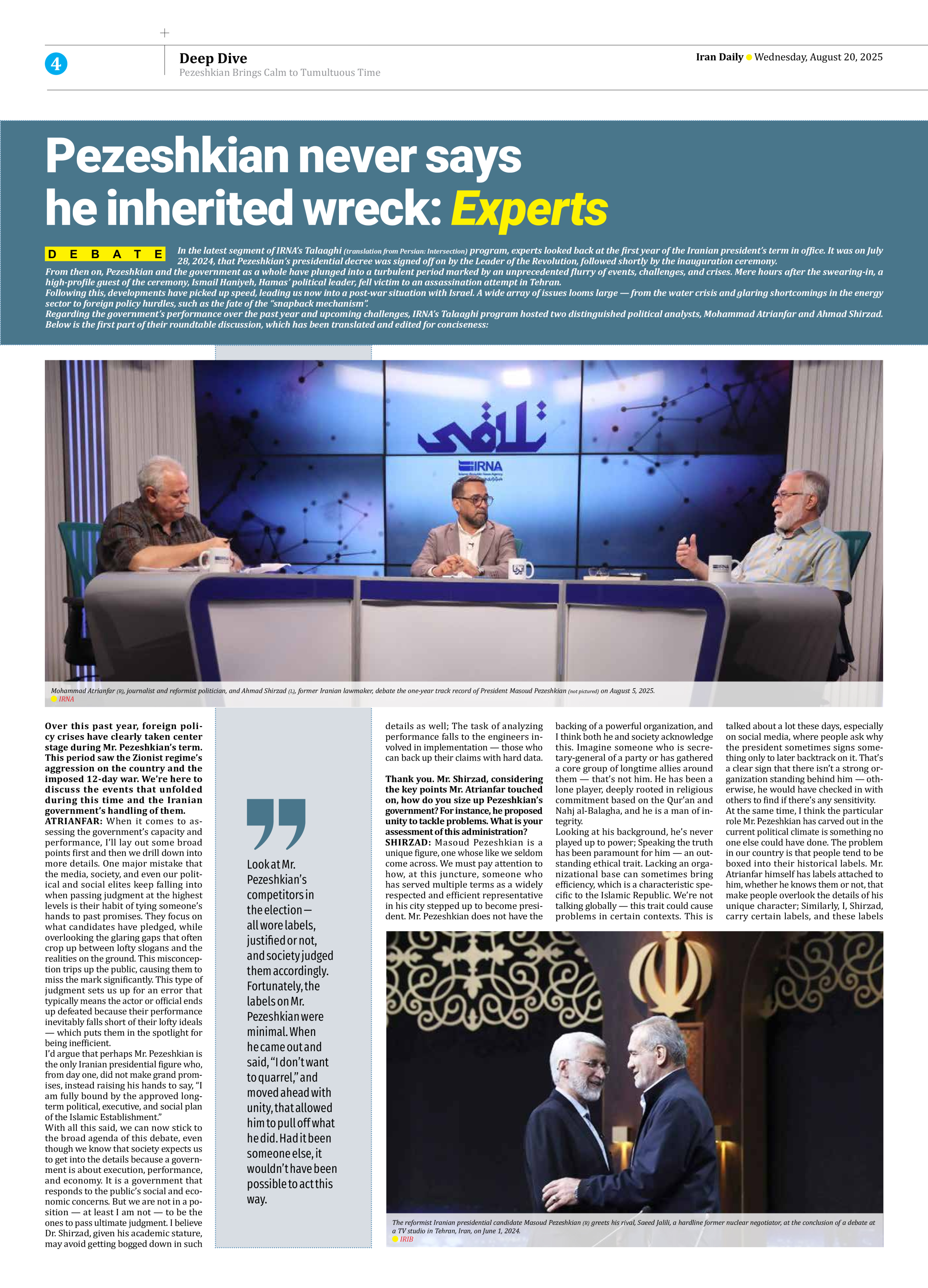
In the latest segment of IRNA’s Talaaghi (translation from Persian: Intersection) program, experts looked back at the first year of the Iranian president’s term in office. It was on July 28, 2024, that Pezeshkian’s presidential decree was signed off on by the Leader of the Revolution, followed shortly by the inauguration ceremony. From then on, Pezeshkian and the government as a whole have plunged into a turbulent period marked by an unprecedented flurry of events, challenges, and crises. Mere hours after the swearing-in, a high-profile guest of the ceremony, Ismail Haniyeh, Hamas’ political leader, fell victim to an assassination attempt in Tehran. Following this, developments have picked up speed, leading us now into a post-war situation with Israel. A wide array of issues looms large — from the water crisis and glaring shortcomings in the energy sector to foreign policy hurdles, such as the fate of the “snapback mechanism”. Regarding the government’s performance over the past year and upcoming challenges, IRNA’s Talaaghi program hosted two distinguished political analysts, Mohammad Atrianfar and Ahmad Shirzad. Below is the first part of their roundtable discussion, which has been translated and edited for conciseness:
Over this past year, foreign policy crises have clearly taken center stage during Mr. Pezeshkian’s term. This period saw the Zionist regime’s aggression on the country and the imposed 12-day war. We’re here to discuss the events that unfolded during this time and the Iranian government’s handling of them.
ATRIANFAR: When it comes to assessing the government’s capacity and performance, I’ll lay out some broad points first and then we drill down into more details. One major mistake that the media, society, and even our political and social elites keep falling into when passing judgment at the highest levels is their habit of tying someone’s hands to past promises. They focus on what candidates have pledged, while overlooking the glaring gaps that often crop up between lofty slogans and the realities on the ground. This misconception trips up the public, causing them to miss the mark significantly. This type of judgment sets us up for an error that typically means the actor or official ends up defeated because their performance inevitably falls short of their lofty ideals — which puts them in the spotlight for being inefficient.
I’d argue that perhaps Mr. Pezeshkian is the only Iranian presidential figure who, from day one, did not make grand promises, instead raising his hands to say, “I am fully bound by the approved long-term political, executive, and social plan of the Islamic Establishment.”
With all this said, we can now stick to the broad agenda of this debate, even though we know that society expects us to get into the details because a government is about execution, performance, and economy. It is a government that responds to the public’s social and economic concerns. But we are not in a position — at least I am not — to be the ones to pass ultimate judgment. I believe Dr. Shirzad, given his academic stature, may avoid getting bogged down in such details as well; The task of analyzing performance falls to the engineers involved in implementation — those who can back up their claims with hard data.
Thank you. Mr. Shirzad, considering the key points Mr. Atrianfar touched on, how do you size up Pezeshkian’s government? For instance, he proposed unity to tackle problems. What is your assessment of this administration?
SHIRZAD: Masoud Pezeshkian is a unique figure, one whose like we seldom come across. We must pay attention to how, at this juncture, someone who has served multiple terms as a widely respected and efficient representative in his city stepped up to become president. Mr. Pezeshkian does not have the backing of a powerful organization, and I think both he and society acknowledge this. Imagine someone who is secretary-general of a party or has gathered a core group of longtime allies around them — that’s not him. He has been a lone player, deeply rooted in religious commitment based on the Qur’an and Nahj al-Balagha, and he is a man of integrity.
Looking at his background, he’s never played up to power; Speaking the truth has been paramount for him — an outstanding ethical trait. Lacking an organizational base can sometimes bring efficiency, which is a characteristic specific to the Islamic Republic. We’re not talking globally — this trait could cause problems in certain contexts. This is talked about a lot these days, especially on social media, where people ask why the president sometimes signs something only to later backtrack on it. That’s a clear sign that there isn’t a strong organization standing behind him — otherwise, he would have checked in with others to find if there’s any sensitivity.
At the same time, I think the particular role Mr. Pezeshkian has carved out in the current political climate is something no one else could have done. The problem in our country is that people tend to be boxed into their historical labels. Mr. Atrianfar himself has labels attached to him, whether he knows them or not, that make people overlook the details of his unique character; Similarly, I, Shirzad, carry certain labels, and these labels cause plenty of issues. In this environment, many others, if they had stepped forward, couldn’t have carried out their duties properly.
Look at Mr. Pezeshkian’s competitors in the election — all wore labels, justified or not, and society judged them accordingly. Fortunately, the labels on Mr. Pezeshkian were minimal. When he came out and said, “I don’t want to quarrel,” and moved ahead with unity, that allowed him to pull off what he did. Had it been someone else, it wouldn’t have been possible to act this way.
One hugely positive move by Mr. Pezeshkian, which I hope continues and that the government has followed, is that he has steered clear of criticizing the past nonstop. This is crucial. People are fed up with officials coming in and tearing down their predecessors. Society is very sensitive to this; It finds such behavior unappealing and unacceptable. Our country’s leaders, including the Leader of the Islamic Revolution, seem to disapprove of it. It’s genuinely unpleasant for the public, and Mr. Pezeshkian has respected this norm.
This stands in sharp contrast to previous governments, where the refrain — rightly or wrongly — was that “we inherited a wreck, and here’s what we’ve done.” Even if true, such remarks do not sit well with the public. People judge the government as a whole; They don’t accept compartmentalized blame.
In the election campaign, Mr. Pezeshkian did not say what he would or would not do but rather called out the challenges we face. He continues to highlight existing shortages and problems honestly. When I hear him say “we have done this work,” the “we” here includes all those involved in this establishment, myself included. This kind of language is very important — it shows he does not seek to pass the buck or distance himself while condemning others. This approach earns him better listening and greater trust from the people.
These are unique qualities that I believe should be emphasized.
In any case, this government came forward and took on responsibility. Now, a year has rolled by since they accepted this responsibility, and during this year, we’ve witnessed a storm brewing in foreign policy as well as a whirlwind of internal political rivalries and other struggles amid these tempests. How has the situation shaped up from your perspective? To be more direct, some critics of Mr. Pezeshkian say that during the campaign, it was said that if his rival won, inflation would skyrocket, war would break out, and many bad scenarios would come to pass — all of which have happened now. What is your assessment?
ATRIANFAR: When it comes to an electoral candidate and the slogans they put out there, some things are said that wouldn’t be fair to pin on the candidate themselves. Likewise, incorrect things were said about the rival candidate as well. As mentioned and as Dr. Shirzad also pointed out, I too stand by the fact that Masoud Pezeshkian is simply Masoud Pezeshkian, and nothing else. This character, aside from refraining from condemning the previous government, first distanced himself from unethical behavior in slogans and actions, and second, as Mr. Shirzad brought up in a very important statement, when he even wants to criticize and lay out the shortages, he merely includes his contribution to the effort and uses the word “we”. This “we” means a broad group of statesmen who have participated, interfered, and taken responsibility; who have been elected and selected, and so on.
Mr. Pezeshkian never said, “When I come in, inflation will be controlled.” Firstly, in the analytical foundations, no matter where you go, two plus two equals four; Logarithms have only one solution everywhere. Wherever you go, this is how it is. Some laws are independent of rational assumptions, and reasoning has no say here. Can anyone claim they really have the power to interfere in those rules, whether they are Pezeshkian or not Pezeshkian, Qalibaf or not, Jalili or any of the esteemed presidential candidates? Physics runs its own course. Official numbers do their own work. To say “If this happens, inflation will go up” is simply not true.
The role of a statesman in this arena is more like that of an operator who must correctly piece together the data; If he does, he may have a slight influence on the outcome and offer a closer solution, but if he slips up, the situation worsens. For this reason, I specifically reject the assertion you pointed out, and no one can lay that claim at Mr. Pezeshkian’s door.
Mr. Pezeshkian has acted within the established frameworks, and the situation is exactly as it should be. Anyone else in his shoes would have faced the same scenario. We accept that when people come in, their direct impact is quite limited. If today, Mr. Jalili were in place of Mr. Pezeshkian, the notion that “war would break out during his term but not under Pezeshkian” is a slogan no one — especially among those who, loosely speaking, are supporters of Pezeshkian under the reformist banner in our society — has thrown out. Especially when a decision-maker understands that issues like war, foreign policy, safeguarding national independence, and dialogue with foreign countries ultimately fall under the Leader’s domain more than the government’s in Iran. The Leader himself has referred to it officially and unofficially that as the leader of the country and its political system, he is responsible for defending Iran’s territorial integrity, securing the nation’s independence, and marshaling the forces and must have the necessary tools at hand.
Mr. Shirzad, from your perspective — and given that both of you come from camps with a positive outlook on the government’s performance — if you were to explain to the audience what successes the government has had amid the internal and external storms of the past year, and why you give it a passing grade, what would you say?
SHIRZAD: Naturally, we wouldn’t give any government a perfect score.
Not a perfect score, but I said a positive one.
SHIRZAD: We give them an acceptable score. In fact, it’s hard to get a good score from us. Look at balanced and developed societies — they usually run at a lower temperature, metaphorically, not because nothing happens. Single incidents do break out here and there, like a small burst of energy passing through, yet society as a whole does not flip out. Most developed societies maintain this calm state.
Mr. Pezeshkian had a remarkable talent which really should be recognized: He brought down the temperature and cooled off society, bringing it closer to equilibrium. People’s nerves were calmer, and that’s very important. Sure, our nerves were frayed by the external enemy, but concurrently, we didn’t have an added nerve-racking tension here — and that is very significant.
Certainly, Iranian society especially demonstrated its maturity during the 12-day war, showing that now is not the time to get on each other’s nerves. Look at the level of political faction tension before and after Mr. Pezeshkian’s government. It hasn’t disappeared, though; The fact that even now some people use very harsh rhetoric on both sides is true. We truly need to dial down these harsh statements, take the edge off these discourses, and try to speak in a way that wins over the other side, bringing them closer to what we want — not to leave them stuck in their position.
Is that something the government, in your view, has done?
SHIRZAD: Yes, Mr. Pezeshkian has done that. Regarding unity, he showed that he never threw out empty slogans or lied; Perhaps the only topic he really zeroed in on during the election was precisely unity. With his unique manner, he asked people not to fight. He genuinely followed through on this and was successful.
Probably the clearest proof was in the early months when he tried to bring on board different figures and factions in the cabinet. When you try to do this, you face pushback — both sides complain about certain appointments — but he succeeded anyway. In securing the parliament’s vote of confidence and bringing the lawmakers on side, he was successful, and overall, if we want to sum up, he managed to bring down the social temperature.
I should mention the fact that Iranian society is more dynamic and developing than some of our friends and pessimistic critics think. When I often meet young people at university, many of them impassioned protesters, I tell them not to think what I say is in promotion of Pezeshkian or Khatami or Ahmadinejad. That’s not the point. You can hold the toughest views against, say, Khatami’s government — it’s fine — but look at how much our society has really grown and developed over these 30 or 40 years.
If you compare our technological level, it’s not that drastically different. Yes, many problems remain and many roads untraveled, but overall, our progress is better than pessimists imagine. Therefore, if a president can keep the atmosphere calm, Iranian society can take off dramatically and pull off extraordinary achievements in a short time. That’s hugely significant.
So, we shouldn’t expect a president to bring inflation down overnight from 50% to 30%. It’s very tough. Mr. Atrianfar explained that these things have fundamental rules. But if you can set the tone for a balanced, calm, and pleasant atmosphere as much as possible, society will do its part — and no enemy will be able to mess with that.
The full interview first appeared in Persian on IRNA.