







Stone artifacts narrating history in Chaharmahal and Bakhtiari Province
Stone artifacts have been discovered and studied in the ancient caves of Shahrekord, Ardal, and Lordegan in Chaharmahal and Bakhtiari Province, dating back approximately 10,000 to 11,000 years. Bardgori (stone graves), stone stairways, inscriptions, stone lions, and caravanserais are among the relics from the Elamite and Sassanian eras, which are now protected as archaeological heritage. Stone carving and sculpting remnants from the Stone Age represent one of the native crafts of Chaharmahal and Bakhtiari Province, with a rich history spanning many centuries.
This craft has traditionally been applied to a wide variety of products and tools, including millstones, gutters, mortars, various stone lions, and more. Unfortunately, for various reasons, most stone artifacts have not seen widespread use among the general population and are instead utilized in limited ways in nomadic regions and remote villages. The main centers of carving and stone sculpting have been the cities of Shahrekord, Hafshejan, and Farsan, where most craftsmen today produce various stone artifacts on a limited basis and primarily by custom order, chtn.ir wrote.
Stone lion
One of the existing rituals in the culture of the people of Chaharmahal and Bakhtiari, especially the Bakhtiari, was placing a stone lion on the graves of enduring, renowned, great, and famous figures of the tribe.
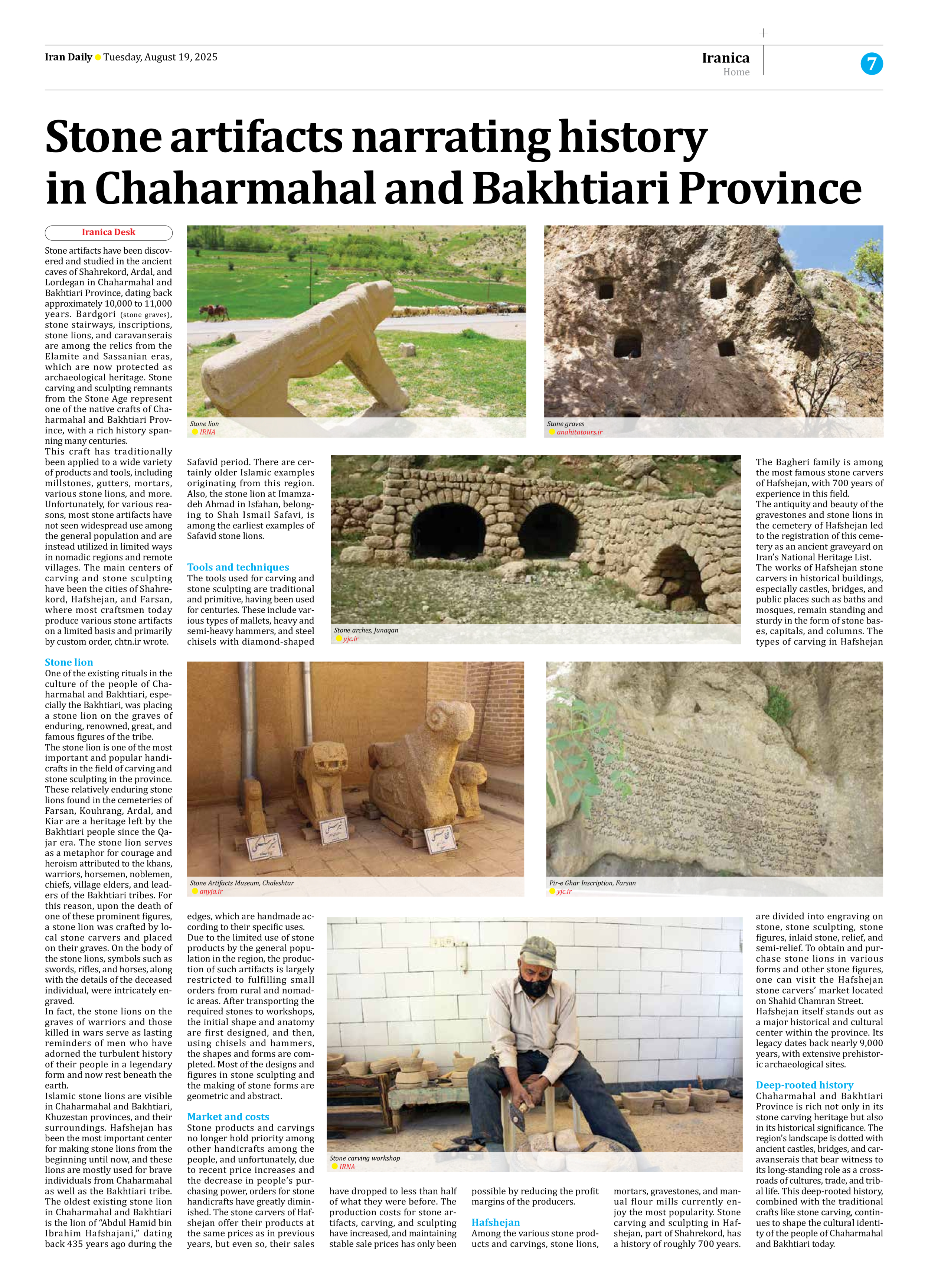
The stone lion is one of the most important and popular handicrafts in the field of carving and stone sculpting in the province. These relatively enduring stone lions found in the cemeteries of Farsan, Kouhrang, Ardal, and Kiar are a heritage left by the Bakhtiari people since the Qajar era. The stone lion serves as a metaphor for courage and heroism attributed to the khans, warriors, horsemen, noblemen, chiefs, village elders, and leaders of the Bakhtiari tribes. For this reason, upon the death of one of these prominent figures, a stone lion was crafted by local stone carvers and placed on their graves. On the body of the stone lions, symbols such as swords, rifles, and horses, along with the details of the deceased individual, were intricately engraved.
In fact, the stone lions on the graves of warriors and those killed in wars serve as lasting reminders of men who have adorned the turbulent history of their people in a legendary form and now rest beneath the earth.
Islamic stone lions are visible in Chaharmahal and Bakhtiari, Khuzestan provinces, and their surroundings. Hafshejan has been the most important center for making stone lions from the beginning until now, and these lions are mostly used for brave individuals from Chaharmahal as well as the Bakhtiari tribe. The oldest existing stone lion in Chaharmahal and Bakhtiari is the lion of “Abdul Hamid bin Ibrahim Hafshajani,” dating back 435 years ago during the Safavid period. There are certainly older Islamic examples originating from this region. Also, the stone lion at Imamzadeh Ahmad in Isfahan, belonging to Shah Ismail Safavi, is among the earliest examples of Safavid stone lions.
Tools and techniques
The tools used for carving and stone sculpting are traditional and primitive, having been used for centuries. These include various types of mallets, heavy and semi-heavy hammers, and steel chisels with diamond-shaped edges, which are handmade according to their specific uses.
Due to the limited use of stone products by the general population in the region, the production of such artifacts is largely restricted to fulfilling small orders from rural and nomadic areas. After transporting the required stones to workshops, the initial shape and anatomy are first designed, and then, using chisels and hammers, the shapes and forms are completed. Most of the designs and figures in stone sculpting and the making of stone forms are geometric and abstract.
Market and costs
Stone products and carvings no longer hold priority among other handicrafts among the people, and unfortunately, due to recent price increases and the decrease in people’s purchasing power, orders for stone handicrafts have greatly diminished. The stone carvers of Hafshejan offer their products at the same prices as in previous years, but even so, their sales have dropped to less than half of what they were before. The production costs for stone artifacts, carving, and sculpting have increased, and maintaining stable sale prices has only been possible by reducing the profit margins of the producers.
Hafshejan
Among the various stone products and carvings, stone lions, mortars, gravestones, and manual flour mills currently enjoy the most popularity. Stone carving and sculpting in Hafshejan, part of Shahrekord, has a history of roughly 700 years. The Bagheri family is among the most famous stone carvers of Hafshejan, with 700 years of experience in this field.
The antiquity and beauty of the gravestones and stone lions in the cemetery of Hafshejan led to the registration of this cemetery as an ancient graveyard on Iran’s National Heritage List.
The works of Hafshejan stone carvers in historical buildings, especially castles, bridges, and public places such as baths and mosques, remain standing and sturdy in the form of stone bases, capitals, and columns. The types of carving in Hafshejan are divided into engraving on stone, stone sculpting, stone figures, inlaid stone, relief, and semi-relief. To obtain and purchase stone lions in various forms and other stone figures, one can visit the Hafshejan stone carvers’ market located on Shahid Chamran Street.
Hafshejan itself stands out as a major historical and cultural center within the province. Its legacy dates back nearly 9,000 years, with extensive prehistoric archaeological sites.
Deep-rooted history
Chaharmahal and Bakhtiari Province is rich not only in its stone carving heritage but also in its historical significance. The region’s landscape is dotted with ancient castles, bridges, and caravanserais that bear witness to its long-standing role as a crossroads of cultures, trade, and tribal life. This deep-rooted history, combined with the traditional crafts like stone carving, continues to shape the cultural identity of the people of Chaharmahal and Bakhtiari today.