







Larijani’s visit inflection point in reinforcing security policies
By Mousa
Alizadeh-Tabatabaei
Iran’s Foreign Ministry official
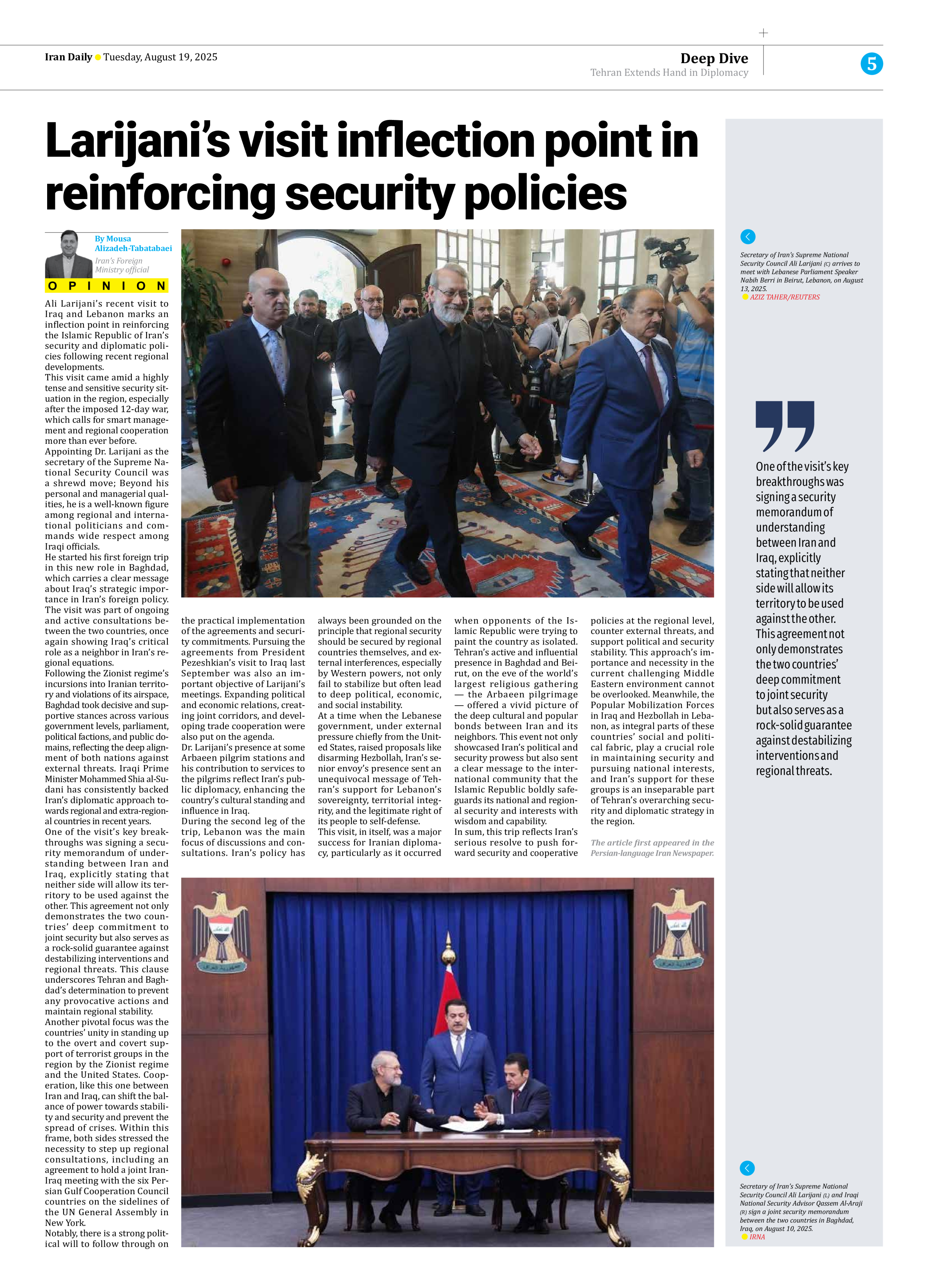
Ali Larijani’s recent visit to Iraq and Lebanon marks an inflection point in reinforcing the Islamic Republic of Iran’s security and diplomatic policies following recent regional developments.
This visit came amid a highly tense and sensitive security situation in the region, especially after the imposed 12-day war, which calls for smart management and regional cooperation more than ever before.
Appointing Dr. Larijani as the secretary of the Supreme National Security Council was a shrewd move; Beyond his personal and managerial qualities, he is a well-known figure among regional and international politicians and commands wide respect among Iraqi officials.
He started his first foreign trip in this new role in Baghdad, which carries a clear message about Iraq’s strategic importance in Iran’s foreign policy. The visit was part of ongoing and active consultations between the two countries, once again showing Iraq’s critical role as a neighbor in Iran’s regional equations.
Following the Zionist regime’s incursions into Iranian territory and violations of its airspace, Baghdad took decisive and supportive stances across various government levels, parliament, political factions, and public domains, reflecting the deep alignment of both nations against external threats. Iraqi Prime Minister Mohammed Shia al-Sudani has consistently backed Iran’s diplomatic approach towards regional and extra-regional countries in recent years.
One of the visit’s key breakthroughs was signing a security memorandum of understanding between Iran and Iraq, explicitly stating that neither side will allow its territory to be used against the other. This agreement not only demonstrates the two countries’ deep commitment to joint security but also serves as a rock-solid guarantee against destabilizing interventions and regional threats. This clause underscores Tehran and Baghdad’s determination to prevent any provocative actions and maintain regional stability.
Another pivotal focus was the countries’ unity in standing up to the overt and covert support of terrorist groups in the region by the Zionist regime and the United States. Cooperation, like this one between Iran and Iraq, can shift the balance of power towards stability and security and prevent the spread of crises. Within this frame, both sides stressed the necessity to step up regional consultations, including an agreement to hold a joint Iran-Iraq meeting with the six Persian Gulf Cooperation Council countries on the sidelines of the UN General Assembly in New York.
Notably, there is a strong political will to follow through on the practical implementation of the agreements and security commitments. Pursuing the agreements from President Pezeshkian’s visit to Iraq last September was also an important objective of Larijani’s meetings. Expanding political and economic relations, creating joint corridors, and developing trade cooperation were also put on the agenda.
Dr. Larijani’s presence at some Arbaeen pilgrim stations and his contribution to services to the pilgrims reflect Iran’s public diplomacy, enhancing the country’s cultural standing and influence in Iraq.
During the second leg of the trip, Lebanon was the main focus of discussions and consultations. Iran’s policy has always been grounded on the principle that regional security should be secured by regional countries themselves, and external interferences, especially by Western powers, not only fail to stabilize but often lead to deep political, economic, and social instability.
At a time when the Lebanese government, under external pressure chiefly from the United States, raised proposals like disarming Hezbollah, Iran’s senior envoy’s presence sent an unequivocal message of Tehran’s support for Lebanon’s sovereignty, territorial integrity, and the legitimate right of its people to self-defense.
This visit, in itself, was a major success for Iranian diplomacy, particularly as it occurred when opponents of the Islamic Republic were trying to paint the country as isolated. Tehran’s active and influential presence in Baghdad and Beirut, on the eve of the world’s largest religious gathering — the Arbaeen pilgrimage — offered a vivid picture of the deep cultural and popular bonds between Iran and its neighbors. This event not only showcased Iran’s political and security prowess but also sent a clear message to the international community that the Islamic Republic boldly safeguards its national and regional security and interests with wisdom and capability.
In sum, this trip reflects Iran’s serious resolve to push forward security and cooperative policies at the regional level, counter external threats, and support political and security stability. This approach’s importance and necessity in the current challenging Middle Eastern environment cannot be overlooked. Meanwhile, the Popular Mobilization Forces in Iraq and Hezbollah in Lebanon, as integral parts of these countries’ social and political fabric, play a crucial role in maintaining security and pursuing national interests, and Iran’s support for these groups is an inseparable part of Tehran’s overarching security and diplomatic strategy in the region.
The article first appeared in the Persian-language Iran Newspaper.