





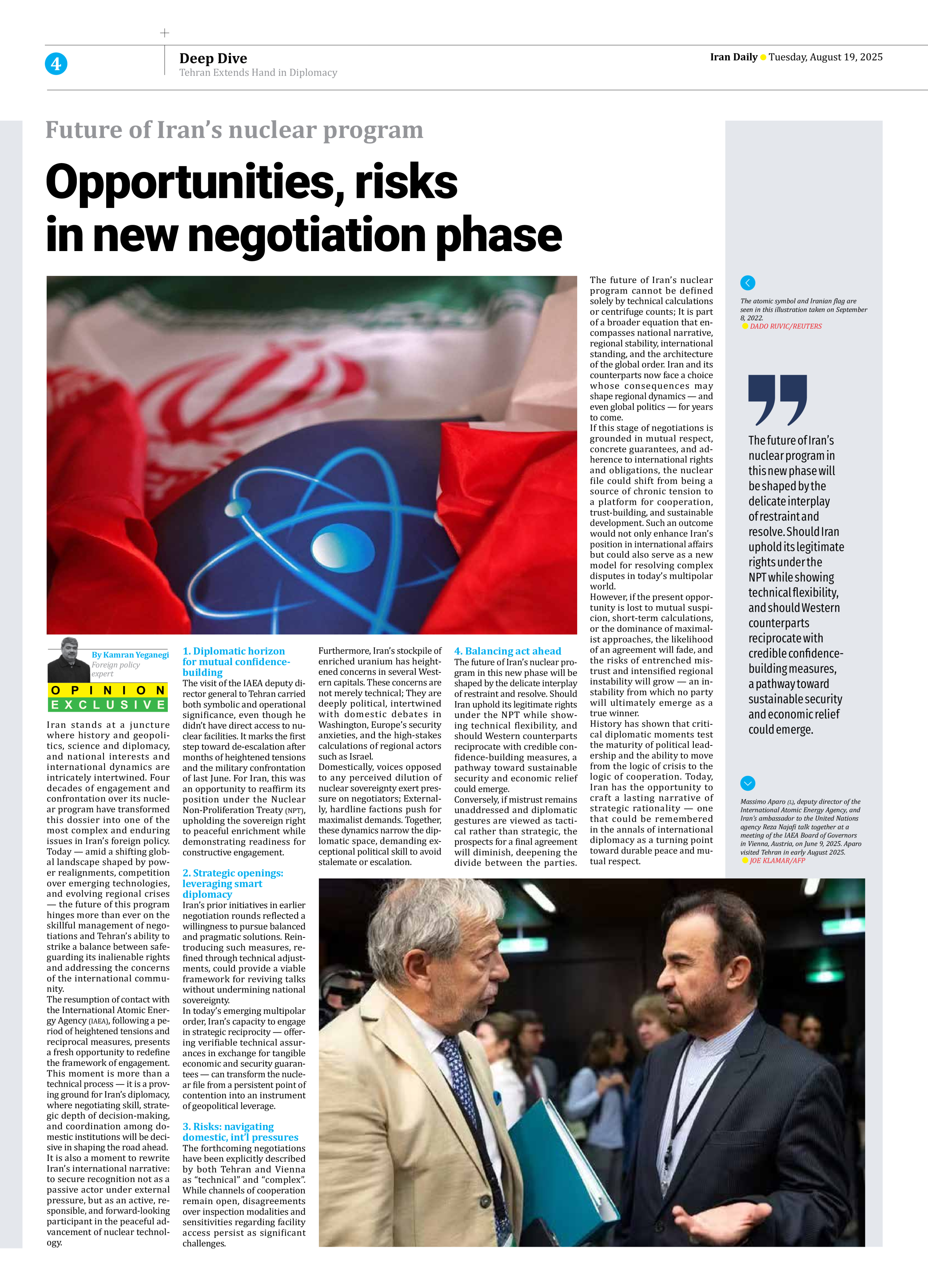


Future of Iran’s nuclear program
Opportunities, risks in new negotiation phase
By Kamran Yeganegi
Foreign policy expert
Iran stands at a juncture where history and geopolitics, science and diplomacy, and national interests and international dynamics are intricately intertwined. Four decades of engagement and confrontation over its nuclear program have transformed this dossier into one of the most complex and enduring issues in Iran’s foreign policy. Today — amid a shifting global landscape shaped by power realignments, competition over emerging technologies, and evolving regional crises — the future of this program hinges more than ever on the skillful management of negotiations and Tehran’s ability to strike a balance between safeguarding its inalienable rights and addressing the concerns of the international community.
The resumption of contact with the International Atomic Energy Agency (IAEA), following a period of heightened tensions and reciprocal measures, presents a fresh opportunity to redefine the framework of engagement. This moment is more than a technical process — it is a proving ground for Iran’s diplomacy, where negotiating skill, strategic depth of decision-making, and coordination among domestic institutions will be decisive in shaping the road ahead.
It is also a moment to rewrite Iran’s international narrative: to secure recognition not as a passive actor under external pressure, but as an active, responsible, and forward-looking participant in the peaceful advancement of nuclear technology.
1. Diplomatic horizon for mutual confidence-building
The visit of the IAEA deputy director general to Tehran carried both symbolic and operational significance, even though he didn’t have direct access to nuclear facilities. It marks the first step toward de-escalation after months of heightened tensions and the military confrontation of last June. For Iran, this was an opportunity to reaffirm its position under the Nuclear Non-Proliferation Treaty (NPT), upholding the sovereign right to peaceful enrichment while demonstrating readiness for constructive engagement.
2. Strategic openings: leveraging smart diplomacy
Iran’s prior initiatives in earlier negotiation rounds reflected a willingness to pursue balanced and pragmatic solutions. Reintroducing such measures, refined through technical adjustments, could provide a viable framework for reviving talks without undermining national sovereignty.
In today’s emerging multipolar order, Iran’s capacity to engage in strategic reciprocity — offering verifiable technical assurances in exchange for tangible economic and security guarantees — can transform the nuclear file from a persistent point of contention into an instrument of geopolitical leverage.
3. Risks: navigating domestic, int’l pressures
The forthcoming negotiations have been explicitly described by both Tehran and Vienna as “technical” and “complex”. While channels of cooperation remain open, disagreements over inspection modalities and sensitivities regarding facility access persist as significant challenges.
Furthermore, Iran’s stockpile of enriched uranium has heightened concerns in several Western capitals. These concerns are not merely technical; They are deeply political, intertwined with domestic debates in Washington, Europe’s security anxieties, and the high-stakes calculations of regional actors such as Israel.
Domestically, voices opposed to any perceived dilution of nuclear sovereignty exert pressure on negotiators; Externally, hardline factions push for maximalist demands. Together, these dynamics narrow the diplomatic space, demanding exceptional political skill to avoid stalemate or escalation.
4. Balancing act ahead
The future of Iran’s nuclear program in this new phase will be shaped by the delicate interplay of restraint and resolve. Should Iran uphold its legitimate rights under the NPT while showing technical flexibility, and should Western counterparts reciprocate with credible confidence-building measures, a pathway toward sustainable security and economic relief could emerge.
Conversely, if mistrust remains unaddressed and diplomatic gestures are viewed as tactical rather than strategic, the prospects for a final agreement will diminish, deepening the divide between the parties.
The future of Iran’s nuclear program cannot be defined solely by technical calculations or centrifuge counts; It is part of a broader equation that encompasses national narrative, regional stability, international standing, and the architecture of the global order. Iran and its counterparts now face a choice whose consequences may shape regional dynamics — and even global politics — for years to come.
If this stage of negotiations is grounded in mutual respect, concrete guarantees, and adherence to international rights and obligations, the nuclear file could shift from being a source of chronic tension to a platform for cooperation, trust-building, and sustainable development. Such an outcome would not only enhance Iran’s position in international affairs but could also serve as a new model for resolving complex disputes in today’s multipolar world.
However, if the present opportunity is lost to mutual suspicion, short-term calculations, or the dominance of maximalist approaches, the likelihood of an agreement will fade, and the risks of entrenched mistrust and intensified regional instability will grow — an instability from which no party will ultimately emerge as a true winner.
History has shown that critical diplomatic moments test the maturity of political leadership and the ability to move from the logic of crisis to the logic of cooperation. Today, Iran has the opportunity to craft a lasting narrative of strategic rationality — one that could be remembered in the annals of international diplomacy as a turning point toward durable peace and mutual respect.