





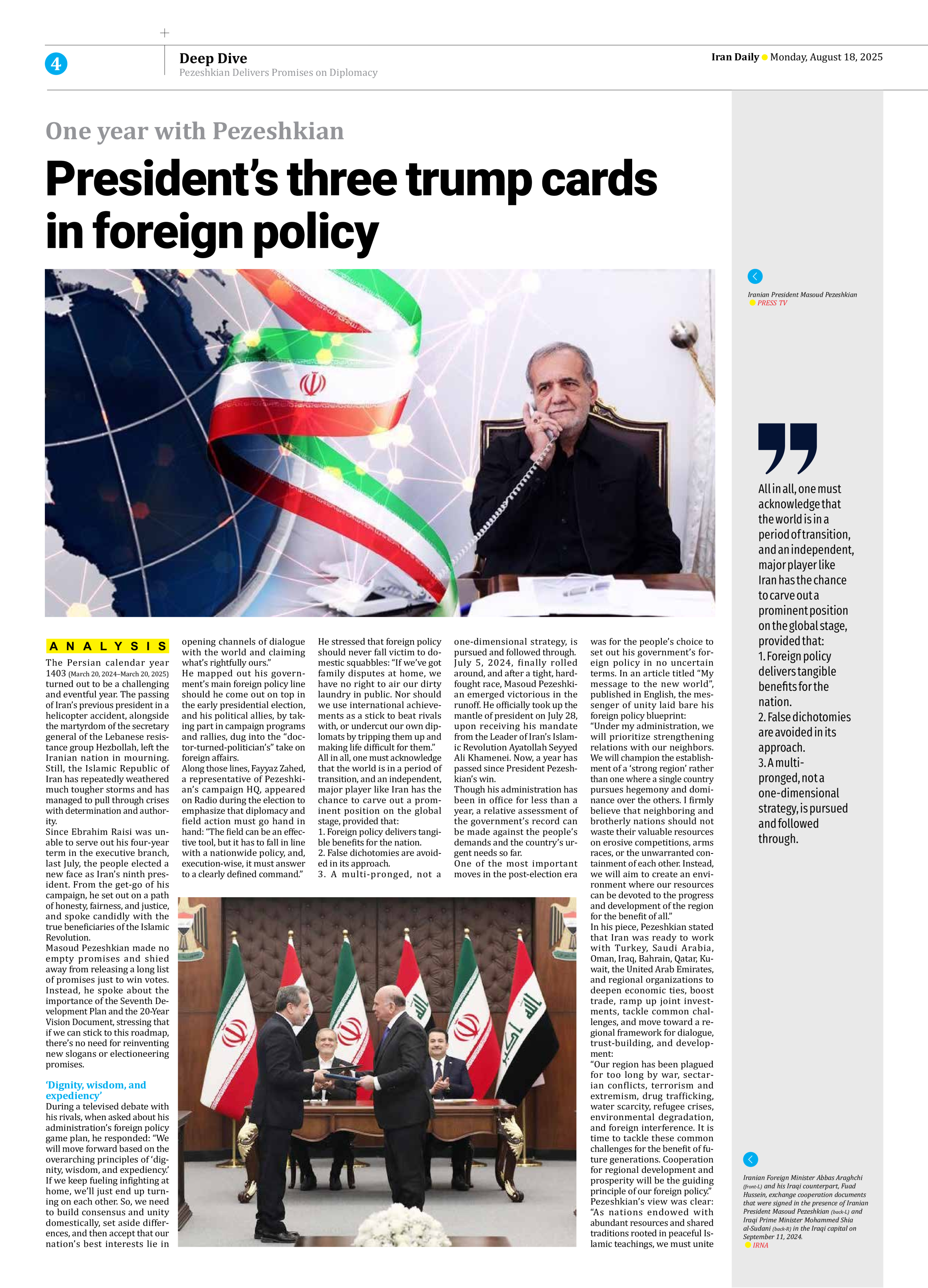


One year with Pezeshkian
President’s three trump cards in foreign policy
The Persian calendar year 1403 (March 20, 2024–March 20, 2025) turned out to be a challenging and eventful year. The passing of Iran’s previous president in a helicopter accident, alongside the martyrdom of the secretary general of the Lebanese resistance group Hezbollah, left the Iranian nation in mourning. Still, the Islamic Republic of Iran has repeatedly weathered much tougher storms and has managed to pull through crises with determination and authority.
Since Ebrahim Raisi was unable to serve out his four-year term in the executive branch, last July, the people elected a new face as Iran’s ninth president. From the get-go of his campaign, he set out on a path of honesty, fairness, and justice, and spoke candidly with the true beneficiaries of the Islamic Revolution.
Masoud Pezeshkian made no empty promises and shied away from releasing a long list of promises just to win votes. Instead, he spoke about the importance of the Seventh Development Plan and the 20-Year Vision Document, stressing that if we can stick to this roadmap, there’s no need for reinventing new slogans or electioneering promises.
‘Dignity, wisdom, and expediency’
During a televised debate with his rivals, when asked about his administration’s foreign policy game plan, he responded: “We will move forward based on the overarching principles of ‘dignity, wisdom, and expediency.’ If we keep fueling infighting at home, we’ll just end up turning on each other. So, we need to build consensus and unity domestically, set aside differences, and then accept that our nation’s best interests lie in opening channels of dialogue with the world and claiming what’s rightfully ours.”
He mapped out his government’s main foreign policy line should he come out on top in the early presidential election, and his political allies, by taking part in campaign programs and rallies, dug into the “doctor-turned-politician’s” take on foreign affairs.
Along those lines, Fayyaz Zahed, a representative of Pezeshkian’s campaign HQ, appeared on Radio during the election to emphasize that diplomacy and field action must go hand in hand: “The field can be an effective tool, but it has to fall in line with a nationwide policy, and, execution-wise, it must answer to a clearly defined command.”
He stressed that foreign policy should never fall victim to domestic squabbles: “If we’ve got family disputes at home, we have no right to air our dirty laundry in public. Nor should we use international achievements as a stick to beat rivals with, or undercut our own diplomats by tripping them up and making life difficult for them.”
All in all, one must acknowledge that the world is in a period of transition, and an independent, major player like Iran has the chance to carve out a prominent position on the global stage, provided that:
1. Foreign policy delivers tangible benefits for the nation.
2. False dichotomies are avoided in its approach.
3. A multi-pronged, not a one-dimensional strategy, is pursued and followed through.
July 5, 2024, finally rolled around, and after a tight, hard-fought race, Masoud Pezeshkian emerged victorious in the runoff. He officially took up the mantle of president on July 28, upon receiving his mandate from the Leader of Iran’s Islamic Revolution Ayatollah Seyyed Ali Khamenei. Now, a year has passed since President Pezeshkian’s win.
Though his administration has been in office for less than a year, a relative assessment of the government’s record can be made against the people’s demands and the country’s urgent needs so far.
One of the most important moves in the post-election era was for the people’s choice to set out his government’s foreign policy in no uncertain terms. In an article titled “My message to the new world”, published in English, the messenger of unity laid bare his foreign policy blueprint:
“Under my administration, we will prioritize strengthening relations with our neighbors. We will champion the establishment of a ‘strong region’ rather than one where a single country pursues hegemony and dominance over the others. I firmly believe that neighboring and brotherly nations should not waste their valuable resources on erosive competitions, arms races, or the unwarranted containment of each other. Instead, we will aim to create an environment where our resources can be devoted to the progress and development of the region for the benefit of all.”
In his piece, Pezeshkian stated that Iran was ready to work with Turkey, Saudi Arabia, Oman, Iraq, Bahrain, Qatar, Kuwait, the United Arab Emirates, and regional organizations to deepen economic ties, boost trade, ramp up joint investments, tackle common challenges, and move toward a regional framework for dialogue, trust-building, and development:
“Our region has been plagued for too long by war, sectarian conflicts, terrorism and extremism, drug trafficking, water scarcity, refugee crises, environmental degradation, and foreign interference. It is time to tackle these common challenges for the benefit of future generations. Cooperation for regional development and prosperity will be the guiding principle of our foreign policy.”
Pezeshkian’s view was clear: “As nations endowed with abundant resources and shared traditions rooted in peaceful Islamic teachings, we must unite and rely on the power of logic rather than the logic of power. By leveraging our normative influence, we can play a crucial role in the emerging post-polar global order by promoting peace, creating a calm environment conducive to sustainable development, fostering dialogue, and dispelling Islamophobia. Iran is prepared to play its fair share in this regard.”
Now, with a year gone by since Pezeshkian’s ascent, commentator and journalist Jalal Khosh-chehre, in an op-ed titled “What Went on the Fourteenth Administration’s Foreign Policy,” asserted that Pezeshkian, throughout his campaign, doubled down on two winning ideas: ensuring external security and building domestic unity. He anchored foreign policy on three strategic pillars: deterrence, peace, and diplomacy. Pezeshkian worked hard to spell out these three concepts for both domestic and foreign audiences, seeking to tie Iran’s interests to those of its neighbors. As a result, his policies not only caught on at home but also struck a chord abroad — so much so that they set alarm bells ringing in Israel.
If we want to zero in on President Pezeshkian’s record in foreign policy, we must lay out three key principles and then raise a fundamental question.
1. Striking a balance between the field and diplomacy: Since the post-election period up to today, Pezeshkian has struck up a fortunate balance between the field and diplomacy, clearly exemplified by the swift rollout of Operation True Promise III and the firm, tough response to the aggressor enemy.
Mohammad Golzari, secretary of the Government Information Council, said regarding this that after the attack by the Zionist regime against Iran, the president and the entire government, through round-the-clock efforts and coordinated field management and active diplomacy, kept the country from spiraling into bigger crises. He added that Pezeshkian is well-versed in defense as well as dialogue; For him, the field is the place to stand one’s ground protecting Iranian soil, and diplomacy is a way to ease tensions with the world.
Majid Nasirpour, the representative of the city of Sarab and member of the Social Committee of the Parliament, also put his stamp of approval on the balance between field and diplomacy, which is the president’s demand, telling IRNA: “We are compelled to have a strong presence across all arenas to run the country properly. Just as our military forces are widely recognized as a deterrent, many issues on the international stage must be followed up on and negotiated. Throughout this period, we have witnessed full coordination between field and diplomacy, both stepping up in pursuit of national goals and interests.”
Nasirpour stated that given the country’s circumstances, our diplomatic apparatus and government coordinate with the field and all other governing bodies, including the Supreme National Security Council, to divide up the work, and our diplomacy moves forward with strength and resolve.
In summary, it must be admitted that Pezeshkian understands the importance of both arenas: the “field” and “negotiation.” He knows both how to defend and how to conduct talks. Accordingly, he neither plays down the field nor undermines diplomacy, but keeps a well-balanced approach to pursuing both. For example, in an interview with American journalist Tucker Carlson — which made waves both inside and outside the country — he explicitly said, “We have no problem with negotiation. But the atrocities Israel has committed in the region and against our country… have caused a crisis… We hope that once we overcome this travesty, it will once again be possible to return to the negotiating table. However, that has a prerequisite: confidence in the negotiation process. Israel must not be allowed to attack again right in the middle of talks and ignite a new war.”
2. Developing regional relations based on neighborly diplomacy: With Masoud Pezeshkian elected as Iran’s president, the incumbent government set out to pursue national interests through a policy of good neighborliness and balanced engagement. The president’s trips to friendly and neighboring countries such as Iraq, Qatar, Tajikistan, Azerbaijan, Oman, and Turkmenistan stand as symbols of the effort to strengthen and expand relations with regional and neighboring countries.
Moreover, the current government, within a framework of balanced interaction with countries like Russia and Egypt and active participation in regional and international organizations and institutions, has been working out a multilateral approach and has sought to boost economic ties with other countries around the globe.
According to the foreign policy laid out by the head of the self-proclaimed “Government of National Unity,” to develop and strengthen regional and international cooperation, especially continuous and effective relations with neighbors, we have so far witnessed a growing political and diplomatic engagement by Masoud Pezeshkian to realize the motto of unity on the regional and global stages, and this path is being continued by him.
Esmaeil Kowsari, representative of Tehran and member of the Parliament’s National Security and Foreign Policy Committee, pointed out that relations with neighboring and friendly countries must be actively maintained, saying: “Expanding relations with neighbors and friendly countries will lead to economic progress. The policy of engaging with neighbors and friends has been very successful and impactful. Therefore, there is always an emphasis on continuing and preserving this trend.”
Within one year after the election, President Pezeshkian has shown he has managed to forge effective and constructive ties with regional countries, and relying on good neighborliness diplomacy, has turned Iran into a more active player in the region. He is also vigorously pursuing the strengthening of regional diplomacy and defining more serious cooperation with countries with which Iran shares many commonalities, such as Saudi Arabia. Therefore, the development of regional relations based on neighborly diplomacy is another winning hand of the incumbent government.
3. Forming a regional alliance to overcome crises: On one hand, the head of Iran’s executive branch keeps pushing for developing regional relations; On the other, he is pursuing the formation of a regional alliance. During his first foreign trip as president to Iraq, he threw out this idea in a meeting with his Iraqi counterpart and, explaining it, spoke about working toward removing borders between these countries, similar to the European Union experience.
Building a regional union could blur borders among countries, strengthen cooperation, and ultimately lead to peace and stability in the region while breaking the back of imperialist conspiracies. Iran fought the vile Zionist regime for 12 days, and if a regional alliance takes shape, the Zionist enemy will no longer be able to roam freely in the Middle East. Accordingly, the government’s strategic policy is to forge an alliance among regional countries to weather the structural and security crises in the Middle East — a union based on common interests, dialogue, and lasting cooperation.
Notably, on Tuesday night, July 8, Mohsen Rezaei, former commander of the Islamic Revolution Guard Corps, in a special news interview, underscored the necessity of forming a South West Union with 25 countries, led by five major regional powers: Egypt, Saudi Arabia, Iran, Turkey, and Pakistan. He likened this union to the European Union, recalling how Europeans, after two world wars, came together to form the EU. He said: “This union could become one of the corners of the new world order and the multipolar system alongside the US, China, Russia, and the EU, and thereby shield the region from future conflicts.”
Now, it is clear why the president has always hammered home the need to build a regional alliance. He fully understood that this is the best recipe to get through the crises.
War’s fate if Pezeshkian not been in charge
Following the Zionist regime’s attack on Iranian soil, some posed the question: What would have been the fate of the war if Pezeshkian had not been at the helm of the executive branch?
Although Ayatollah Khamenei, the commander-in-chief of the Armed Forces, managed the war with intelligence and wise measures, the role of the country’s second-in-command cannot be overlooked or downplayed; The president, by being actively present and running affairs fully coordinated and aligned with the Leader, stood firm to defend the nation’s core and interests. He also, with a revolutionary pragmatism, tried over the past year to strengthen the links between the government and the people with a rhythm of unity and cohesion. Hence, if Pezeshkian’s government were not in office, the loss of popular support for the government would have triggered major problems during the war.
Ali Shakouri Rad, a political activist, told IRNA: “Analyzing this matter isn’t easy, but one of the key factors alongside Iran’s military might was Pezeshkian’s approach. He was able to bring national power to the forefront through people’s unity and cohesion, which was very impactful. Alongside military strength, the national unity and solidarity between the people and the government in the face of the foreign enemy played an equally pivotal role in ending the war sooner and preventing further devastation.”
A glance at the moves and actions of our president shows he remains true to the pledge he made to the people. Before formally starting his work, he unveiled his plans and, up to today — on the eve of his government’s first anniversary — he has done his utmost to stick to those plans. He is after tangible gains in Iran’s foreign policy, avoids creating dichotomies, and treats foreign policy not as one-dimensional but multi-faceted. Overall, he advances the entirety of foreign policy within the framework of the system’s strategy and high-level policies, and at the one-year mark of his election, he can hand over to the people a respectable record.
Mr. President, the justice-seeker and peace-lover, well done.
The article first appeared in
Persian on IRNA.