





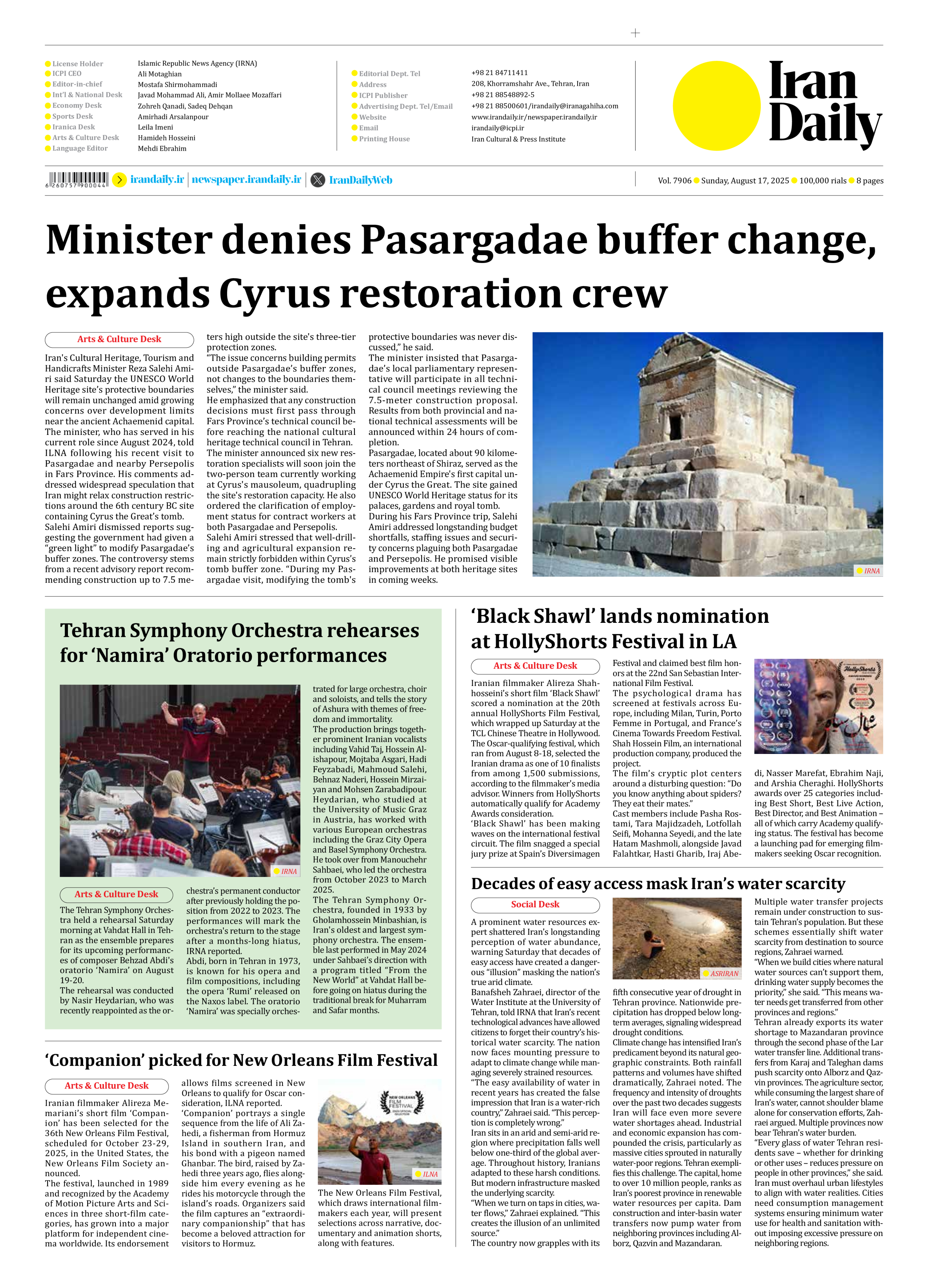


Decades of easy access mask Iran’s water scarcity
A prominent water resources expert shattered Iran’s longstanding perception of water abundance, warning Saturday that decades of easy access have created a dangerous “illusion” masking the nation’s true arid climate.
Banafsheh Zahraei, director of the Water Institute at the University of Tehran, told IRNA that Iran’s recent technological advances have allowed citizens to forget their country’s historical water scarcity. The nation now faces mounting pressure to adapt to climate change while managing severely strained resources.
“The easy availability of water in recent years has created the false impression that Iran is a water-rich country,” Zahraei said. “This perception is completely wrong.”
Iran sits in an arid and semi-arid region where precipitation falls well below one-third of the global average. Throughout history, Iranians adapted to these harsh conditions. But modern infrastructure masked the underlying scarcity.
“When we turn on taps in cities, water flows,” Zahraei explained. “This creates the illusion of an unlimited source.”
The country now grapples with its fifth consecutive year of drought in Tehran province. Nationwide precipitation has dropped below long-term averages, signaling widespread drought conditions.
Climate change has intensified Iran’s predicament beyond its natural geographic constraints. Both rainfall patterns and volumes have shifted dramatically, Zahraei noted. The frequency and intensity of droughts over the past two decades suggests Iran will face even more severe water shortages ahead. Industrial and economic expansion has compounded the crisis, particularly as massive cities sprouted in naturally water-poor regions. Tehran exemplifies this challenge. The capital, home to over 10 million people, ranks as Iran’s poorest province in renewable water resources per capita. Dam construction and inter-basin water transfers now pump water from neighboring provinces including Alborz, Qazvin and Mazandaran.
Multiple water transfer projects remain under construction to sustain Tehran’s population. But these schemes essentially shift water scarcity from destination to source regions, Zahraei warned.
“When we build cities where natural water sources can’t support them, drinking water supply becomes the priority,” she said. “This means water needs get transferred from other provinces and regions.”
Tehran already exports its water shortage to Mazandaran province through the second phase of the Lar water transfer line. Additional transfers from Karaj and Taleghan dams push scarcity onto Alborz and Qazvin provinces. The agriculture sector, while consuming the largest share of Iran’s water, cannot shoulder blame alone for conservation efforts, Zahraei argued. Multiple provinces now bear Tehran's water burden.
“Every glass of water Tehran residents save – whether for drinking or other uses – reduces pressure on people in other provinces,” she said.
Iran must overhaul urban lifestyles to align with water realities. Cities need consumption management systems ensuring minimum water use for health and sanitation without imposing excessive pressure on neighboring regions.