







Saeb Tabrizi’s tomb to become cultural beacon with Farshchian’s burial
Saeb Tabrizi’s tomb, belonging to the renowned poet of the 17th century, stands as one of the most distinguished examples of Iranian garden tombs. Restored in the 1950s, it has since become recognized as a major literary and cultural hub in Isfahan. This site is not only a valuable legacy of Iranian and Isfahani traditions through its unique design and architecture but has also evolved into a gathering place for lovers of poetry, literature, and art.
Farshchian burial decision
According to the decision made by the family of Mahmoud Farshchian, a master of Persian miniature painting who passed away on August 9, and in accordance with his will, the artist’s body is to be buried on Monday, August 19, in the western part of the tomb, beneath the stairs of Saeb’s mausoleum. This choice of location has once again drawn public attention to the artistic and architectural features of the tomb, placing it at the forefront of cultural interest.
In this context, three eminent experts in architecture, art, and culture participated in an interview with Mehr News Agency to explore various dimensions of Saeb’s tomb, offering a clear depiction of its hidden values for audiences who may be less familiar with this monument.
Architectural reinterpretation
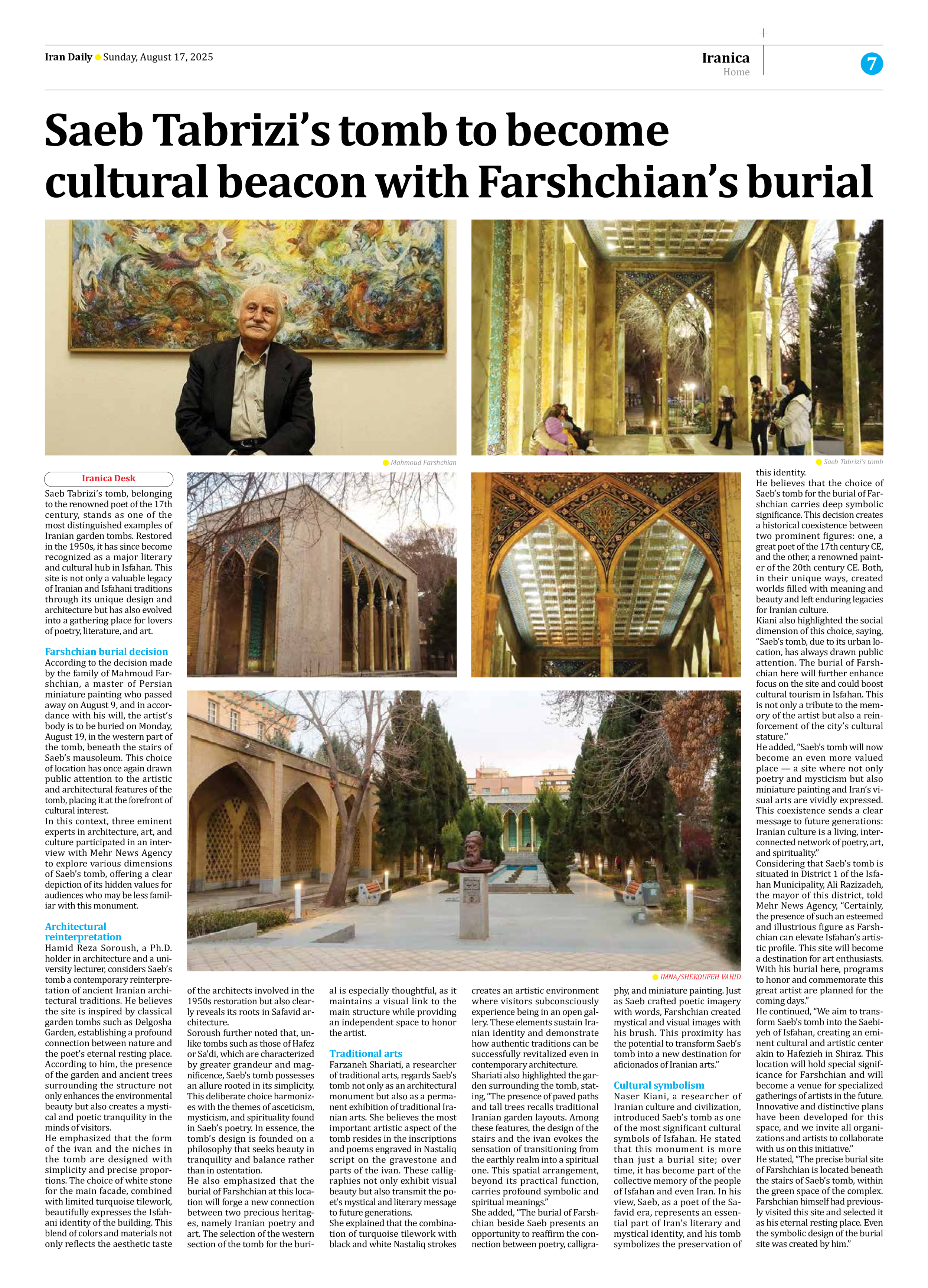
Hamid Reza Soroush, a Ph.D. holder in architecture and a university lecturer, considers Saeb’s tomb a contemporary reinterpretation of ancient Iranian architectural traditions. He believes the site is inspired by classical garden tombs such as Delgosha Garden, establishing a profound connection between nature and the poet’s eternal resting place. According to him, the presence of the garden and ancient trees surrounding the structure not only enhances the environmental beauty but also creates a mystical and poetic tranquility in the minds of visitors.
He emphasized that the form of the ivan and the niches in the tomb are designed with simplicity and precise proportions. The choice of white stone for the main facade, combined with limited turquoise tilework, beautifully expresses the Isfahani identity of the building. This blend of colors and materials not only reflects the aesthetic taste of the architects involved in the 1950s restoration but also clearly reveals its roots in Safavid architecture.
Soroush further noted that, unlike tombs such as those of Hafez or Sa’di, which are characterized by greater grandeur and magnificence, Saeb’s tomb possesses an allure rooted in its simplicity. This deliberate choice harmonizes with the themes of asceticism, mysticism, and spirituality found in Saeb’s poetry. In essence, the tomb’s design is founded on a philosophy that seeks beauty in tranquility and balance rather than in ostentation.
He also emphasized that the burial of Farshchian at this location will forge a new connection between two precious heritages, namely Iranian poetry and art. The selection of the western section of the tomb for the burial is especially thoughtful, as it maintains a visual link to the main structure while providing an independent space to honor the artist.
Traditional arts
Farzaneh Shariati, a researcher of traditional arts, regards Saeb’s tomb not only as an architectural monument but also as a permanent exhibition of traditional Iranian arts. She believes the most important artistic aspect of the tomb resides in the inscriptions and poems engraved in Nastaliq script on the gravestone and parts of the ivan. These calligraphies not only exhibit visual beauty but also transmit the poet’s mystical and literary message to future generations.
She explained that the combination of turquoise tilework with black and white Nastaliq strokes creates an artistic environment where visitors subconsciously experience being in an open gallery. These elements sustain Iranian identity and demonstrate how authentic traditions can be successfully revitalized even in contemporary architecture.
Shariati also highlighted the garden surrounding the tomb, stating, “The presence of paved paths and tall trees recalls traditional Iranian garden layouts. Among these features, the design of the stairs and the ivan evokes the sensation of transitioning from the earthly realm into a spiritual one. This spatial arrangement, beyond its practical function, carries profound symbolic and spiritual meanings.”
She added, “The burial of Farshchian beside Saeb presents an opportunity to reaffirm the connection between poetry, calligraphy, and miniature painting. Just as Saeb crafted poetic imagery with words, Farshchian created mystical and visual images with his brush. This proximity has the potential to transform Saeb’s tomb into a new destination for aficionados of Iranian arts.”
Cultural symbolism
Naser Kiani, a researcher of Iranian culture and civilization, introduced Saeb’s tomb as one of the most significant cultural symbols of Isfahan. He stated that this monument is more than just a burial site; over time, it has become part of the collective memory of the people of Isfahan and even Iran. In his view, Saeb, as a poet of the Safavid era, represents an essential part of Iran’s literary and mystical identity, and his tomb symbolizes the preservation of this identity.
He believes that the choice of Saeb’s tomb for the burial of Farshchian carries deep symbolic significance. This decision creates a historical coexistence between two prominent figures: one, a great poet of the 17th century CE, and the other, a renowned painter of the 20th century CE. Both, in their unique ways, created worlds filled with meaning and beauty and left enduring legacies for Iranian culture.
Kiani also highlighted the social dimension of this choice, saying, “Saeb’s tomb, due to its urban location, has always drawn public attention. The burial of Farshchian here will further enhance focus on the site and could boost cultural tourism in Isfahan. This is not only a tribute to the memory of the artist but also a reinforcement of the city’s cultural stature.”
He added, “Saeb’s tomb will now become an even more valued place — a site where not only poetry and mysticism but also miniature painting and Iran’s visual arts are vividly expressed. This coexistence sends a clear message to future generations: Iranian culture is a living, interconnected network of poetry, art, and spirituality.”
Considering that Saeb’s tomb is situated in District 1 of the Isfahan Municipality, Ali Razizadeh, the mayor of this district, told Mehr News Agency, “Certainly, the presence of such an esteemed and illustrious figure as Farshchian can elevate Isfahan’s artistic profile. This site will become a destination for art enthusiasts. With his burial here, programs to honor and commemorate this great artist are planned for the coming days.”
He continued, “We aim to transform Saeb’s tomb into the Saebiyeh of Isfahan, creating an eminent cultural and artistic center akin to Hafezieh in Shiraz. This location will hold special significance for Farshchian and will become a venue for specialized gatherings of artists in the future. Innovative and distinctive plans have been developed for this space, and we invite all organizations and artists to collaborate with us on this initiative.”
He stated, “The precise burial site of Farshchian is located beneath the stairs of Saeb’s tomb, within the green space of the complex. Farshchian himself had previously visited this site and selected it as his eternal resting place. Even the symbolic design of the burial site was created by him.”