





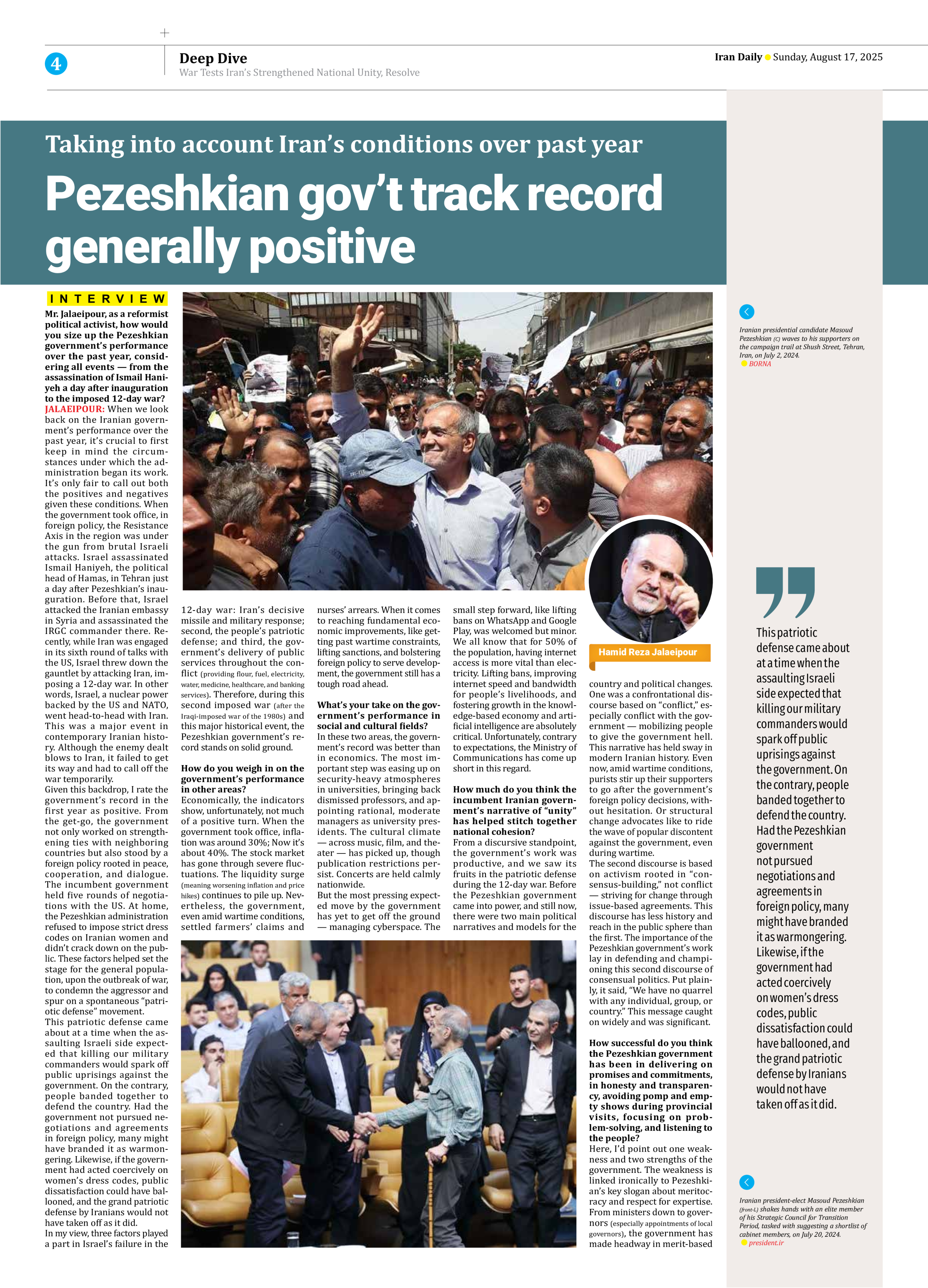


Taking into account Iran’s conditions over past year
Pezeshkian gov’t track record generally positive
Mr. Jalaeipour, as a reformist political activist, how would you size up the Pezeshkian government’s performance over the past year, considering all events — from the assassination of Ismail Haniyeh a day after inauguration to the imposed 12-day war?
JALAEIPOUR: When we look back on the Iranian government’s performance over the past year, it’s crucial to first keep in mind the circumstances under which the administration began its work. It’s only fair to call out both the positives and negatives given these conditions. When the government took office, in foreign policy, the Resistance Axis in the region was under the gun from brutal Israeli attacks. Israel assassinated Ismail Haniyeh, the political head of Hamas, in Tehran just a day after Pezeshkian’s inauguration. Before that, Israel attacked the Iranian embassy in Syria and assassinated the IRGC commander there. Recently, while Iran was engaged in its sixth round of talks with the US, Israel threw down the gauntlet by attacking Iran, imposing a 12-day war. In other words, Israel, a nuclear power backed by the US and NATO, went head-to-head with Iran. This was a major event in contemporary Iranian history. Although the enemy dealt blows to Iran, it failed to get its way and had to call off the war temporarily.
Given this backdrop, I rate the government’s record in the first year as positive. From the get-go, the government not only worked on strengthening ties with neighboring countries but also stood by a foreign policy rooted in peace, cooperation, and dialogue. The incumbent government held five rounds of negotiations with the US. At home, the Pezeshkian administration refused to impose strict dress codes on Iranian women and didn’t crack down on the public. These factors helped set the stage for the general population, upon the outbreak of war, to condemn the aggressor and spur on a spontaneous “patriotic defense” movement.
This patriotic defense came about at a time when the assaulting Israeli side expected that killing our military commanders would spark off public uprisings against the government. On the contrary, people banded together to defend the country. Had the government not pursued negotiations and agreements in foreign policy, many might have branded it as warmongering. Likewise, if the government had acted coercively on women’s dress codes, public dissatisfaction could have ballooned, and the grand patriotic defense by Iranians would not have taken off as it did.
In my view, three factors played a part in Israel’s failure in the 12-day war: Iran’s decisive missile and military response; second, the people’s patriotic defense; and third, the government’s delivery of public services throughout the conflict (providing flour, fuel, electricity, water, medicine, healthcare, and banking services). Therefore, during this second imposed war (after the Iraqi-imposed war of the 1980s) and this major historical event, the Pezeshkian government’s record stands on solid ground.
How do you weigh in on the government’s performance in other areas?
Economically, the indicators show, unfortunately, not much of a positive turn. When the government took office, inflation was around 30%; Now it’s about 40%. The stock market has gone through severe fluctuations. The liquidity surge (meaning worsening inflation and price hikes) continues to pile up. Nevertheless, the government, even amid wartime conditions, settled farmers’ claims and nurses’ arrears. When it comes to reaching fundamental economic improvements, like getting past wartime constraints, lifting sanctions, and bolstering foreign policy to serve development, the government still has a tough road ahead.
What’s your take on the government’s performance in social and cultural fields?
In these two areas, the government’s record was better than in economics. The most important step was easing up on security-heavy atmospheres in universities, bringing back dismissed professors, and appointing rational, moderate managers as university presidents. The cultural climate — across music, film, and theater — has picked up, though publication restrictions persist. Concerts are held calmly nationwide.
But the most pressing expected move by the government has yet to get off the ground — managing cyberspace. The small step forward, like lifting bans on WhatsApp and Google Play, was welcomed but minor. We all know that for 50% of the population, having internet access is more vital than electricity. Lifting bans, improving internet speed and bandwidth for people’s livelihoods, and fostering growth in the knowledge-based economy and artificial intelligence are absolutely critical. Unfortunately, contrary to expectations, the Ministry of Communications has come up short in this regard.
How much do you think the incumbent Iranian government’s narrative of “unity” has helped stitch together national cohesion?
From a discursive standpoint, the government’s work was productive, and we saw its fruits in the patriotic defense during the 12-day war. Before the Pezeshkian government came into power, and still now, there were two main political narratives and models for the country and political changes. One was a confrontational discourse based on “conflict,” especially conflict with the government — mobilizing people to give the government hell. This narrative has held sway in modern Iranian history. Even now, amid wartime conditions, purists stir up their supporters to go after the government’s foreign policy decisions, without hesitation. Or structural change advocates like to ride the wave of popular discontent against the government, even during wartime.
The second discourse is based on activism rooted in “consensus-building,” not conflict — striving for change through issue-based agreements. This discourse has less history and reach in the public sphere than the first. The importance of the Pezeshkian government’s work lay in defending and championing this second discourse of consensual politics. Put plainly, it said, “We have no quarrel with any individual, group, or country.” This message caught on widely and was significant.
How successful do you think the Pezeshkian government has been in delivering on promises and commitments, in honesty and transparency, avoiding pomp and empty shows during provincial visits, focusing on problem-solving, and listening to the people?
Here, I’d point out one weakness and two strengths of the government. The weakness is linked ironically to Pezeshkian’s key slogan about meritocracy and respect for expertise. From ministers down to governors (especially appointments of local governors), the government has made headway in merit-based selection but still has a long way to go. Even within the Pasteur complex, the government has yet to roll out an administration organized and adapted to current conditions.
But two features of the government in terms of public engagement are its plus points: First, Pezeshkian does not exploit the “distressed masses” as a political tool. You remember that during the two terms of president Ahmadinejad, thousands of desperate people rushed after the president’s motorcade, desperately trying to get their petitions in and collect 50,000 tomans! Pezeshkian is not into these crowd-pleasing tactics but still visits cities and actively pursues resolving people’s problems.
Second, Pezeshkian gets straight with the people and acts accordingly. For example, when his deputy praises him in a meeting, Pezeshkian says, “Jafar, cut it out.” Or if the government messes up by submitting a flawed cybersecurity bill, they own up and withdraw it. My impression is that people take to this straightforwardness. Also, despite the many problems people face, the public’s everyday relationship with the Pezeshkian government is not hostile.
What score would you give Pezeshkian and his government concerning actual compliance — not just rhetoric or show — with the Leader’s directives?
That consensual approach — the one that posits “we have no quarrels” — really showed its worth in the relationship between the Leader’s office and the government. The government’s success in the 12-day war would not have been possible without this cooperation between the government and the Leader’s office. The Leader of Iran’s Islamic Revolution Ayatollah Seyyed Ali Khamenei himself repeatedly stressed the importance of this collaboration.
The interview first appeared in Persian on IRNA.