







NGL plant comes on stream in Ilam Province with 240 mcf/d capacity
Oil minister: Gas flaring to end by early 2029
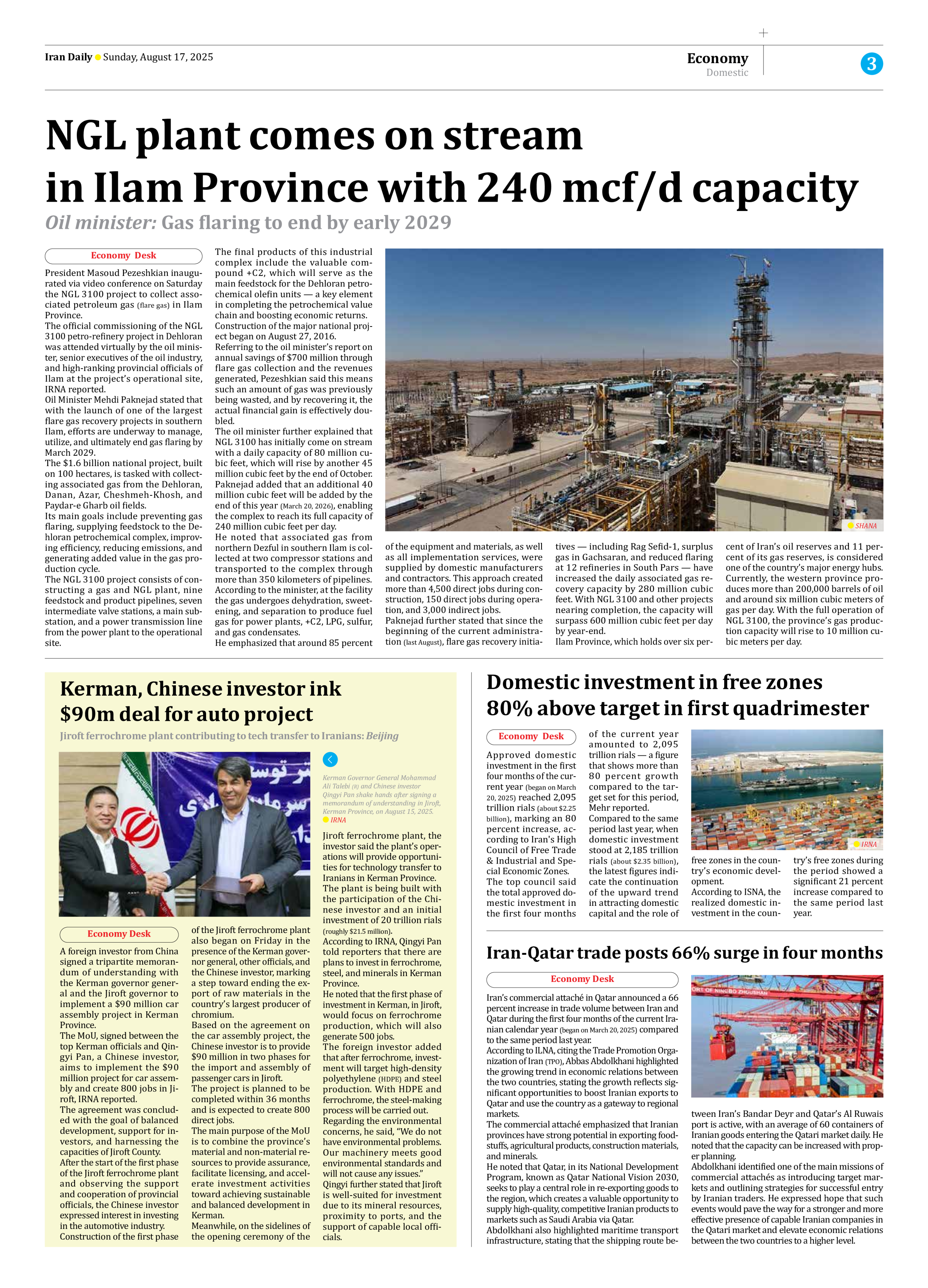
President Masoud Pezeshkian inaugurated via video conference on Saturday the NGL 3100 project to collect associated petroleum gas (flare gas) in Ilam Province.
The official commissioning of the NGL 3100 petro-refinery project in Dehloran was attended virtually by the oil minister, senior executives of the oil industry, and high-ranking provincial officials of Ilam at the project’s operational site, IRNA reported.
Oil Minister Mehdi Paknejad stated that with the launch of one of the largest flare gas recovery projects in southern Ilam, efforts are underway to manage, utilize, and ultimately end gas flaring by March 2029.
The $1.6 billion national project, built on 100 hectares, is tasked with collecting associated gas from the Dehloran, Danan, Azar, Cheshmeh-Khosh, and Paydar-e Gharb oil fields.
Its main goals include preventing gas flaring, supplying feedstock to the Dehloran petrochemical complex, improving efficiency, reducing emissions, and generating added value in the gas production cycle.
The NGL 3100 project consists of constructing a gas and NGL plant, nine feedstock and product pipelines, seven intermediate valve stations, a main substation, and a power transmission line from the power plant to the operational site.
The final products of this industrial complex include the valuable compound +C2, which will serve as the main feedstock for the Dehloran petrochemical olefin units — a key element in completing the petrochemical value chain and boosting economic returns.
Construction of the major national project began on August 27, 2016.
Referring to the oil minister’s report on annual savings of $700 million through flare gas collection and the revenues generated, Pezeshkian said this means such an amount of gas was previously being wasted, and by recovering it, the actual financial gain is effectively doubled.
The oil minister further explained that NGL 3100 has initially come on stream with a daily capacity of 80 million cubic feet, which will rise by another 45 million cubic feet by the end of October.
Paknejad added that an additional 40 million cubic feet will be added by the end of this year (March 20, 2026), enabling the complex to reach its full capacity of 240 million cubic feet per day.
He noted that associated gas from northern Dezful in southern Ilam is collected at two compressor stations and transported to the complex through more than 350 kilometers of pipelines.
According to the minister, at the facility the gas undergoes dehydration, sweetening, and separation to produce fuel gas for power plants, +C2, LPG, sulfur, and gas condensates.
He emphasized that around 85 percent of the equipment and materials, as well as all implementation services, were supplied by domestic manufacturers and contractors. This approach created more than 4,500 direct jobs during construction, 150 direct jobs during operation, and 3,000 indirect jobs.
Paknejad further stated that since the beginning of the current administration (last August), flare gas recovery initiatives — including Rag Sefid-1, surplus gas in Gachsaran, and reduced flaring at 12 refineries in South Pars — have increased the daily associated gas recovery capacity by 280 million cubic feet. With NGL 3100 and other projects nearing completion, the capacity will surpass 600 million cubic feet per day by year-end.
Ilam Province, which holds over six percent of Iran’s oil reserves and 11 percent of its gas reserves, is considered one of the country’s major energy hubs.
Currently, the western province produces more than 200,000 barrels of oil and around six million cubic meters of gas per day. With the full operation of NGL 3100, the province’s gas production capacity will rise to 10 million cubic meters per day.