







Mostowfi House; a cultural oasis in Shushtar
Mostowfi House in Shushtar, Khuzestan Province, dates back to the Qajar dynasty. This complex includes a mosque, public bath, and bridge, all built under the orders of Mohammad Ali Mostowfi during the reign of Muzaffar-Al-Din Shah. The architect was Mohammad Taghi Memar.
The complex also houses a museum, restaurant, handicrafts gallery, and photography studio. It has been designated as the official UNESCO center in Khuzestan Province.
The traditional interior design, scenic view of the Shadorwan River, and authentic local cuisine make the monument one of Shushtar’s prime tourist destinations.
The house is divided into two sections: Zananeh and Biruni, both offering views of the Shadorwan weir-dam and the Shatit River, a branch of the Karun River.
The Biruni section consists of doorways, corridors, rooms surrounding a vestibule, while the Zananeh (women) section features a central courtyard, alcove, porch, reception rooms (divided into summer and winter areas), and windcatchers. The structure is primarily built from clay, brick, and stucco.
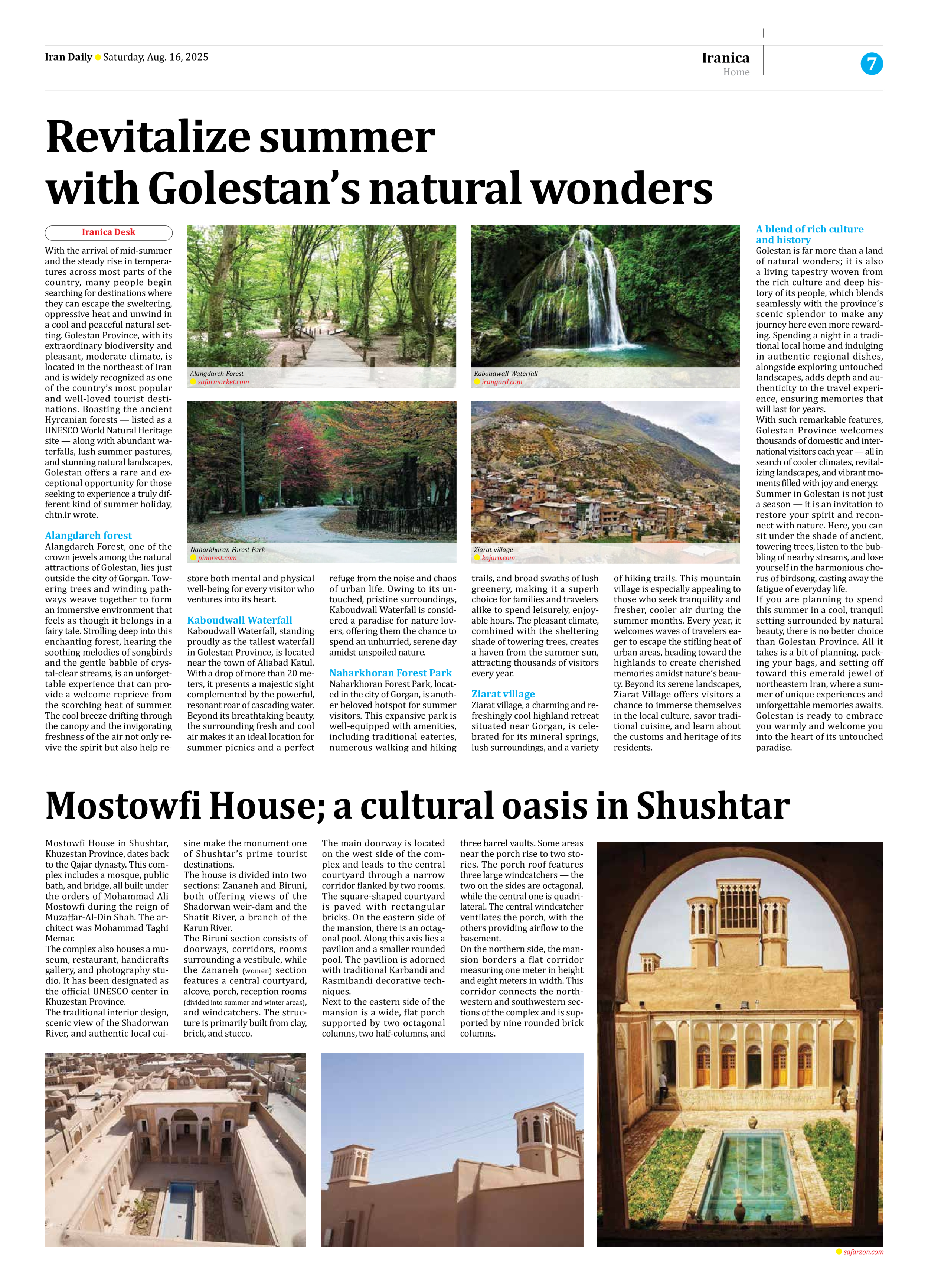
The main doorway is located on the west side of the complex and leads to the central courtyard through a narrow corridor flanked by two rooms. The square-shaped courtyard is paved with rectangular bricks. On the eastern side of the mansion, there is an octagonal pool. Along this axis lies a pavilion and a smaller rounded pool. The pavilion is adorned with traditional Karbandi and Rasmibandi decorative techniques.
Next to the eastern side of the mansion is a wide, flat porch supported by two octagonal columns, two half-columns, and three barrel vaults. Some areas near the porch rise to two stories. The porch roof features three large windcatchers — the two on the sides are octagonal, while the central one is quadrilateral. The central windcatcher ventilates the porch, with the others providing airflow to the basement.
On the northern side, the mansion borders a flat corridor measuring one meter in height and eight meters in width. This corridor connects the northwestern and southwestern sections of the complex and is supported by nine rounded brick columns.