





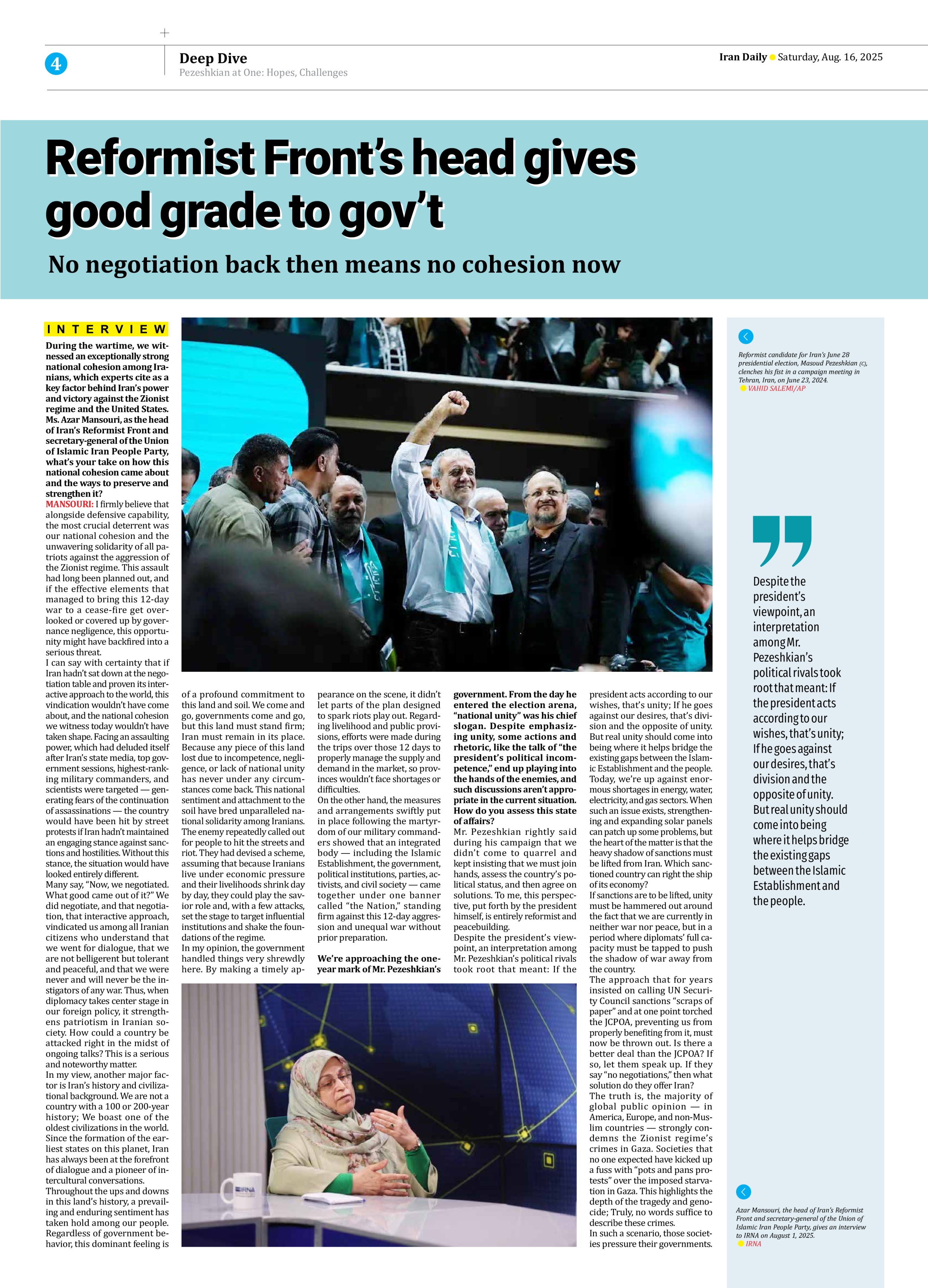


Reformist Front’s head gives good grade to gov’t
No negotiation back then means no cohesion now
During the wartime, we witnessed an exceptionally strong national cohesion among Iranians, which experts cite as a key factor behind Iran’s power and victory against the Zionist regime and the United States. Ms. Azar Mansouri, as the head of Iran’s Reformist Front and secretary-general of the Union of Islamic Iran People Party, what’s your take on how this national cohesion came about and the ways to preserve and strengthen it?
MANSOURI: I firmly believe that alongside defensive capability, the most crucial deterrent was our national cohesion and the unwavering solidarity of all patriots against the aggression of the Zionist regime. This assault had long been planned out, and if the effective elements that managed to bring this 12-day war to a cease-fire get overlooked or covered up by governance negligence, this opportunity might have backfired into a serious threat.
I can say with certainty that if Iran hadn’t sat down at the negotiation table and proven its interactive approach to the world, this vindication wouldn’t have come about, and the national cohesion we witness today wouldn’t have taken shape. Facing an assaulting power, which had deluded itself after Iran’s state media, top government sessions, highest-ranking military commanders, and scientists were targeted — generating fears of the continuation of assassinations — the country would have been hit by street protests if Iran hadn’t maintained an engaging stance against sanctions and hostilities. Without this stance, the situation would have looked entirely different.
Many say, “Now, we negotiated. What good came out of it?” We did negotiate, and that negotiation, that interactive approach, vindicated us among all Iranian citizens who understand that we went for dialogue, that we are not belligerent but tolerant and peaceful, and that we were never and will never be the instigators of any war. Thus, when diplomacy takes center stage in our foreign policy, it strengthens patriotism in Iranian society. How could a country be attacked right in the midst of ongoing talks? This is a serious and noteworthy matter.
In my view, another major factor is Iran’s history and civilizational background. We are not a country with a 100 or 200-year history; We boast one of the oldest civilizations in the world. Since the formation of the earliest states on this planet, Iran has always been at the forefront of dialogue and a pioneer of intercultural conversations.
Throughout the ups and downs in this land’s history, a prevailing and enduring sentiment has taken hold among our people. Regardless of government behavior, this dominant feeling is of a profound commitment to this land and soil. We come and go, governments come and go, but this land must stand firm; Iran must remain in its place. Because any piece of this land lost due to incompetence, negligence, or lack of national unity has never under any circumstances come back. This national sentiment and attachment to the soil have bred unparalleled national solidarity among Iranians.
The enemy repeatedly called out for people to hit the streets and riot. They had devised a scheme, assuming that because Iranians live under economic pressure and their livelihoods shrink day by day, they could play the savior role and, with a few attacks, set the stage to target influential institutions and shake the foundations of the regime.
In my opinion, the government handled things very shrewdly here. By making a timely appearance on the scene, it didn’t let parts of the plan designed to spark riots play out. Regarding livelihood and public provisions, efforts were made during the trips over those 12 days to properly manage the supply and demand in the market, so provinces wouldn’t face shortages or difficulties.
On the other hand, the measures and arrangements swiftly put in place following the martyrdom of our military commanders showed that an integrated body — including the Islamic Establishment, the government, political institutions, parties, activists, and civil society — came together under one banner called “the Nation,” standing firm against this 12-day aggression and unequal war without prior preparation.
We’re approaching the one-year mark of Mr. Pezeshkian’s government. From the day he entered the election arena, “national unity” was his chief slogan. Despite emphasizing unity, some actions and rhetoric, like the talk of “the president’s political incompetence,” end up playing into the hands of the enemies, and such discussions aren’t appropriate in the current situation. How do you assess this state of affairs?
Mr. Pezeshkian rightly said during his campaign that we didn’t come to quarrel and kept insisting that we must join hands, assess the country’s political status, and then agree on solutions. To me, this perspective, put forth by the president himself, is entirely reformist and peacebuilding.
Despite the president’s viewpoint, an interpretation among Mr. Pezeshkian’s political rivals took root that meant: If the president acts according to our wishes, that’s unity; If he goes against our desires, that’s division and the opposite of unity. But real unity should come into being where it helps bridge the existing gaps between the Islamic Establishment and the people.
Today, we’re up against enormous shortages in energy, water, electricity, and gas sectors. When such an issue exists, strengthening and expanding solar panels can patch up some problems, but the heart of the matter is that the heavy shadow of sanctions must be lifted from Iran. Which sanctioned country can right the ship of its economy?
If sanctions are to be lifted, unity must be hammered out around the fact that we are currently in neither war nor peace, but in a period where diplomats’ full capacity must be tapped to push the shadow of war away from the country.
The approach that for years insisted on calling UN Security Council sanctions “scraps of paper” and at one point torched the JCPOA, preventing us from properly benefiting from it, must now be thrown out. Is there a better deal than the JCPOA? If so, let them speak up. If they say “no negotiations,” then what solution do they offer Iran?
The truth is, the majority of global public opinion — in America, Europe, and non-Muslim countries — strongly condemns the Zionist regime’s crimes in Gaza. Societies that no one expected have kicked up a fuss with “pots and pans protests” over the imposed starvation in Gaza. This highlights the depth of the tragedy and genocide; Truly, no words suffice to describe these crimes.
In such a scenario, those societies pressure their governments. For example, we saw France announce it recognizes Palestine, but the real power to make that decision lies with the ruling elites in those countries.
Alongside official diplomacy, we must run with public diplomacy as well. We’ve also told Mr. Pezeshkian that the crimes of the Zionist regime during this 12-day war against the Iranian people — from Evin Prison to Tajrish Square, hospitals, residential homes, and innocent civilians, including pregnant women and children — are hugely important on their own rights, but the place that can lift the shadow of sanctions off us is diplomacy and negotiation. Therefore, all forces loyal to Iran must back the negotiation. We have no path other than negotiation. Of course, resistance is not denied where appropriate and feasible, but now is the time for diplomacy.
A criticism aimed at your group is that you mean total surrender or merely going to the negotiation table.
Absolutely not.
So, you believe we must uphold our conditions and positions while simultaneously negotiating?
Exactly. About 20 years ago, in 2005, a vision document was drafted. One of its clauses stated Iran should become the top regional power by 2025; This goal was based on constructive engagement with the world and dialogue framed by three principles: dignity, wisdom, and expediency. This is precisely the concept President Pezeshkian advances today. But why did the governments after the Reform era brush aside this pathway? After all, the name of an Iranian president had been recorded as the pioneer of the dialogue of civilizations.
The Vision Document was also part of the general policies of the Islamic Establishment.
Exactly. This issue had been signed off on by the Leader of the Revolution and the Expediency Council, and governments were tasked with implementing it. Everyone had permitted it, but the previous government ditched it. The document’s approach was the very strategy that could have catapulted us to be the leading country in the region, not where we are now in eighth or ninth place economically. We were supposed to be the number one economy in the region, but the plans were not carried out by the Ahmadinejad governments as well.
If there’s talk of unity in foreign policy now, then that unity must be hammered out around solutions. The bottom line is: If the establishment bodies reach an agreement on solutions, then these negotiations should carry on. This is where the government’s cooperation with the current broader policy becomes clear.
On the domestic front, many of the existing rifts must be addressed and patched up through unity. Do you think these gaps are being mended satisfactorily? All the factors causing dissatisfaction, anger, and even hatred toward the structure must be rooted out, and the state broadcaster should turn itself around to regain its national standing so people will tune back in.
When we talk about a soft war, where does this come into play? When we say the state broadcaster must assume the position of a national media, it means its role must be boosted to reduce citizens’ drift toward foreign media. Without this function, it acts against the country’s national interests.
Why is FATF held up? This is where unity comes into focus. If Mr. Pezeshkian’s success is the Islamic Establishment’s success, and his failure is the Islamic Establishment’s failure — this is a statement by the Leader — then all obstacles blocking this government on economic and livelihood issues must be cleared out. So why is there a delay? When we talk about unity, this is precisely where it must take root.
I also said during the elections that under these circumstances, anyone from the reformists who becomes a presidential candidate aware of the country’s situation has sacrificed themselves. Despite all pressures, Mr. Pezeshkian has stood his ground and is striving and negotiating. I am certain if anyone else but Mr. Pezeshkian had been president during this 12-day conflict — I mean his electoral rivals — they wouldn’t have been able to keep the country afloat in the same way.
Now, the reward for this sound management is cooperation with the government to bridge gaps. We must iron out sanctions issues and resolve problems in economic and trade exchanges with the world. Therefore, the FATF issue must be sorted out as soon as possible, and negotiations to lift sanctions must move forward. Even during the war, I wrote that we must push forward to isolate the Zionist regime and its main backers.
Of course, it’s true we face numerous sanctions, but the “snapback” mechanism also lends legitimacy to these sanctions, and new sanctions keep popping up against our country. Is this in Iran’s national interest? Now, the diplomatic apparatus and government must be strengthened so society feels the ruling system is pulling out all the stops to meet the people’s demands. At the same time, serious criticisms are directed at some government members and ministers.
How successful do you think Mr. Pezeshkian has been in achieving his goals and plans?
Mr. Pezeshkian said he’s not one for conflict and must form a cabinet that is a symbol of eschewing quarrels. Naturally, this means some considerations had to be taken into account in forming the cabinet. If we look at the one-year track record of some ministries, not only is there no improvement, but in some cases, the previous trends have been maintained or even gone downhill. A clear example is the Ministry of Energy. Given the energy and water supply situation, the primary responsibility rests with the Ministry of Energy, which should have managed the situation to prevent shortages from getting out of hand.
For example, power cuts for a dairy factory lasting three hours cause irreparable damage that only the producer truly understands. Power cuts in hospitals carry similar consequences. This issue is not just about water shortages; The industry, food production, and other businesses are also affected. The Ministry of Energy plays a decisive role in these shortages, which extend beyond resources and energy supply to affect all sectors. Thus, this ministry faces serious criticism.
In some provinces, especially during elections, expectations were raised, and government representatives and governors were picked in ways that not only didn’t meet these expectations but sometimes were perceived as opposing them.
But if I were to sum up the overall performance of Mr. President after one year, I would give him a passing grade because he has pulled out all the stops, dedicates his time fully, and is truly open to engagement, with no goal other than serving the nation. Perhaps Mr. Pezeshkian is one of the few presidents who has not set his sights on a second term; Had that been the case, he might have taken other routes. Therefore, I firmly believe Mr. Pezeshkian’s government holds a once-in-a-lifetime opportunity for the Iranian establishment.
Fair to say that the government has faced severe challenges during this period. What happened this year could have knocked any administration off course.
When someone takes responsibility under such conditions, it’s an opportunity for the Islamic Establishment, and we must seize this opportunity. I’m not saying it’s the only opportunity, but it’s probably one of the few opportunities to revive governance and fix those behaviors that have turned our governance into something undesirable. These reforms must be carried out by this government. Therefore, a competent cabinet must be formed, and the government must be able to pick its own team. What sense does it make that parliament members intervene to this extent in appointments?
The full interview first appeared in Persian on IRNA.