







VP reiterates Iran’s opposition to foreign meddling in regional geopolitics
Aref: EAEU needs collective resilience against future shocks
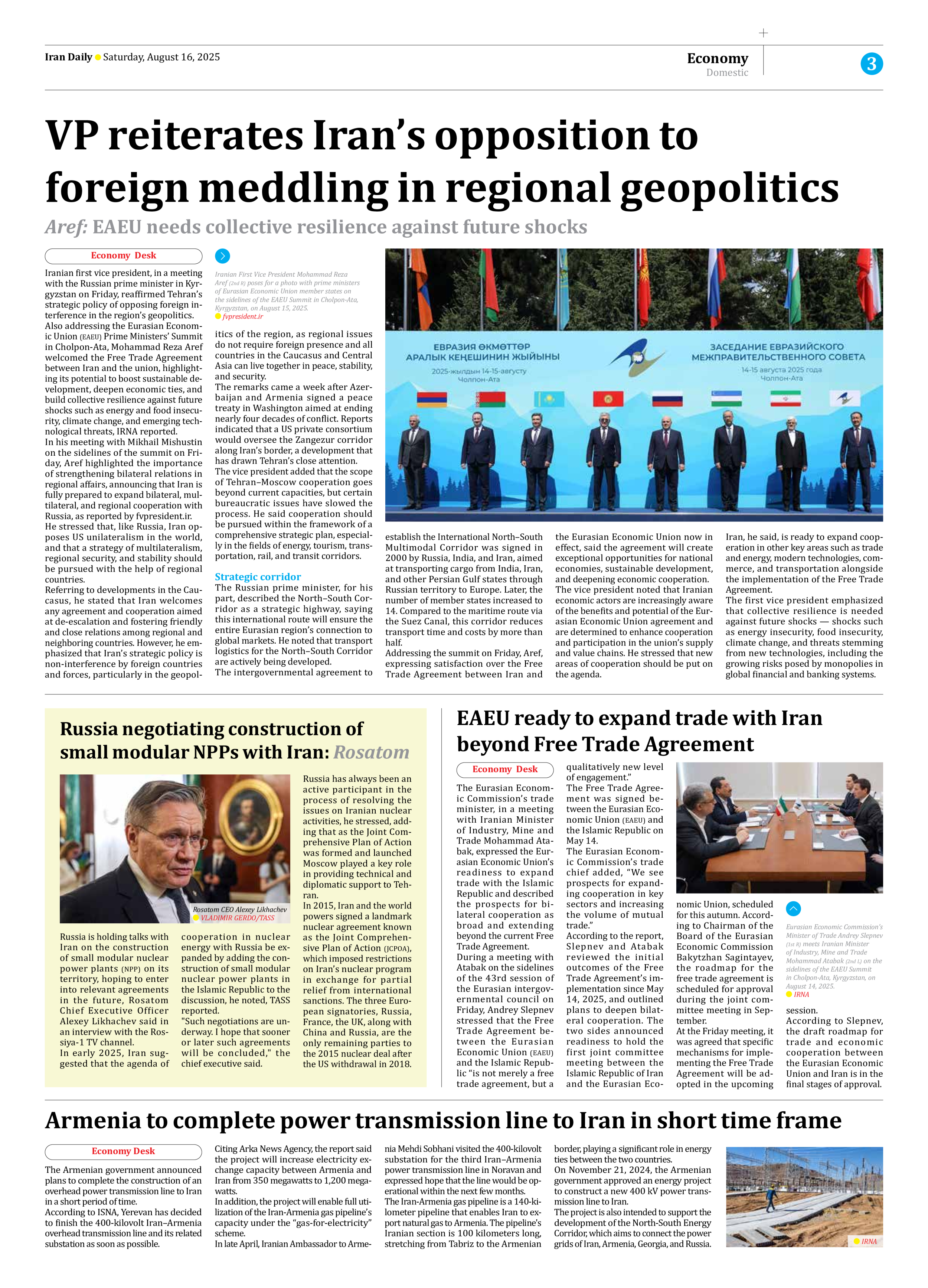
Iranian first vice president, in a meeting with the Russian prime minister in Kyrgyzstan on Friday, reaffirmed Tehran’s strategic policy of opposing foreign interference in the region’s geopolitics.
Also addressing the Eurasian Economic Union (EAEU) Prime Ministers’ Summit in Cholpon-Ata, Mohammad Reza Aref welcomed the Free Trade Agreement between Iran and the union, highlighting its potential to boost sustainable development, deepen economic ties, and build collective resilience against future shocks such as energy and food insecurity, climate change, and emerging technological threats, IRNA reported.
In his meeting with Mikhail Mishustin on the sidelines of the summit on Friday, Aref highlighted the importance of strengthening bilateral relations in regional affairs, announcing that Iran is fully prepared to expand bilateral, multilateral, and regional cooperation with Russia, as reported by fvpresident.ir.
He stressed that, like Russia, Iran opposes US unilateralism in the world, and that a strategy of multilateralism, regional security, and stability should be pursued with the help of regional countries.
Referring to developments in the Caucasus, he stated that Iran welcomes any agreement and cooperation aimed at de-escalation and fostering friendly and close relations among regional and neighboring countries. However, he emphasized that Iran’s strategic policy is non-interference by foreign countries and forces, particularly in the geopolitics of the region, as regional issues do not require foreign presence and all countries in the Caucasus and Central Asia can live together in peace, stability, and security.
The remarks came a week after Azerbaijan and Armenia signed a peace treaty in Washington aimed at ending nearly four decades of conflict. Reports indicated that a US private consortium would oversee the Zangezur corridor along Iran’s border, a development that has drawn Tehran’s close attention.
The vice president added that the scope of Tehran–Moscow cooperation goes beyond current capacities, but certain bureaucratic issues have slowed the process. He said cooperation should be pursued within the framework of a comprehensive strategic plan, especially in the fields of energy, tourism, transportation, rail, and transit corridors.
Strategic corridor
The Russian prime minister, for his part, described the North–South Corridor as a strategic highway, saying this international route will ensure the entire Eurasian region’s connection to global markets. He noted that transport logistics for the North–South Corridor are actively being developed.
The intergovernmental agreement to establish the International North–South Multimodal Corridor was signed in 2000 by Russia, India, and Iran, aimed at transporting cargo from India, Iran, and other Persian Gulf states through Russian territory to Europe. Later, the number of member states increased to 14. Compared to the maritime route via the Suez Canal, this corridor reduces transport time and costs by more than half.
Addressing the summit on Friday, Aref, expressing satisfaction over the Free Trade Agreement between Iran and the Eurasian Economic Union now in effect, said the agreement will create exceptional opportunities for national economies, sustainable development, and deepening economic cooperation.
The vice president noted that Iranian economic actors are increasingly aware of the benefits and potential of the Eurasian Economic Union agreement and are determined to enhance cooperation and participation in the union’s supply and value chains. He stressed that new areas of cooperation should be put on the agenda.
Iran, he said, is ready to expand cooperation in other key areas such as trade and energy, modern technologies, commerce, and transportation alongside the implementation of the Free Trade Agreement.
The first vice president emphasized that collective resilience is needed against future shocks — shocks such as energy insecurity, food insecurity, climate change, and threats stemming from new technologies, including the growing risks posed by monopolies in global financial and banking systems.