







Araghchi: Iran working with China, Russia against snapback invocation
Beijing says ‘opposes’ European sanctions on Tehran
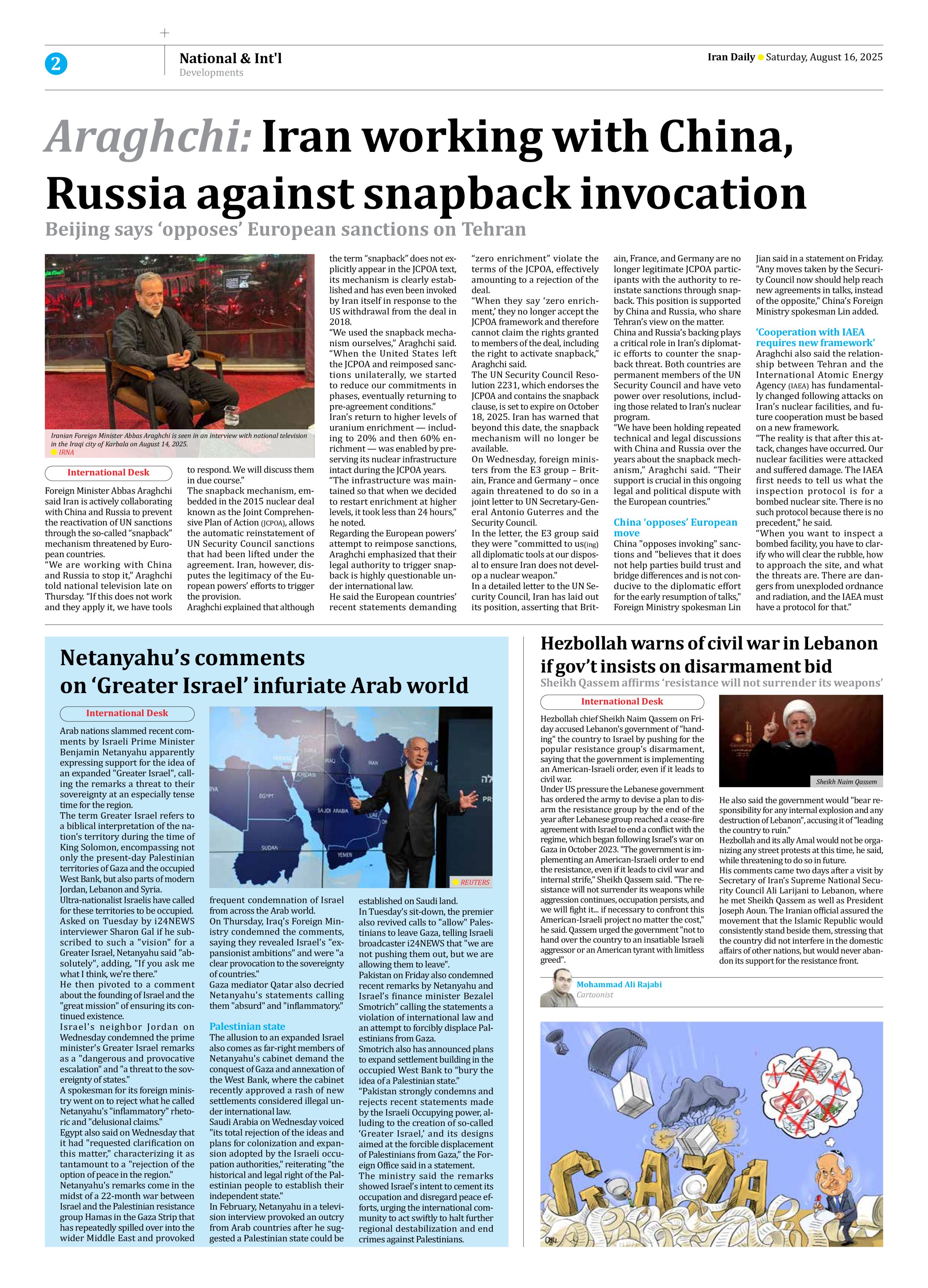
Foreign Minister Abbas Araghchi said Iran is actively collaborating with China and Russia to prevent the reactivation of UN sanctions through the so-called “snapback” mechanism threatened by European countries.
“We are working with China and Russia to stop it,” Araghchi told national television late on Thursday. “If this does not work and they apply it, we have tools to respond. We will discuss them in due course.”
The snapback mechanism, embedded in the 2015 nuclear deal known as the Joint Comprehensive Plan of Action (JCPOA), allows the automatic reinstatement of UN Security Council sanctions that had been lifted under the agreement. Iran, however, disputes the legitimacy of the European powers’ efforts to trigger the provision.
Araghchi explained that although the term “snapback” does not explicitly appear in the JCPOA text, its mechanism is clearly established and has even been invoked by Iran itself in response to the US withdrawal from the deal in 2018.
“We used the snapback mechanism ourselves,” Araghchi said. “When the United States left the JCPOA and reimposed sanctions unilaterally, we started to reduce our commitments in phases, eventually returning to pre-agreement conditions.”
Iran’s return to higher levels of uranium enrichment — including to 20% and then 60% enrichment — was enabled by preserving its nuclear infrastructure intact during the JCPOA years.
“The infrastructure was maintained so that when we decided to restart enrichment at higher levels, it took less than 24 hours,” he noted.
Regarding the European powers’ attempt to reimpose sanctions, Araghchi emphasized that their legal authority to trigger snapback is highly questionable under international law.
He said the European countries’ recent statements demanding “zero enrichment” violate the terms of the JCPOA, effectively amounting to a rejection of the deal.
“When they say ‘zero enrichment,’ they no longer accept the JCPOA framework and therefore cannot claim the rights granted to members of the deal, including the right to activate snapback,” Araghchi said.
The UN Security Council Resolution 2231, which endorses the JCPOA and contains the snapback clause, is set to expire on October 18, 2025. Iran has warned that beyond this date, the snapback mechanism will no longer be available.
On Wednesday, foreign ministers from the E3 group – Britain, France and Germany – once again threatened to do so in a joint letter to UN Secretary-General Antonio Guterres and the Security Council.
In the letter, the E3 group said they were "committed to us(ing) all diplomatic tools at our disposal to ensure Iran does not develop a nuclear weapon."
In a detailed letter to the UN Security Council, Iran has laid out its position, asserting that Britain, France, and Germany are no longer legitimate JCPOA participants with the authority to reinstate sanctions through snapback. This position is supported by China and Russia, who share Tehran’s view on the matter.
China and Russia’s backing plays a critical role in Iran’s diplomatic efforts to counter the snapback threat. Both countries are permanent members of the UN Security Council and have veto power over resolutions, including those related to Iran’s nuclear program.
“We have been holding repeated technical and legal discussions with China and Russia over the years about the snapback mechanism,” Araghchi said. “Their support is crucial in this ongoing legal and political dispute with the European countries.”
China ‘opposes’ European move
China "opposes invoking" sanctions and "believes that it does not help parties build trust and bridge differences and is not conducive to the diplomatic effort for the early resumption of talks," Foreign Ministry spokesman Lin Jian said in a statement on Friday.
"Any moves taken by the Security Council now should help reach new agreements in talks, instead of the opposite," China’s Foreign Ministry spokesman Lin added.
‘Cooperation with IAEA requires new framework’
Araghchi also said the relationship between Tehran and the International Atomic Energy Agency (IAEA) has fundamentally changed following attacks on Iran’s nuclear facilities, and future cooperation must be based on a new framework.
“The reality is that after this attack, changes have occurred. Our nuclear facilities were attacked and suffered damage. The IAEA first needs to tell us what the inspection protocol is for a bombed nuclear site. There is no such protocol because there is no precedent," he said.
“When you want to inspect a bombed facility, you have to clarify who will clear the rubble, how to approach the site, and what the threats are. There are dangers from unexploded ordnance and radiation, and the IAEA must have a protocol for that.”