







US covets mineral resources, strategic position of southern Armenia
The recent agreement between Armenia and Azerbaijan to open up transit routes in the South Caucasus has once again shone a spotlight on Iran’s geopolitical sensitivities in the region. The issue of creating or restoring routes that could cut out or diminish Iran’s role in regional transit is, for Tehran, not just an economic matter but a national security concern. Iran’s short yet strategic border with Armenia, which serves as the country’s only land gateway to Europe and a lifeline against geopolitical pressures, has always been front and center of Iran’s foreign policy calculations. Tehran has repeatedly stressed that holding on to this border is part of a “red line” for Iran’s national security, warning that any geopolitical shifts affecting this corridor will meet a strong reaction. From Iran’s perspective, this border is vital not only for trade and international relations but also symbolically represents historical ties and a balancing factor against power dynamics in the South Caucasus. Iran’s policy toward developments in the South Caucasus rests on key principles: respecting countries’ territorial integrity, opposing any changes to international borders, and keeping at bay foreign powers’ influence in the region’s affairs. Following this policy, Tehran has taken a firm and cautionary stance against any plan that would set up a “corridor,” “passage,” or similar route that would sever or limit Iran’s land connection to Armenia. Iran is determined to hold its ground through active diplomacy and regional cooperation, both to protect its economic interests in transit corridors and to prevent any arrangements that would tip the geopolitical balance against it. To delve into this issue, Ali Saghayian, former Iranian ambassador to Armenia and a Caucasus analyst, provided his expert views in the interview below:
We witnessed an agreement at the White House regarding the not-so-new issue of a transit corridor in southern Armenia. What is your overall assessment of this agreement?
SAGHAYIAN: Let me get straight to what the main issue is first, then touch on the recent meeting in Washington at the White House between the leaders of Baku and Yerevan. After the Soviet Union’s collapse, Azerbaijan and Armenia emerged as independent republics recognized by Iran. Some Soviet-era issues, such as Nagorno-Karabakh, initially didn’t stir up tensions between the Armenian and Muslim Azerbaijani inhabitants there. However, for specific reasons, conflicts erupted, pushing Armenia to step in to support the Armenians of Nagorno-Karabakh, deploying troops to protect them. This escalated into a series of conflicts between the two countries, punctuated by brief wars and ceasefire negotiations mediated by Iran, Russia, France, and the US, under the Minsk Group framework. This process continued into president Sargsyan’s tenure, when eight more regions came under Armenian and Nagorno-Karabakh control.
After 2020, which you mentioned, with the rise of Armenian Prime Minister Pashinyan, whom I consider a Western-leaning government leader coming to power via a color revolution, the situation changed. Although earlier attempts at such a revolution had failed, he ultimately won popular support and high election votes. Pashinyan adopted a Western-oriented approach and aimed to break away from the Nagorno-Karabakh conflict. He mapped out plans to return territories previously absorbed into Nagorno-Karabakh and publicly announced them.
I must add that Iran’s stance was crucial at this stage. At the highest level, the Commander-In-Chief of the Armed Forces Seyyed Ali Khamenei declared that “Nagorno-Karabakh is the soil of the Republic of Azerbaijan,” a position that played a key role in the peaceful return of those areas without bloodshed. This happened during a short 24-hour clash, after which Armenian forces withdrew, and Ilham Aliyev thanked Iran and its leadership personally.
The November 9, 2020, agreement did not mention a “corridor” but referred to “links” between Lachin in Armenia and Nakhchivan on the other end. I should remind that since Azerbaijan’s independence, Iran has supported Nakhchivan from the outset. Even during the period when Heydar Aliyev, Ilham Aliyev’s father, was in exile in Nakhchivan and the region was under siege, Iran stepped up to supply food, fuel, and essential goods via Jolfa. Heydar Aliyev himself has repeatedly acknowledged this.
To me, the “corridor” issue is a subject that the US and other external forces are keen to push forward. They have their eyes on the area’s mineral resources, energy reserves, and strategic military significance. As Brzezinski said, whoever controls this region will hold the reins of the entire South Caucasus.
Do you mean the Syunik region?
Yes, because this area has untouched mineral resources, gas, oil, and abundant water, which doubles its importance. The waters from the Syunik mountains supply much of Baku’s water resources, so capturing this region could jeopardize Azerbaijan’s capital security.
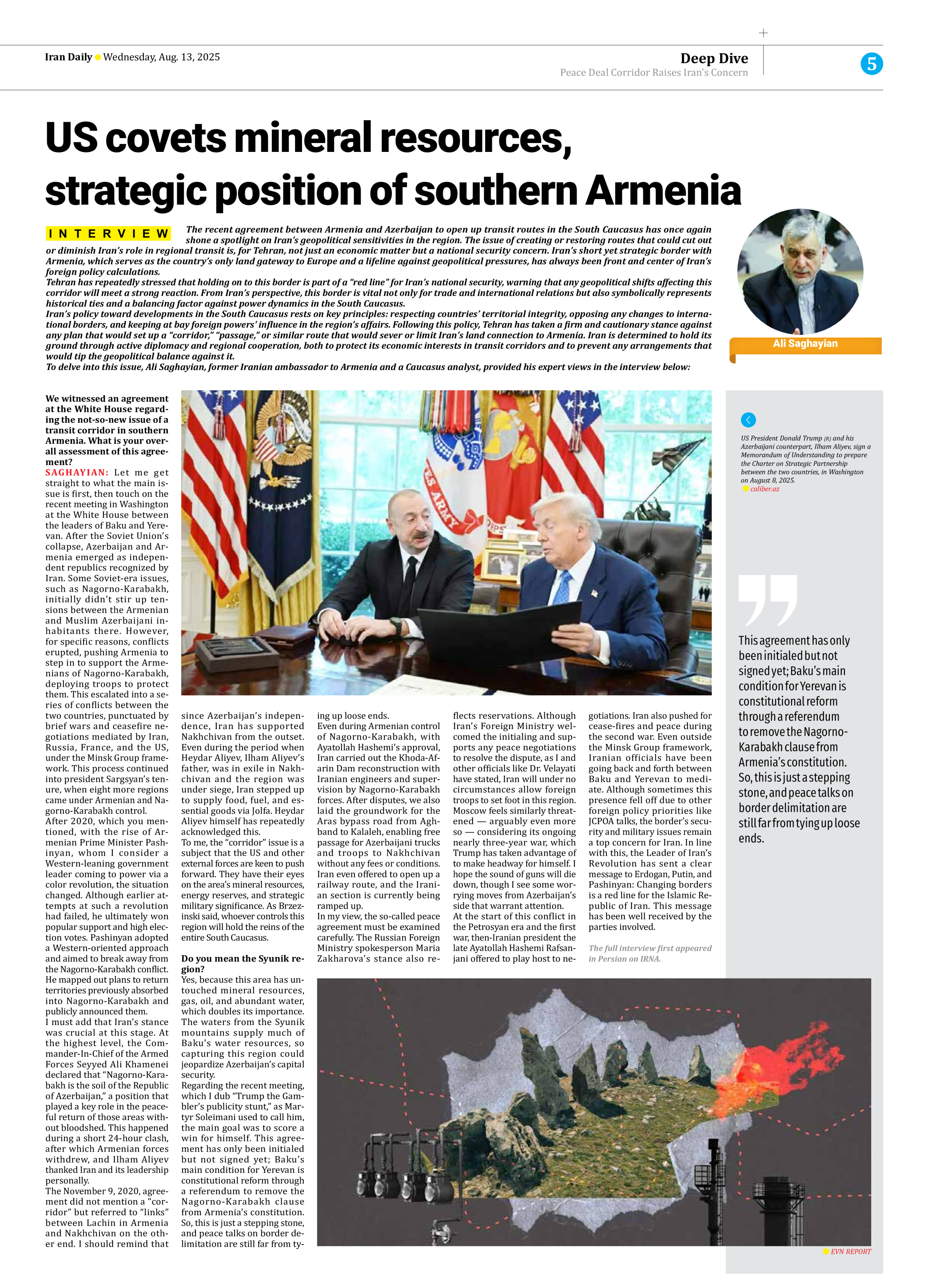
Regarding the recent meeting, which I dub “Trump the Gambler’s publicity stunt,” as Martyr Soleimani used to call him, the main goal was to score a win for himself. This agreement has only been initialed but not signed yet; Baku’s main condition for Yerevan is constitutional reform through a referendum to remove the Nagorno-Karabakh clause from Armenia’s constitution. So, this is just a stepping stone, and peace talks on border delimitation are still far from tying up loose ends.
Even during Armenian control of Nagorno-Karabakh, with Ayatollah Hashemi’s approval, Iran carried out the Khoda-Afarin Dam reconstruction with Iranian engineers and supervision by Nagorno-Karabakh forces. After disputes, we also laid the groundwork for the Aras bypass road from Aghband to Kalaleh, enabling free passage for Azerbaijani trucks and troops to Nakhchivan without any fees or conditions. Iran even offered to open up a railway route, and the Iranian section is currently being ramped up.
In my view, the so-called peace agreement must be examined carefully. The Russian Foreign Ministry spokesperson Maria Zakharova’s stance also reflects reservations. Although Iran’s Foreign Ministry welcomed the initialing and supports any peace negotiations to resolve the dispute, as I and other officials like Dr. Velayati have stated, Iran will under no circumstances allow foreign troops to set foot in this region. Moscow feels similarly threatened — arguably even more so — considering its ongoing nearly three-year war, which Trump has taken advantage of to make headway for himself. I hope the sound of guns will die down, though I see some worrying moves from Azerbaijan’s side that warrant attention.
At the start of this conflict in the Petrosyan era and the first war, then-Iranian president the late Ayatollah Hashemi Rafsanjani offered to play host to negotiations. Iran also pushed for cease-fires and peace during the second war. Even outside the Minsk Group framework, Iranian officials have been going back and forth between Baku and Yerevan to mediate. Although sometimes this presence fell off due to other foreign policy priorities like JCPOA talks, the border’s security and military issues remain a top concern for Iran. In line with this, the Leader of Iran’s Revolution has sent a clear message to Erdogan, Putin, and Pashinyan: Changing borders is a red line for the Islamic Republic of Iran. This message has been well received by the parties involved.
The full interview first appeared in Persian on IRNA.